

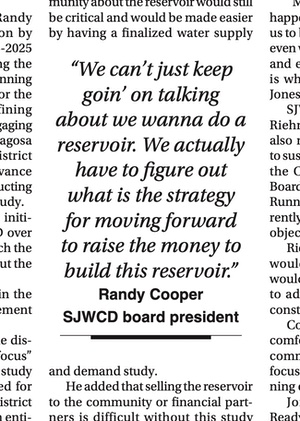
The pull-quote shared in the July 9 issue of the Pagosa Springs SUN came from a June 15 conversation among the members of the San Juan Water Conservancy District (SJWCD) board of directors.
SJWCD Board President Randy Cooper, speaking to his board on June 15:
“We can’t just keep goin’ on talking about we wanna do a reservoir. We actually have to figure out what is the strategy for moving forward to raise the money to build this reservoir.”
As noted yesterday in Part One, Archuleta County voters have rejected two ballot issues aimed at helping to fund the Dry Gulch Reservoir. In particular, the voter reaction to a proposed 2018 mill levy increase was overwhelmingly negative.
SUN jounalist Josh Pike reported on the SJWCD meeting and reported:
Cooper commented that the District needs to have a “singular focus” on finalizing a water demand study and, if that study shows a need for more water in the future, the district needs to focus on working with entities that will help the SJWCD raise money to construct the reservoir at Running Iron Ranch.
Based on past ballot issue failures, it would appear that — if any money can be raised to “build this reservoir” — it will come from outside of Archuleta County.
Which suggests a couple of interesting questions.
If the San Juan Water Conservancy District was created to serve Archuleta County residents… and if all the property taxes that fund SJWCD’s annual budget come from Archuleta County property owners… would SJWCD use Archuleta County property taxes to help build a reservoir that mainly serves people outside of Archuleta County?
Presumably, the answer is: Of course not.
But if the only money available to help build the reservoir will come from outside the county… would an “entity” located outside the county want to fund a project that must serve the property owners in Archuleta County…?
…The same property owners who have never indicated a willingness to help fund the reservoir?
Between 2003 and 2012, SJWCD was cooperating with the Pagosa Area Water and Sanitation District (PAWSD) to plan a reservoir that would specifically serve the needs of Archuleta County taxpayers. Then, PAWSD, with its multi-million-dollar annual budget and financial means to create multi-million-dollar debts, pulled out of the partnership and left the project in SJWCD’s under-financed hands. By 2012, new members with new ideas had been elected to the PAWSD Board of Directors, and the new Board determined that the Dry Gulch project was not needed, and was too expensive for a small rural population.
Disclosure: I currently serve as a volunteer on the Pagosa Area Water and Sanitation District (PAWSD) Board of Directors, but this editorial series reflects only my own opinions, and not necessarily the opinions of the PAWSD Board as a whole or the PAWSD staff.
Here’s that quote again from Josh Pike’s July 9 article:
Cooper commented that the District needs to have a “singular focus” on finalizing a water demand study and, if that study shows a need for more water in the future, the district needs to focus on working with entities that will help the SJWCD raise money to construct the reservoir at Running Iron Ranch.
Of course, SJWCD already has a few “water demand studies” in its files. Do those studies show a “need for more water in the future”?
That all depends on what you mean by “need”.
For example, Durango water engineer Steve Harris performed a “water demand study” in 2003, and updated it in 2007, to justify the purchase — by PAWSD and SJWCD — of the 660-acre Running Iron Ranch, as the site for a future Dry Gulch Reservoir. He carefully calculated the amount of water used per person within the PAWSD service area, and then estimated the population many years into the future. Using simple multiplication, he determined that the community would require — that is to say, “need” — over 5,000 acre-feet of drinking water by the year 2020.
His careful, but simple, calculations generated the red “water demand” line in the chart below.
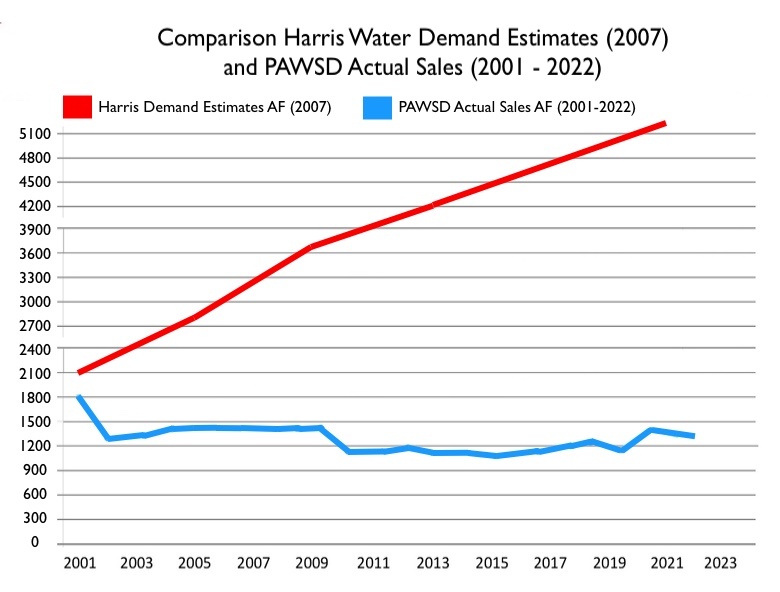
The blue line in the graph above show the actual PAWSD water demand.
Reader may notice a slight difference between the “water demand study” by Mr. Harris, and the actual, historical PAWSD water demand.
Based on Mr. Harris’ (ridiculous) calculations — coming from one of the most respected and knowledgeable water engineers in Colorado — PAWSD put its customers over $9 million in debt to purchase the Ranch, and proceeded to develop preliminary plans for a $357 million Dry Gulch reservoir.
In 2022, SJWCD paid good money for another “water demand study” from another respected water engineer, Erin Wilson. Ms. Wilson and her team determined that, if Pagosa’s population grew at the rate they expected, PAWSD would need to be delivering an amount of water — up to 6,323 acre-feet per year — by 2050 that compares favorably with Mr. Harris’ outrageous predictions.
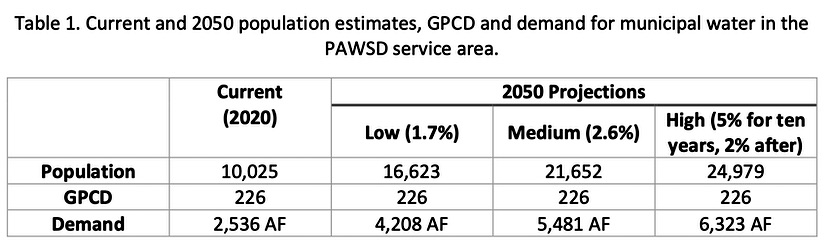
The respected engineers at Wilson Water Group made a few careless errors, however. When they defined “water demand” in 2020, they included the Pagosa Golf Course, which does not use PAWSD drinking water. They also included the 30%-40% of PAWSD drinking water that is lost through leaking pipes.
As we see from the Harris chart above, actual PAWSD water demand in 2020 was less than 1,500 acre-feet. Not 2,536.
Wilson Water Group then made the same error as Mr. Harris. They simply multiplied by their ridiculous population growth estimate — “5% for ten years, 2% after” — by the wrong “GPCD” — 226 Gallons Per Capita per Day.
Obviously, governments can pay a lot of money for misleading “water demand studies”.
And then, when an actual drought arrives, the whole picture changes, and we can throw all the calculations out the window.
Because “water demand” is not a fixed quantity. It changes dramatically, depending on the weather.
Bill Hudson began sharing his opinions in the Pagosa Daily Post in 2004 and can't seem to break the habit. He claims that, in Pagosa Springs, opinions are like pickup trucks: everybody has one.