
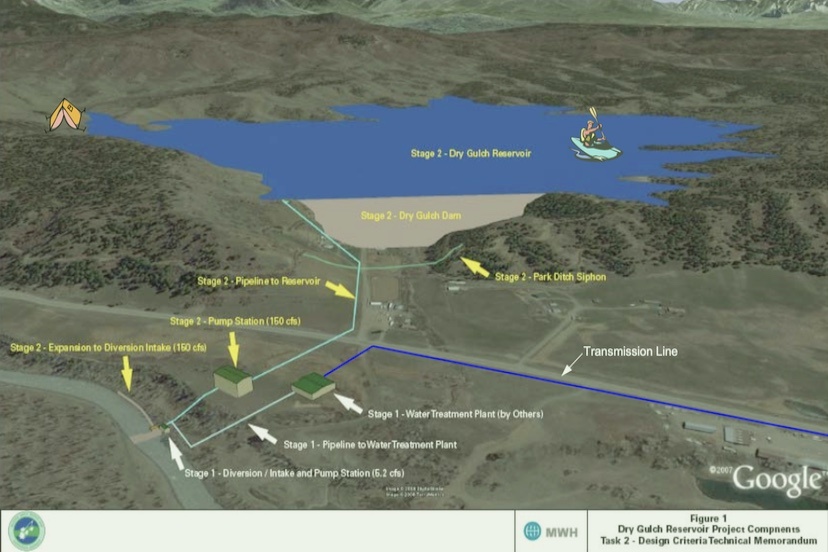
Image: Drawing from 2009 of a proposed $357 million Dry Gulch Reservoir project, when the project was projected at 32,000-acre-feet.
Public financing for public projects and much-needed maintenance of public infrastructure has been in the Pagosa Springs news lately.
A new PreK-8 school complex on Vista Boulevard? More downtown parks? Repairs and upgrades to sewer systems, both uptown and downtown? A proposed County administration building? A downtown EMS facility? An increased Lodging Tax to help pay for road maintenance? Bankrupt condo complexes available for purchase, as workforce housing?
An 11,000-acre-foot Dry Gulch Reservoir?
A friend texted me a clipping from the July 9 Pagosa Springs SUN, quoting the president of the San Juan Water Conservancy District board, Randy Cooper.
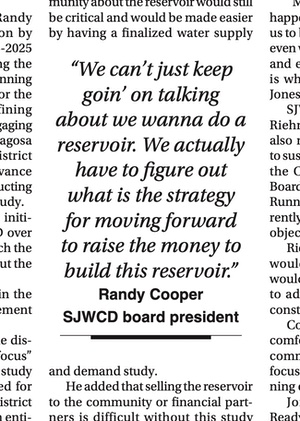
More about that quote in a moment.
Engineer and urban activist Chuck Marohn, founder of StrongTowns.org, has written occasionally about the “Ponzi Scheme” of public spending, where the ability to pay off public debt, and pension obligations, and other commitments, depends on constant population growth.
According to Mr. Marohn’s analysis, this problem is especially acute in suburban areas — like, perhaps, Pagosa Lakes and other rural subdivisions — where the relatively low population density does not generate enough tax revenue to properly maintain the sprawling roads and other infrastructure.
But when the population keeps growing, local governments can fool themselves into thinking they will come out ahead, eventually.
According to the Colorado Demographer’s Office, the population of Archuleta County in 2024 was about 14,182. The estimate for 2026: $14,042.
A decline of 140 residents over two years.
The estimate for 2027: 14,071. So maybe an increase? Of 29 residents?
The Demographer then predicts a slow and steady population increase through 2060.
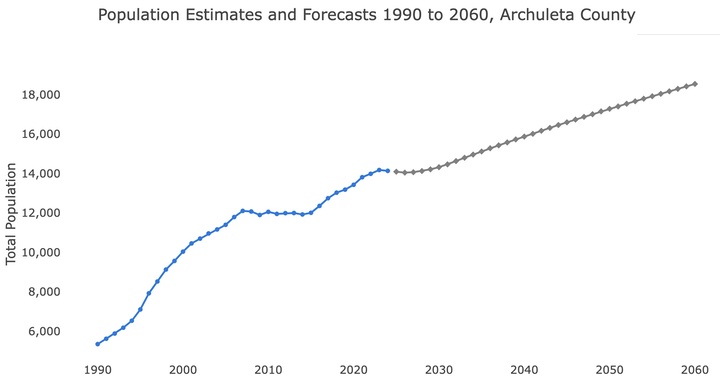
As we can see, this isn’t the first time the Colorado Demographer estimated a population drop in Archuleta County. In 2007, our population was estimated at 12,109, and by 2009, had fallen to 11,901. It was still below the 2007 estimate in 2015.
Then in 2017, growth kicked back in, and continued until 2024.
We might mention that the population growth between 1990 and 2007 had very little to do with anything our local governments did differently. It was driven by national population trends — mostly, in my opinion, people escaping from big cities.
I’ve been writing about the Demographer’s Office projections for 20 years, and their projections for Archuleta County’s future population have occasionally been way off. So I wouldn’t place too much importance on the future projections shown above.
Not all Colorado counties have seen population growth over the past 35 years.
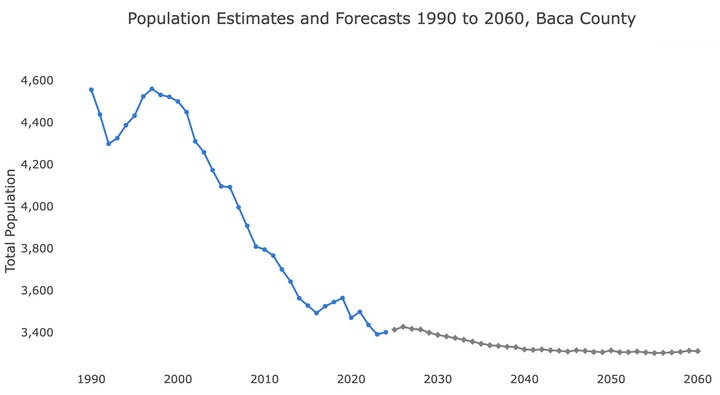
We can imagine how the local governments in Baca County might be struggling to maintain their infrastructure, and especially their debt burdens, if they’d been counting on a steady tax revenue.
From the June 10 Pagosa Springs SUN, a story entitled “Monthly sales tax collections down for a third time this year” by Clayton Chaney:
According to data released by Archuleta County Finance Director Chad Eaton on June 4, sales tax collections in Archuleta County for April were reported to be down 9.07 percent compared to figures from April 2025…
…According to data in Eaton’s press release, the year-to-date comparison for January through April of this year shows a 4.55 percent decrease, or $258,391.45 less received compared to figures from January through April 2025…
People are being more thoughtful with their big financial decisions lately, I hear, and maybe even with their small financial decisions. The economy, nationally and locally, seems to be in a state of flux. A 4.55% decrease in four months, here in Archuleta County? Might we predict a continuing decrease through the rest of 2026?
Just accounting for steady price inflation for consumer goods, the sales taxes should have been increasing…
But let’s get back to that pull-quote in the SUN:
SUN editor Randi Pierce picked a quote that contains some implications.
We could start by noting that Candace Jones has been SJWCD President for the past several years, but resigned from that position this year. (She continues to serve on the SJWCD Board. She also serves as First Vice Chair for the Archuleta County Democratic Party.)
We can also note Randy Cooper’s background as the new SJWCD President. From LinkedIn:
About
Technical Advisor to the investment community, Geosciences Manager, Senior Petrophysical Manager, geologist and petroleum engineer with experience in resource plays (Marcellus, Permian, Eagle Ford, Bakken, and SCOOP/STACK). International experience in the North Sea, Africa, Russia, Southeast Asia and the Gulf of Mexico. Diversified technical expertise in petrophysics, reservoir engineering, geology, and operations…
…Society of Petrophysicists and Well Log Analysts: President 2011-2012, President-elect 2010-2011, Vice President Education 2007-2008, Regional Director Asia/Australia 2004-2007…
For some reason, Mr. Cooper’s LinkedIn account does not mention his current involvement with the proposed Dry Gulch Reservoir, although it does mention that he’s taken a new position as an Technology Commercialization Manager for local clothing manufacturer Voomi.
For Daily Post readers who have been following the turmoil around the proposed Dry Gulch Reservoir — first proposed as a viable public project in 2003 — the first sentence in this pull-quote will feel self-explanatory.
“We can’t just keep goin’ on talking about we wanna do a reservoir…”
But let’s clarify a few things. Who is talking about wanting to “do a reservoir”? Well, it’s the eight or nine members of the San Juan Water Conservancy District Board.
How long has SJWCD been “talking about doing a reservoir”? Since 1989.
How long has this tax-funded organization been “talking about” the Dry Gulch Reservoir project in particular? Since 2003.
What does the general public think about the Dry Gulch Reservoir project? Well… SJWCD asked the taxpayers to help fund the project in 2004, and the voters said, “No, thank you”.
SJWCD asked the voters again for financial help in 2018, and the voters said, “No, thank you” by a 3-to-1 margin.
If I were a smart person, I would look at those ballot results and determine that the community doesn’t want to help fund this reservoir.
The folks serving on the SJWCD Board have indeed made that determination. So they have focused their recent efforts on building a $100- to $200-million reservoir without the help of the local taxpayers. It’s basically up to eight or nine smart people to find financing for, and oversee the construction of, an 11,000-acre-foot that the community doesn’t really want. Or at least, is not willing to help pay for…
There are so many other things to pay for…
Bill Hudson began sharing his opinions in the Pagosa Daily Post in 2004 and can't seem to break the habit. He claims that, in Pagosa Springs, opinions are like pickup trucks: everybody has one.