
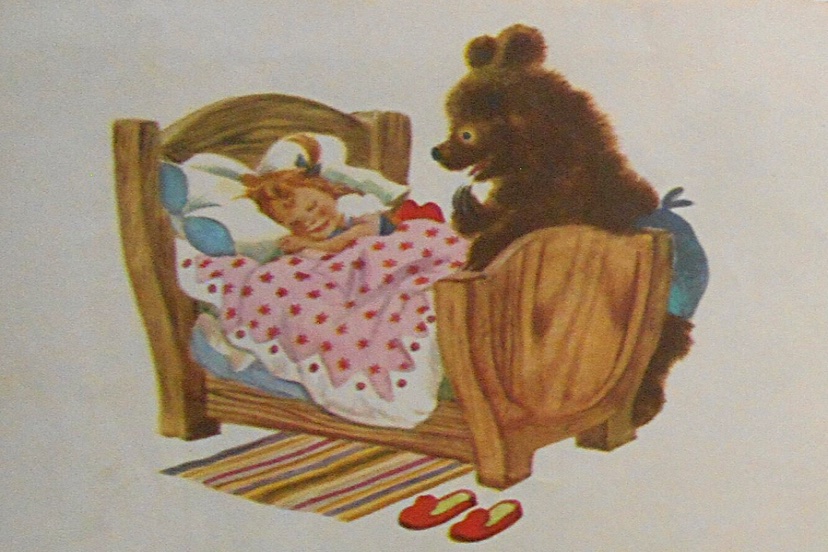
Illustration by Feodor Rojankovsky, from the Little Golden Book ‘The Three Bears’, 1948.
Pease porridge hot, pease porridge cold
Pease porridge in the pot, nine days old…
— Children’s singing and hand-clapping game from the 18th century.
A friend told me the other day that she had never felt it so hot here in Pagosa Springs, in the 30 years since she first started visiting.
She also said she hopes we don’t get too much snow, this coming winter.
Obviously, some people don’t like it too hot, or too cold. Sort of like Goldilocks when she tested the porridge that the Three Bears had left on the table.
First she tasted the porridge of the Great Big Bear, and that was too hot for her. Next she tasted the porridge of the Middle-sized Bear, but that was too cold for her. And then she went to the porridge of the Little Wee Bear, and tasted it, and that was neither too hot nor too cold, but just right, and she liked it so well that she ate it all up, every bit!
The Bears were not happy about this.
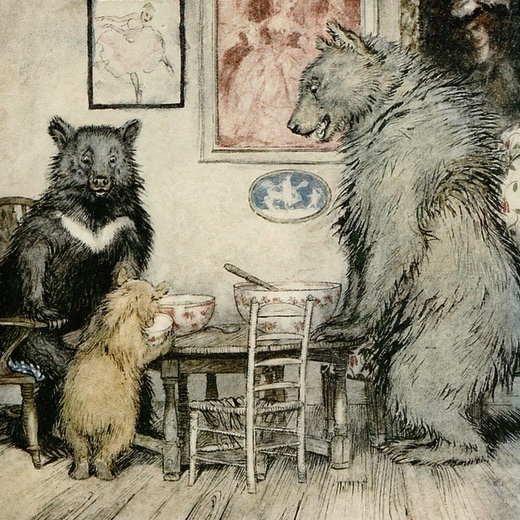
They hadn’t yet noticed that the Little Wee Bear’s chair had been ruined.
Nor had they found the perpetrator.
These discoveries were still in the future.
I’d like to point out that an independent investigator — Goldilocks — had found the Great Big Bear’s porridge to be “too hot”… but had found the Middle-sized Bear’s porridge to be “too cold.” The Little Wee Bear’s porridge, meanwhile, was neither too hot nor too cold, but was in fact, “just right”.
Obviously, this outcome is not scientifically possible, if all the bowls of porridge were dished up from the same pot, at the same time. The smallest bowl would have cooled off the fastest.
The quantitative relationship between heat transfer and temperature change contains three factors: Q = mcΔT, where Q is the symbol for heat transfer, m is the mass of the substance, and ΔT is the change in temperature. Owing to the fact that the transferred heat is equal to the change in the internal energy, the heat is proportional to the mass of the substance and the temperature change.
Since the mass of the Little Wee Bear’s porridge was significantly less than the mass of the Middle-sized Bear’s porridge, Goldilocks should have found the Little Wee Bear’s porridge to be “too cold” and the Middle-sized Bear’s porridge to be “just right’.
You don’t need to be a scientist to know this stuff. Everyone knows from experience that bigger things take longer to heat up and cool down.
The big thing that takes the longest to heat up or cool down is, of course, the Earth. It was pretty darn cold during the Ice Age, 10,000 years ago.
The atmosphere that surrounds the Earth can heat up and cool down a lot more quickly. Like, yesterday morning, it was 55 degrees outside, but by late afternoon, it was up to 95 degrees. Your porridge takes a long time to cool down when the atmosphere is 95 degrees, so probably best to fix it in the early morning.
Some people who study the climate are telling us that we can expect the atmosphere to keep getting hotter and hotter with each passing year.
Too bad we can’t just go out for a stroll in the woods, like the Three Bears did when they wanted to let their porridge cool off. Life was so much simpler then. Once you woke up the perpetrator sleeping the Little Wee Bear’s bed, she screamed, jumped out the window, and ran away of her own accord.
Of course, we know who the perpetrator is, for our atmosphere heating up. It’s us.
And there’s nowhere to run, even if we had a window to jump out of.
Underrated writer Louis Cannon grew up in the vast American West, although his ex-wife, given the slightest opportunity, will deny that he ever grew up at all. You can read more stories on his Substack account.