
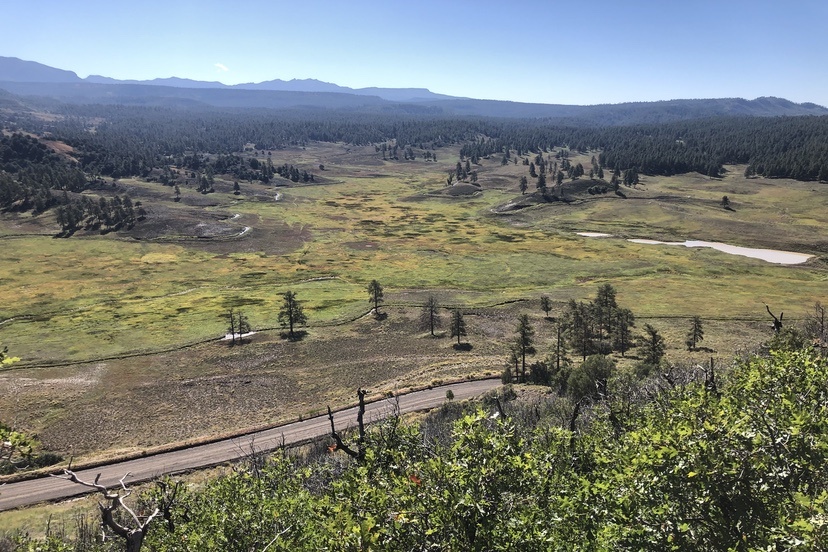
Photo: The Running Iron Ranch, September 2024.
I sometimes feel that I basically understand how the world works… but then, I come face to face with amazing (and sometimes amusing) mysteries, in both the natural world and in human society.
A sizable number of Pagosa Springs business and elected leaders were not amused, back in 2009, when Pagosa Area Water and Sanitation District (PAWSD) and the San Juan Water Conservancy District (SJWCD) revealed plans for a proposed 32,000-acre-foot reservoir on the Running Iron Ranch, estimated to cost the local community $357 million. That money would come mainly from a new ‘Water Resource Fee’ being collected by PAWSD from new homes and development.
The community leaders were not amused, but may have been amazed.
But also, angry. This WRF fee threatened to further stifle new development in Pagosa Springs, during a time when the construction industry had already come to a virtual standstill as a result of the Great Recession.
The amazement and anger led to a turnover on the PAWSD Board of Directors, and eventually, to a cancellation of the WRF and a refund to homebuilders and developers who had paid the fee.
15 years later, a few intelligent and thoughtful people would still like to see a large water reservoir built on the Running Iron Ranch. I find this situation somewhat amazing.
Disclosure: I currently serve as a volunteer on the Pagosa Area Water and Sanitation District (PAWSD) Board of Directors, but this editorial series reflects only my own opinions, and not necessarily the opinions of the PAWSD Board as a whole or the PAWSD staff.
The folks who appear most intent on this reservoir project serve as volunteers on the SJWCD Board of Directors, and one of the board’s current goals is to convince Archuleta County that such a reservoir is not only possible, but also necessary. The SJWCD met on June 15, to discuss strategy, and one of the conversations centered on “water demand studies”.
Which is the mystery we will consider this morning. The mystery concerns the behavior of humans.
I mentioned yesterday, in Part Two, that SJWCD has in their files at least two water demand studies written by respected engineers. Both of those studies suggested that Pagosa Springs would likely be unable to meet “water demand” in the near future, unless a reservoir were built on the Running Iron Ranch.
As mentioned yesterday, the 2007 Harris study predicted that Pagosa Springs water users would be consuming more than 5,000 acre-feet of drinking water by 2020. In fact, in 2025, the PAWSD community consumed less drinking water than they did in 2001.
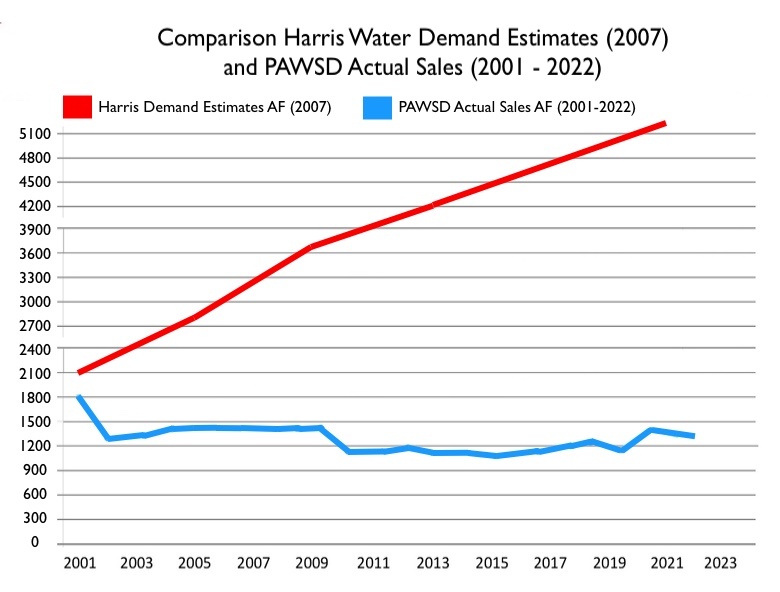
That’s actually an important point to understand. That in spite of a 32% increase in population since 2001, the Archuleta County community still uses less water each year than they did in 2001.
If you look at the graph above, you see that in 2001, PAWSD customers purchased a total of about 1,787 acre-feet of drinking water. (This does not include the raw water used by the Pagosa Springs Golf Course.)
But a year later, in 2002, PAWSD sold about 1,200 acre-feet. A 33% drop in water purchases, in one year. This decline resulted partly from PAWSD Drought Management requirements put in place in 2002 as a result of an ongoing drought.
This decline in water demand was not a secret. In fact, it resulted from a well-publicized effort to reduce water demand. Remarkably enough, PAWSD customers never went back to using the amount of water they’d happily used in 2001.
But there’s another mystery to consider, related to human behavior.
The red line in the graph above was generated by predictions made by respected water engineer Steve Harris in his 2007 water demand study.
Presumably, when a respected engineer is paid to write a water demand study for a community, he would look at actual water demand.
But when we look at the graph above, we note that actual PAWSD water demand in 2005 was 1,249 acre feet. This was not secret information. PAWSD actually tracks how much water they sell. It’s a public record.
But in Mr. Harris’ 2007 water demand study, he listed the water demand in 2005 as “2,518 acre-feet”. He then predicted that by 2020, Pagosa water demand would be “5,130 acre-feet.” PAWSD actually sold less than 1,400 acre-feet in 2020.
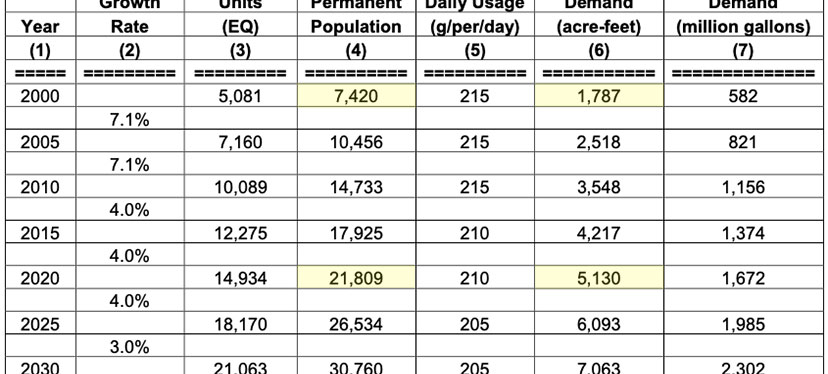
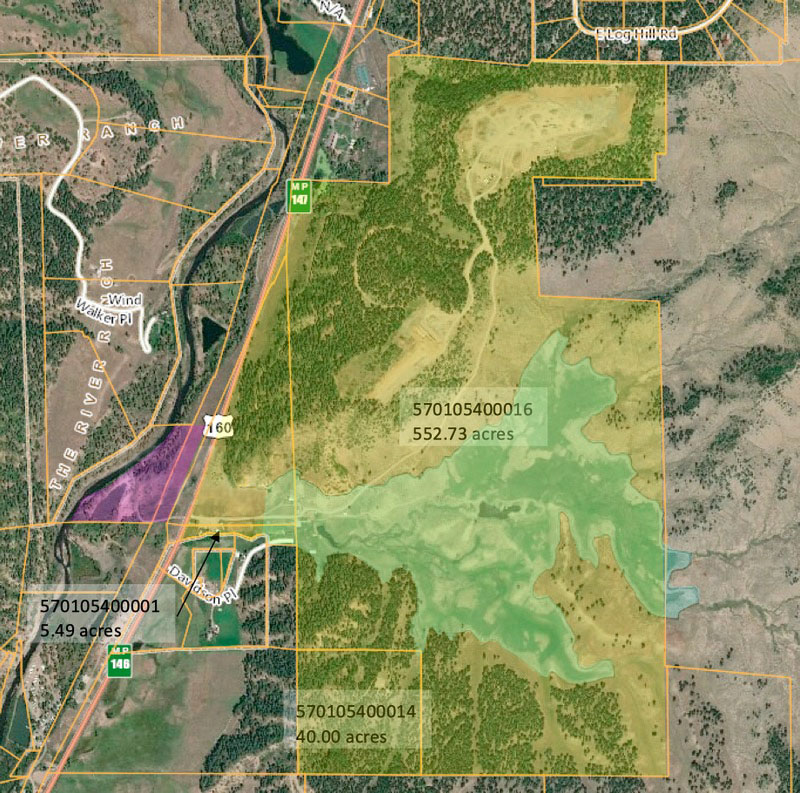
PAWSD and SJWCD accepted the Harris water demand study as presented, and used the water demand study to justify the purchase of the 660-acre Running Iron Ranch.
The volunteers serving on the PAWSD Board at the time were intelligent, caring people. But they never bothered to check Mr. Harris’ math, and instead moved ahead with plans for a $357 million reservoir.
Why did the PAWSD Board not raise questions about Mr. Harris’ questionable and ultimately flawed math? That’s another mystery of human behavior.
We — the Archuleta County community — are now under Drought Stage 2 water restrictions, just as we were in the summer of 2002, when the community willingly reduced its water demand by 33%. The intentions behind the Stage 2 water restrictions is to reduce water demand, once again. It worked very well in 2002. We don’t yet know how well it will work this time around.
With that in mind, we note that what appeared to a respected water engineer and a PAWSD Board of Directors as scientifically calculated actual water demand was nothing more than science fiction. But rather expensive science fiction.
19 years after the release of the 2007 Harris water demand study, a few intelligent and thoughtful people would still like to see a large water reservoir built on the Running Iron Ranch.
I find the situation somewhat amazing. And mysterious.
Bill Hudson began sharing his opinions in the Pagosa Daily Post in 2004 and can't seem to break the habit. He claims that, in Pagosa Springs, opinions are like pickup trucks: everybody has one.