
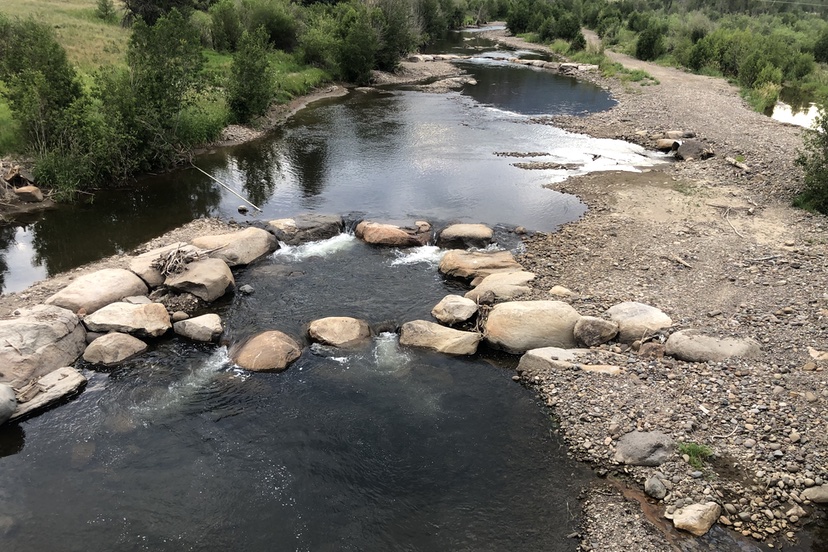
Photo: West Fork of the San Juan River, summer 2026.
I suspect most Pagosa Springs residents have little inclination to try and understand the current controversy around local water supplies. I certainly didn’t think about that issue during my first 15 years in Pagosa. I turned on the tap and clean water came out. Why worry?
I also suspect the current drought and watering restrictions have caused some local residents to take sit up and take notice, and maybe even begin to worry about our water supplies. I’ve been contacted by a few people displeased by neighbors irrigating their yards ‘excessively’ during the drought.
Disclosure: I currently serve as a volunteer on the Pagosa Area Water and Sanitation District (PAWSD) Board of Directors, but this editorial series reflects only my own opinions, and not necessarily the opinions of the PAWSD Board as a whole or the PAWSD staff.
Earlier this week, I snapped the photo, above, from the Highway 160 bridge over the West Fork of the San Juan River, the source for Pagosa Area Water and Sanitation District (PAWSD) raw water for the Snowball Water Treatment Plant that serves the eastern part of the PAWSD district.
PAWSD has relatively secure water rights allowing the district to consistently divert up to 5 CFS (cubic feet per second) from the West Fork, but prior to the construction of the new treatment plant on Snowball Road, the old outdated water plant was able to purify less than 2 CFS.
For comparison, the Park Ditch, which also draws water from the San Juan River to serve agricultural users in the eastern part of the county, has secure water rights to divert 12 times as much water.
60 CFS.
But normally, the Park Ditch Association diverts water only during the spring and summer irrigation season.
PAWSD diversions also vary by season, with water needs roughly doubling during the summer months… due to the arrival of tourists, tourism industry workers, and second-home owners… and increased residential irrigation. This summer, PAWSD has instituted water restrictions to encourage conservation during the current drought conditions.
PAWSD draws water for the uptown area mainly from Fourmile Creek, but also sometimes from the San Juan River. But the Fourmile Creek diversion gets shut off in the spring when agricultural users start irrigating, to grow grass for cows.
Here’s another number to consider. If PAWSD could divert a steady flow of 2 CFS year round, that could generate about 1,400 acre-feet of drinking water.
Last year, PAWSD sold about 1,400 acre-feet of drinking water.
But PAWSD needs to generate around 2,000 acre-feet, because some of the treated water is lost through leaks in an aging pipeline system. PAWSD fixes those leaks as they are discovered, but since the leaks are underground, finding them can be a challenge.
As mentioned before in this editorial series, PAWSD water demand dropped, during the 2002 drought, from 1,787 acre-feet down to 1,151 acre-feet, a 33% reduction in one year. This reduction was accomplished mainly through watering restrictions.
If PAWSD had been able to build the proposed Dry Gulch Reservoir as they planned to do back in 2009, the 32,000-acre-foot reservoir would have (theoretically) held enough water to serve the current population of Archuleta County community for 20 years. Without needing a single drop of rain or flake of snow.
But the reservoir was never built. Some of us, who may have an inclination to understand water demand and reservoir operations, believe it will likely never be built.
The existing PAWSD reservoirs have consistently supplied sufficient drinking water for Archuleta County customers since the 1970s — when the county population was around 3,000 — until 2026, with a population of about 14,500. PAWSD serves about 75% of the homes in the county, and nearly all the commercial properties.
And, although the county population has increased by about 32% over the past 25 years, PAWSD still sells less water than it did in 2001 prior to the 2002 drought.
Our governments, when they aren’t putting us deeper in debt to the financial industry, draw their operating revenue mainly from the so-called “middle class”.
The “lower class” pays a larger percentage of their income to governments, but it’s a smaller total amount because they have less to give.
The “upper class” (AKA the corporate ownership class) hires clever lawyers and accountants — and offers “campaign donations” to legislators — to ensure that they can avoid paying their fair share.
So the middle class foots most of the bill. Locally, statewide, and nationally.
I understand the middle class is shrinking, as a proportion of the American population? And the demographics are also changing, particularly in Archuleta County. Here are a couple of interesting graphs from the Colorado State Demographer’s website:
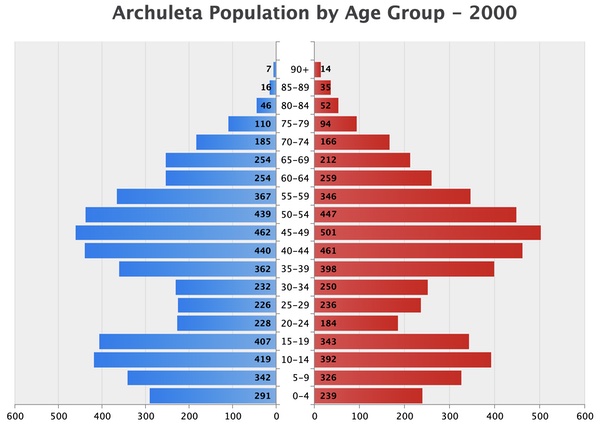
The estimated population in 2000. Males are shown in blue, females in red. The largest population groups were 10-19 years (1,560 individuals) and 40-54 years (2,750 individuals).
Archuleta County had already experienced a rather fabulous doubling of the population between 1990 and 2000, and apparently many of the newer residents had teenage children or kids entering college or careers.
Here’s the State Demographer’s predictions for 2050. 24 years from now.
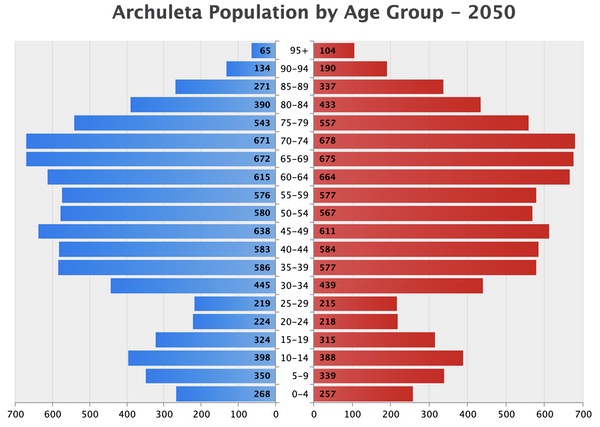
Even though the total estimated population is much greater than in 2000, the number of individuals age 10-19 is less that in 2000.
The largest demographic group is now 65-74. That is to say, retirees.
I would guess, middle-class retirees, mostly. But that remains to be seen.