

I can certainly understand why state legislators in Colorado recently passed a law requiring county governments to update their Comprehensive Plans by December 31, 2026, to include “a Water Supply Element that inventories water providers, water rights, and facilities…” and also “a Strategic Growth Element that encourages infill, discourages sprawl, and helps guide where and how the County grows…”
Colorado and the American Southwest are in the midst of a serious water crisis that’s likely to change the way we all use water. Locally, Pagosa Area Water and Sanitation District (PAWSD) customers are subject to ‘Drought Stage 2’ water use limitations, with the possibility of going into ‘Drought Stage 3’ in the near future.
State legislators also want our communities to cease allowing ‘suburban sprawl’ type development that spreads residential development out into the Wildland-Urban Interface (WUI) and requires roads and other infrastructure to extend out — unaffordably — into the hinterland.
The Lower Blanco Road neighborhood is a prime example of residential subdivision development in the WUI, adjacent to a highly flammable national forest. The U.S. Forest Service is right now expending many millions of dollars, trying to protect that neighborhood from the potentially destructive Rio Blanco Fire.
State legislators are likewise concerned about the higher cost of home construction and residential infrastructure when it takes place outside the community’s central core.
Can we do a better job of planning our communities?
Yesterday, I used the following quote from the Archuleta County website as the ‘subheading’ for Part One of this editorial series:
Planning ahead helps ensure that as the County grows, residents keep access to a range of housing options, reliable infrastructure, a strong local economy…
This is, of course, magical thinking. “Planning ahead”, per se, doesn’t “help ensure” anything at all.
The Archuleta County government and the Pagosa Springs municipal government have been “planning ahead” for the past 30 years, and now we’ve reached a point where many working families can barely afford to live here, employers struggle to find qualified employees, many of our roads are in worse shape than they were 30 years ago, local property taxes and sales taxes have increased, our governments are digging themselves deeper in debt, the Town’s sewer system is constantly under repair, excessive tourist use is impacting our trail systems and wilderness areas, the largest music festival in southwest Colorado has gone the way of the buffalo, and our school district claims to need a $122 million bond issue for a new PreK-8 facility because they’ve not kept up with maintaining our existing school buildings…
I could go on.
On the other hand, we now have a Walmart store. So there’s that. And we have new pickleball courts downtown.
All is not lost.
My point being, you can “plan ahead successfully” and you can “plan ahead poorly”. It seems to me that, in most cases, “planning ahead” produces a net positive result only if you’re lucky. Half the time, you plan ahead and it leads to a poor outcome, simply because you didn’t see what was coming.
You imagine that life will proceed in basically the same direction that it’s been proceeding… and then it doesn’t.
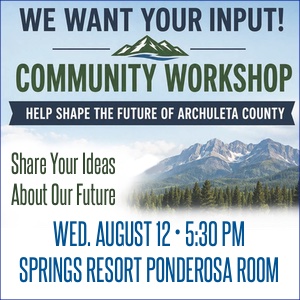
In Part One, I shared links to some “planning” documents that may (or may not) relate to the Archuleta County Comprehensive Plan update, now being written by consultants. The County is asking citizens to weigh in with their ideas about planning for the future, and will be holding a community meeting on August 12 as part of the community input process.
2017 Archuleta County Community Plan
2025 Regional Housing Needs Assessment
Pagosa Area Water and Sanitation District (PAWSD) Drought Management Plan
2025–2028 Archuleta County Strategic Plan
One of these documents — the 2025–2028 Archuleta County Strategic Plan — was the result of a couple of years of work by Archuleta County staff, local citizen volunteers, and paid consultants from Oregon-based Civic*Possible.
The development of that plan included a survey of local taxpayers, and the 47-page document includes a summary of the survey results, which theoretically helped inform the plan. I personally participated in that 2024 survey, and I suspect some of our Daily Post readers may have, as well.
The Archuleta County Planning Department has seen substantial turnover since 2024, initiated by the Board of County Commissioners.
Recently, the Planning Department posted yet another online survey of local taxpayers, in connection with the required Comprehensive Plan update. You can take the survey here.
If you compare the 2024 Strategic Plan survey with the new Comprehensive Plan survey, you might notice (as I did) that the new survey asks many of the very same questions that were asked in 2024.
We have to wonder why the County believes we need to engage in yet another survey of the same population, asking basically the same questions again, 18 months later?
I would hate to think that the County leadership forgot that they did a taxpayer survey a few months earlier.
Those of us who serve on government boards (as I do currently) understand very well that the taxpayers are generally busy with their lives and personal interests, and prefer to complain quietly to their friends rather than get actively involved in local decision-making. A survey such as the one conducted by Archuleta School District last month, for example, is lucky of they can get responses from 2% of the taxpayers.
The only truly valid surveys — in my humble opinion — take place at the ballot box. In 2024, for instance, over 80% of eligible Archuleta County voters submitted their ballots.
If Archuleta County truly wants to know what We the People think, just put the issue on the ballot.
Sometimes, however, elected leaders do not truly want to know what We the People think. It’s too complicated.