
The sky was hazy with wildfire smoke as I drove through downtown Pagosa on Tuesday, August 4, on my way to a community meeting about the Rio Blanco Fire, now eight days old and still growing.
The first time I’d noticed this much smoky haze since the fire started on July 28.
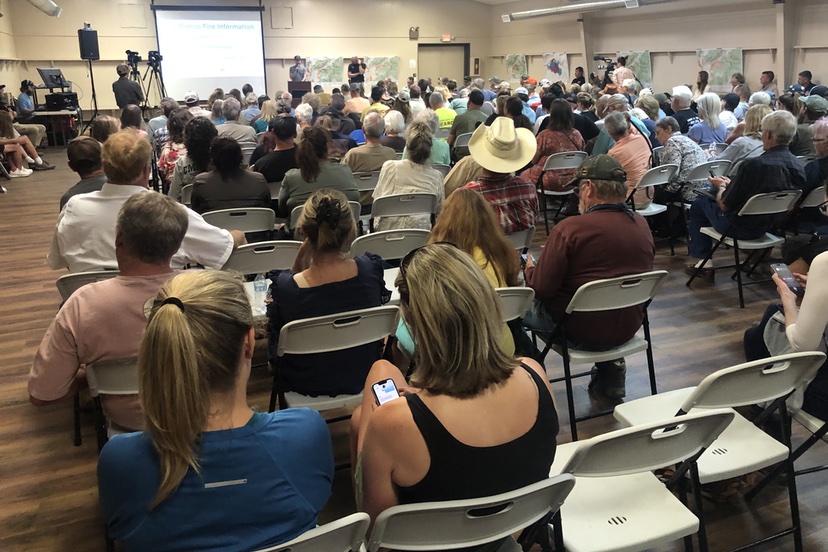
Walking into the Extension Building located at the Archuleta County Fairgrounds on Highway 84, I had the impression that I was walking into a ‘standing room only’ event. But making my way to the front of the audience, I saw there were numerous empty seats available.
Maybe people just felt like standing in the back of the room? At a distance?
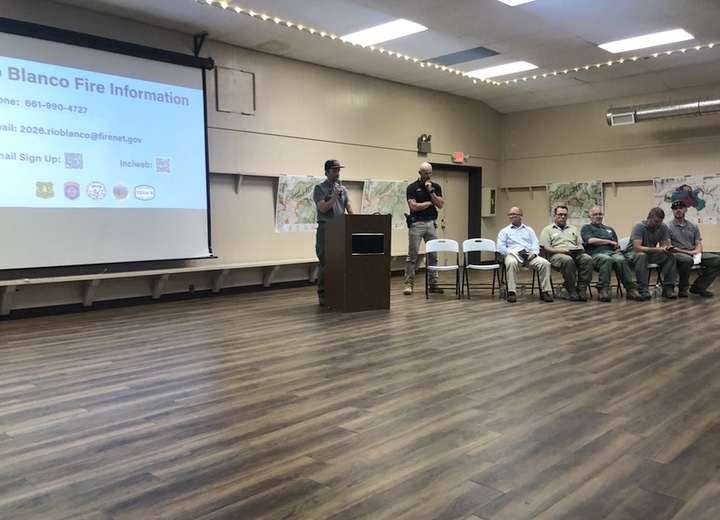
Pinned to the walls were numerous large maps, and a large projector screen behind the podium was displaying a welcome message. Off to one side was the video crew that would be streaming the presentation on social media.
Several men were seated near the podium, ready to present information.
As of Tuesday evening, the fire had grown to about 1,300 acres and appeared to be moving north and west, threatening the Lower Blanco Road (CR 335) neighborhood, which was under an evacuation order.
Not all the news was bad news, however. Or so we were told.
I didn’t catch the name of the master of ceremonies, who was wearing one of the gray polo shirts that seem popular with folks leading wildfire crews. He was careful to point out the emergency exits in the auditorium, in case of fire.
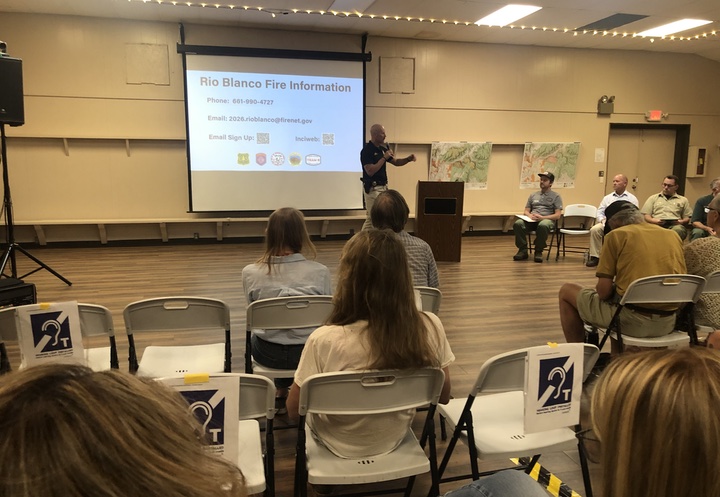
He then introduced Archuleta County Sheriff Mike Le Roux, who in turn introduced County Commissioner Warren Brown. The commissioner briefly summarized the numerous ways that Archuleta County staff are assisting with keeping people safe during the emergency.
Sheriff Le Roux then mentioned that this community gathering was justified by the size of the Rio Blanco Fire, and by the property values under threat.
“This fire is the biggest fire that we’ve had in recent history — in fact, in any history — threatening the Wildland-Urban Interface, with the most values at risk and by far the most people displaced, which is all of you and more.
“And for the longest time. We haven’t had a mandatory evacuation for more than a couple of days, and today is Day 7.”
To be clear, this may be the biggest fire in recent history that has threatened a populated residential neighborhood, but not the “biggest fire” in Archuleta County. The Little Sand Fire, in 2012, burned about 24,450 acres, with suppression costs of more than $6.7 million. It was, however, relatively remote from residential areas.
According to the Sheriff, the “mandatory evacuation” of CR 335 “means that we highly recommend that you leave your property, because there is an imminent threat to life safety.”
“Not everybody chooses to leave in these situations. Those who did choose to leave, we thank you. It takes a lot to leave your property, your animals. But that allows first responders inside that evacuation zone to engage the incident as best they can, without having to deal with other incidents.”
Sheriff Le Roux noted that two other neighborhoods near the fire — east and west of the Lower Blanco Road — are under “pre-evacuation”.
Ovwer the past week, evacuated residents have been occasionally allowed back into the CR 335 neighborhood to check on their properties — with a law enforcement escort.
That access has since been reduced due to fire activity.
“During the evacuation, even though it’s mandatory, we will never forcibly remove anybody from their property. However, the one caveat is, if you do unselfishly leave, you are not welcome back unless it is by a law enforcement escort. That is for the protection of you as an individual, but also for the protection of other properties and residents.
“We have knocked again on every door, and we have an inventory of who is still in the zone, and who has left. And 90% plus of the people have left, so thank you to everybody who has left. I realize it’s uncomfortable…”
We then heard from Josh Peck, Head Ranger for the Pagosa Springs Ranger District, who is handling much of the leadership role during this incident, since the fire is mainly burning within the San Juan National Forest.
“It’s a tremendous strain to host 400 firefighters in a small community like Pagosa Springs. A strain on infrastructure, roads. Things as simple as food — and ice — become hard to come by…”
He shared is sympathy for the folks who have been evacuated.
“We understood, from the moment this began, that this was going to be a difficult incident to manage. The location, where it started, the weather at the time, the fuel condition. Basically, everything was stacked against a simple incident, to be able to easily put out the fire.
“We understood the values in the immediate area… We understood very quickly that we needed help, so we requested help from a Type 3 incident management team. We have a local team that’s probably one of the best in the country, who had been working on the Ferris Fire, and they were here within a couple of hours.
“That was a huge ‘win’ for starting off on this incident on the right foot.
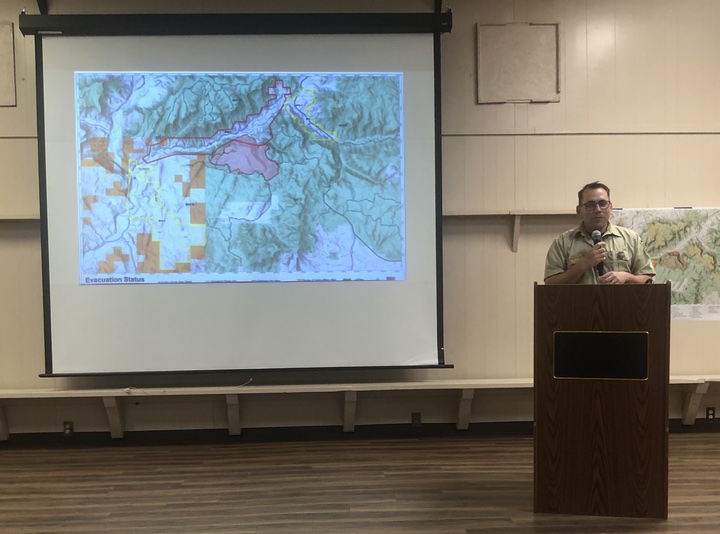
Behind Ranger Peck, a map of the fire was displayed on the screen, showing a recent plot. The red area looked very close to — and encroaching on — the CR 335 neighborhood.
Encroaching slowly, a week into the incident.
Some recent catastrophic wildfires in Colorado have burned through residential neighborhoods within a matter of hours after starting, when driven by high winds. So far, the wind has not been terribly active in Pagosa Springs during the past week.
Nor are we expecting high winds over the coming week, according to the incident meteorologist (whose name I didn’t catch…)
But… we’re apparently expecting other negative weather aspects…
Bill Hudson began sharing his opinions in the Pagosa Daily Post in 2004 and can't seem to break the habit. He claims that, in Pagosa Springs, opinions are like pickup trucks: everybody has one.