
More than 800 pounds of peanut butter — enough for around 15,000 sandwiches — has been spread across the floor of Museum Boijmans Van Beuningen in the Netherlands, in tribute to Dutch artist Wim T. Schippers, who died last month.
— from a story posted by the Associated Press on July 9, 2026.
The peanut butter tribute was unveiled on July 9 for a two-month exhibit. A similar conceptual art installation had appeared previously in other gallery locations, much to the delight of rats and mice living in the building, but the installation at Museum Boijmans Van Beuningen last month will presumably mark the art piece’s final appearance.
Mr. Schippers, a conceptual artist who died this past June at the age of 83, first created the Pindakaasvloer (‘Peanut Butter Floor’) in 1969 in Loenersloot. The work was redone in 1997 in the Centraal Museum in Utrecht, and again in a gallery in 2010. Museum Boijmans Van Beuningen in Rotterdam bought the concept in 2010, and installed it in 2011.
Mr. Schippers was a beloved non-conformist character in the Netherlands, where he voiced Ernie and Kermit the Frog for the children’s TV show, Sesamstraat, the Dutch version of “Sesame Street.” He also created absurdist works that challenged conventional ideas about the meaning of art.
I’m all in favor of challenging conventional ideas. With or without jelly.
From the AP story:
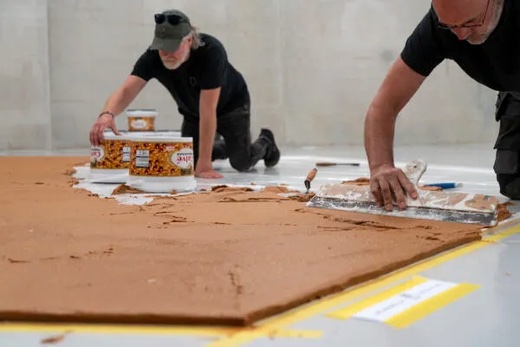
It took two employees of the Museum Boijmans Van Beuningen several days to spread 40 buckets of peanut butter across a 25-square-meter (270-square-foot) hexagon last week. The pair used drywall trowels to smear the peanut butter to a thickness of 2 centimeters (0.8 inch)…
“It was a lot of work,” Leon Duenk, one of the two men who installed the artwork, told AP…
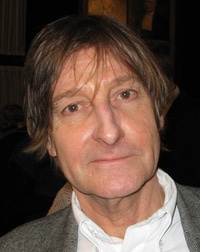
Prior to his death, the artist had discussed with the museum how to recreate the work, resulting in a 20-point plan that included the requirement to apply the peanut butter “as smoothly and boringly as possible.”
Schippers did not specify the size or shape of the work, but he did say it needed to be smooth peanut butter and that he preferred the Dutch peanut butter brand Calvé. The company donated 40 tubs of peanut butter for the work.
I can’t claim to be an art expert, but I know art when I see it.
I also know peanut butter, when I see it. And I can tell smooth peanut butter from crunchy, even from a reasonable distance. I was pleased to read learn the museum honored the request to use the smooth variety.
Not all museums are quite so accommodating.
I’m always fascinated by the way languages get translated. Pindakaasvloer could be more literally translated as “peanut” (pinda) “cheese” (kaas) “floor” (vloer). Peanut butter does not, in my experience, make me think of “cheese”, but it also does not make me think of “butter”. Except that both cheese and butter are sometimes eaten with bread… as is peanut butter, of course.
But liverwurst is also typically eaten with bread, and it’s almost the same color as peanut butter.
Just saying.
Artists are not always precise with their word choices. Especially, perhaps, conceptual artists. The word “sloppy” comes to mind. Not to describe the artwork itself, but rather the title of the artwork.
We journalists tend to be more finicky about using language accurately.
Looking at the photos of this installation, it strikes me that the peanut butter the museum has installed as a tribute to artist Wim Schippers more closely resembles a “tapijt” (carpet) than a “vloer” (floor).
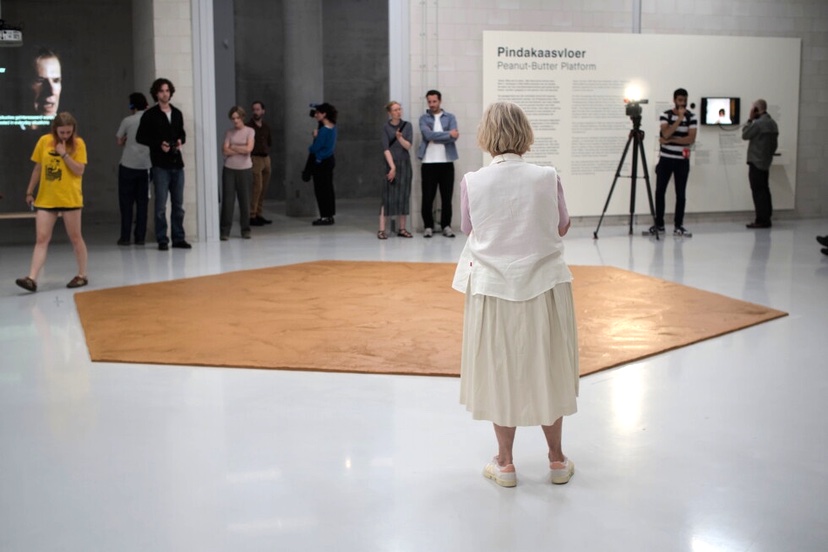
In this photo, the museum visitors are clearly standing on a pale gray vloer, and the Pindakassvloer is not a vloer at all, but more like a tapijt that no one is allowed to walk on.
Maybe Dutch artists weren’t yet familiar with carpets in 1969 when Mr. Schippers created the title for his first version of the art piece. But this is the 21st century, and we’re having enough trouble with misinformation.
Since Mr. Schippers is not longer with us, he can’t reasonably object if the Museum Boijmans Van Beuningen gives a more precise title to the artwork.
Pindakaastapijt.
Just don’t ask me to pronounce it.
Underrated writer Louis Cannon grew up in the vast American West, although his ex-wife, given the slightest opportunity, will deny that he ever grew up at all. You can read more stories on his Substack account.