
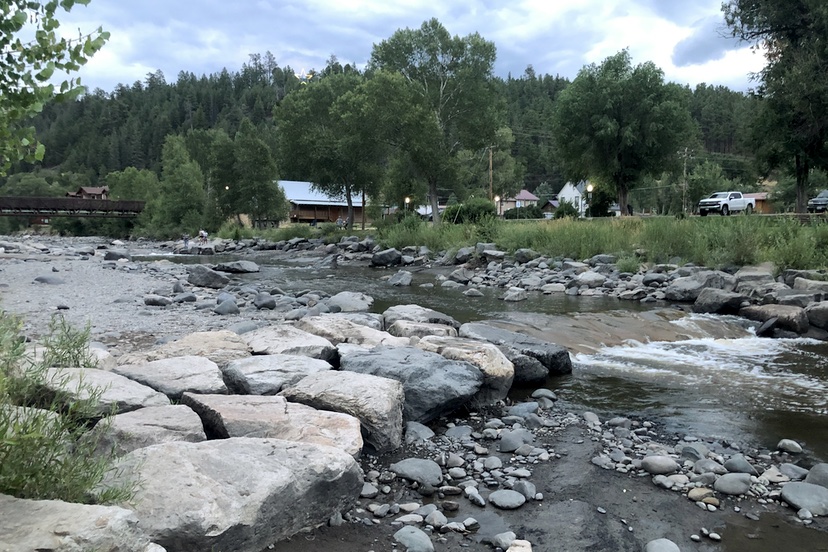
Photo: The San Juan River, downtown Pagosa Springs, July 2026.
If 2026 reminded us of anything, it’s that there isn’t a silver bullet for the challenges facing the Colorado River. Across western Colorado, water users have been adapting in real time – stretching limited supplies, finding practical solutions, and proving once again that the people closest to the resource are often the ones leading the way.
— from the Colorado River District email newsletter, July 15, 2026.
The Colorado River Water Conservation District, commonly referred to as the Colorado River District — or more simply, as “the River District” — is a public water planning and policy agency for the state, created in 1937 during an era of public works investments and economic development under the Franklin D. Roosevelt administration, following the peak of the Great Depression and the three extreme-drought years, 1934-1936, that contributed to the economic and social disaster known as the Dust Bowl.
Those were tough times in the American West. Some of the worst erosion effects during the Dust Bowl were seen in eastern Colorado.
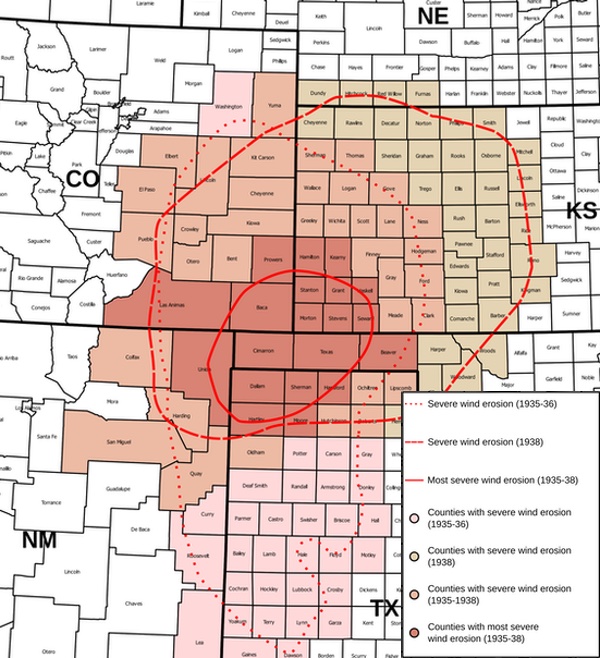
The phenomenon was caused by a combination of natural factors — severe drought — and human error, including a failure to apply dryland farming methods to prevent wind erosion, and notably, the destruction of natural topsoil by settlers in the region.
The federal government had encouraged settlement and development of the Great Plains for agriculture via the Homestead Act of 1862, offering settlers “quarter section” 160-acre plots. Following the end of the American Civil War in 1865 and the completion of the first transcontinental railroad in 1869, newly-arrived migrants and immigrants greatly increased the acreage under cultivation.
An unusually wet period during the 1870s led settlers to embrace the belief that “rain follows the plow” — a popular phrase used by real estate promoters — and to believe that the region’s climate had permanently changed as a result of human activity. William Gilpin, the first territorial governor of Colorado, strongly promoted this belief as one of his reasons for encouraging settlement of the American West.
All this took place 150 years prior to the development of Brandolini’s Law in 2013:
The amount of energy needed to refute bullshit is an order of magnitude bigger than the energy needed to produce it.
An order of magnitude being 10 times the smaller number.
In a controversy around water demand and public financing efforts for a proposed reservoir such as the proposed Dry Gulch Reservoir, we are not necessarily dealing with “bullshit” — that is to say, with intentional or unintentional misinformation.
We are dealing at least partly with “beliefs” that cannot be proven true or false.
Disclosure: I currently serve as a volunteer on the Pagosa Area Water and Sanitation District (PAWSD) Board of Directors, but this editorial series reflects only my own opinions, and not necessarily the opinions of the PAWSD Board as a whole or the PAWSD staff.
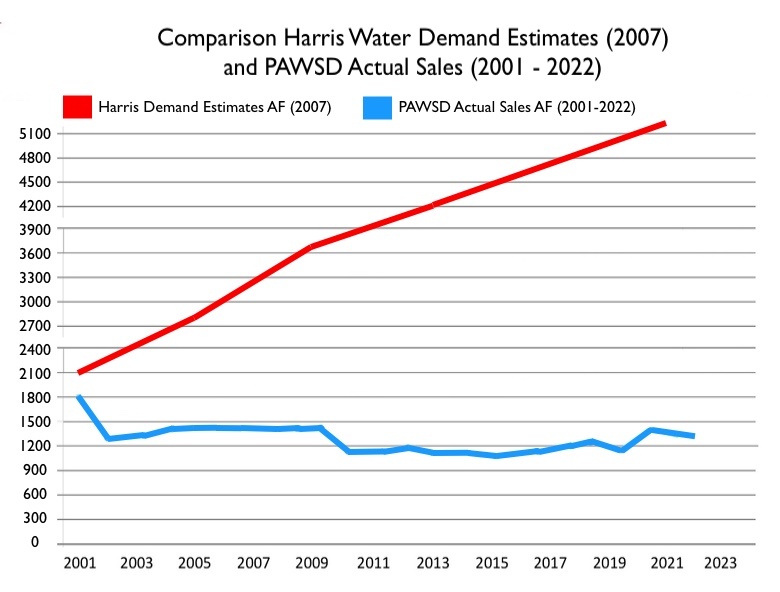
It’s a known fact that, in 2001, the 10,000 residents of Archuleta County (plus our businesses and any visiting tourists and second-home owners) purchased about 1,800 acre-feet (587 million gallons) of water from the Pagosa Area Water and Sanitation District. According to my pocket calculator, that comes to about 160 gallons per resident per day.
We could define that as “Archuleta County’s Water Demand”… “160 gallons per capita per day”…
…but we would be wrong.
Because in 2021 — twenty years later — 14,000 residents of Archuleta County (plus our businesses and any visiting tourists and second-home owners) purchased about 1,300 acre-feet (423 million gallons) of water from the Pagosa Area Water and Sanitation District. According to my pocket calculator, that comes to about 83 gallons per resident per day.
We could therefore define that number as “Archuleta County’s Water Demand”… “83 gallons per capita per day”… in other words, “half the apparent water demand per capita as in 2001″…
…but we would again be wrong.
There is, in fact, no way accurate way to define “the water demand in Archuleta County”, in much the same sense that it’s impossible to accurately define “the weather in Archuleta County” except during any given five-minute period.
Nevertheless, in 2007, PAWSD and the San Juan Water Conservancy District accepted projections about our community’s “future water demand” as calculated by respected water engineer Steve Harris, and used those projections to begin planning a $357 million reservoir project to be built on the Running Iron Ranch, in the Dry Gulch Valley.
A curious side note.
Here’s the definition of “dry gulch” — a slang term from the old cowboy days — from PetticoatsAndPistols.com:
Dry-gulch: to ambush someone, particularly in a cowardly manner.
This might help us understand why the San Juan Water Conservancy District, in 2018, stopped referring to their planned reservoir project as the ‘Dry Gulch Reservoir’, and adopted the label “San Juan Headwaters Project”.
I began today’s editorial with a reference to the Colorado River District, based in Glenwood Springs.
The Colorado River District is local government. We exist to serve you – water users across the 15 West Slope Colorado counties that [draw water] from the headwaters of the Yampa, White, Gunnison, and Colorado Rivers. We do this through legal and legislative advocacy, technical and engineering support, community outreach and education, and multi-benefit water project grant funding.
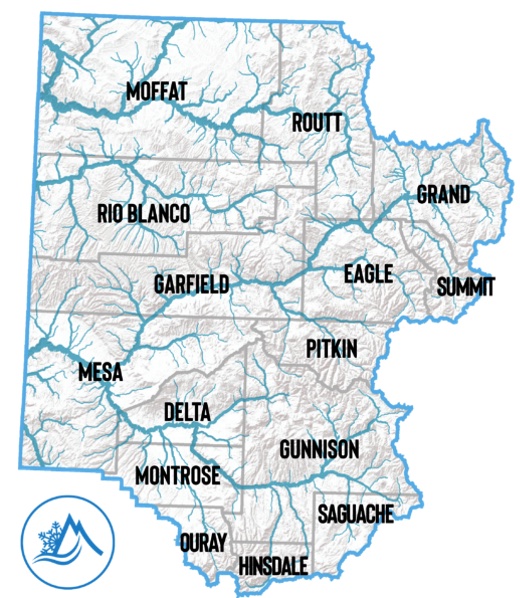
All the tributaries shown in the map above ultimately flow into the Colorado River, which empties into Lake Powell, the nation’s second largest man-made water reservoir and a source of hydroelectricity for parts of the American Southwest. The reservoir is struggling to produce electricity due to the current drought and excessive water withdrawals.
The San Juan River also flows into Lake Powell.
One could argue that, by continuing to allow the San Juan River to flow freely into Lake Powell — instead of diverting 11,000 acre-feet into an (unnecessary and expensive?) reservoir on the Running Iron Ranch — Archuleta County contributes, in a small way, to the overall economic health of the American Southwest.
For the time being, and in the midst of a Colorado River crisis, the San Juan River is still making that small contribution.
Not everyone agrees with that particular perspective on “water demand”.
Some might believe there’s a silver bullet.
Bill Hudson began sharing his opinions in the Pagosa Daily Post in 2004 and can't seem to break the habit. He claims that, in Pagosa Springs, opinions are like pickup trucks: everybody has one.