
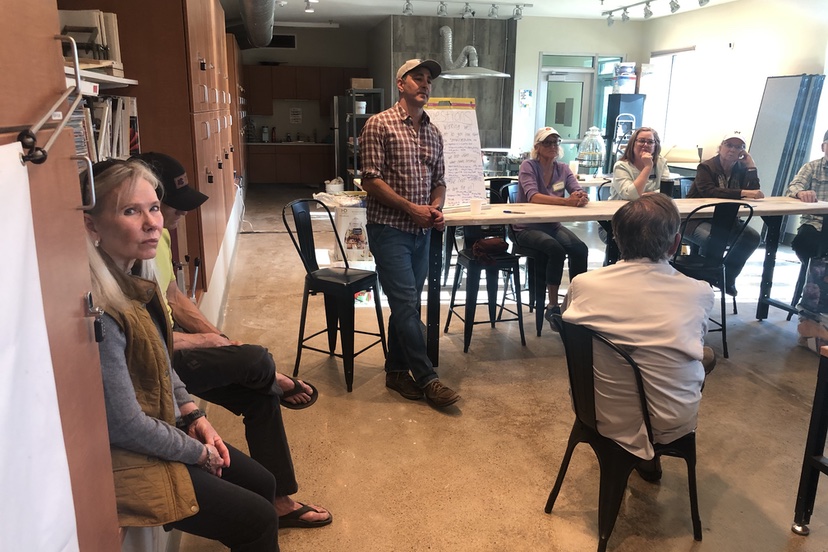
Photo: Congressional candidate Alex Kelloff fields questions at a political gathering at The Studios, May 11, 2026.
By Alex Kelloff, candidate for Colorado’s Third Congressional District.
When I stopped in Pagosa Springs on May 11 as part of my By The People Tour, I came to hear directly from the people who live here about what is working, what isn’t, and what they need from Washington and their representative.
People talked about the things they love about Archuleta County: the mountains, the rivers, the sense of community, and the independence that comes with living in rural Colorado. But they also talked about being worried about whether their local hospital will remain strong enough to serve the community. Or that wildfire seasons seem longer and more dangerous than the ones they remember. They worry that decisions made thousands of miles away are making life harder for the people who actually live here.
What stood out the most was how connected these concerns are across the entire district.
The discussion in Pagosa Springs centered on two issues. The first was restoring federal support for wildfire mitigation and emergency preparedness. The second was protecting independent rural healthcare systems from budget cuts that threaten their long-term viability. But both issues are really part of the same bigger challenge. Rural communities depend on public institutions that are often taken for granted and could be taken away.
When a forest management program loses funding, a community becomes more vulnerable to catastrophic wildfire. When a rural hospital loses funding, families may have to drive hours for care. In both cases, the decisions are being made elsewhere but the consequences are felt at here at home.
After traveling more than 3,300 miles across Colorado’s 3rd Congressional District and holding 17 community workshops, I heard again and again that people were tired of the political theater and wanted a government that is focused on solving practical problems. Too many people feel that the government has become disconnected from the communities it is supposed to serve.
Communities like Pagosa Springs often bear the consequences of federal decisions without having much influence over them. Forest Service staffing levels affect local wildfire risk. Medicaid funding decisions affect local hospitals. Housing shortages affect whether teachers, nurses, and first responders can afford to stay in town.
One lesson from this tour is that rural communities are not asking for special treatment. They are simply asking to not be overlooked. The conversations in Pagosa Springs reinforced that message.
The people who attended did not agree on everything, no community ever does. But there was an agreement that the government should be accountable, responsive, and focused on solving problems that affect everyday families.
I left the conversation in Pagosa Springs with a deeper appreciation for both the challenges and the resilience of this community. The ideas shared there became part of a district-wide policy roadmap shaped by thousands of miles of travel and countless conversations.
More importantly, they served as a reminder that the best solutions rarely come from Washington first, but instead from the people who live with these challenges every day.
The Pagosa Daily Post welcomes submissions, photos, letters and videos from people who love, and care about, Pagosa Springs, Colorado. More information available at 970-903-2673 or pagosadailypost@gmail.com