
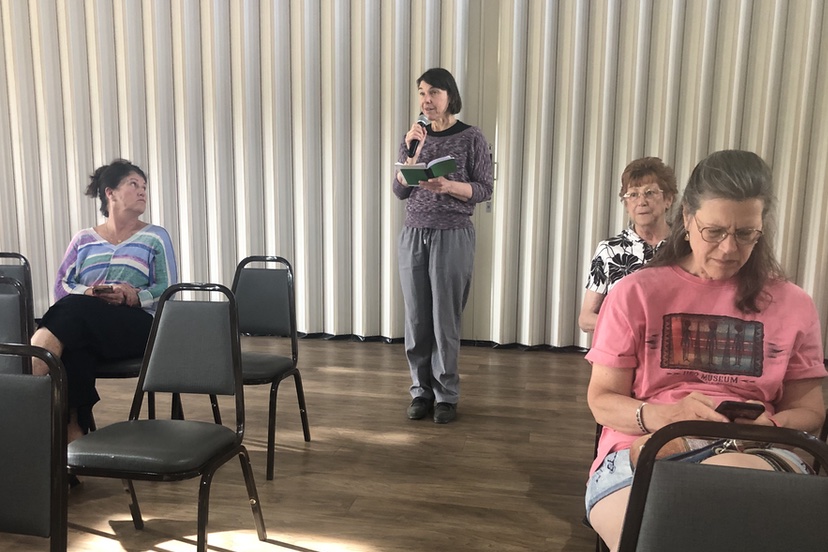
Photo: Candace Jones, one of the organizers of the four-event “Community Conversations” presentation series, poses questions about Pagosa Springs Medical Center to CEO Rhonda Webb on June 1, 2026.
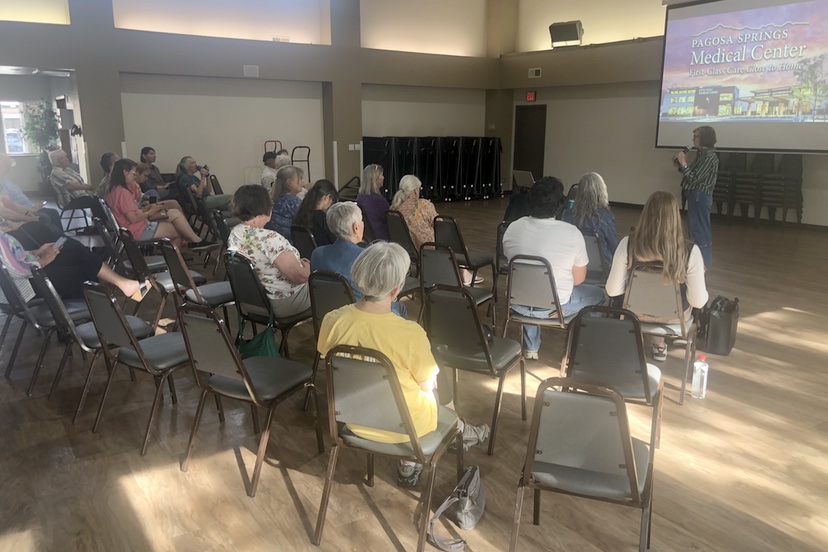
About two dozen local voters turned up for a June 1 “Community Conversation” about an issue that may — or may not — appear on next November’s ballot. Pagosa Springs Medical Center (PSMC) receives about $2.4 million annually in property taxes from property owners living within the Upper San Juan Health Service District (USJHSD), to augment a $50 million annual budget. The USJHSD Board of Directors have not yet decided whether to place a request before the district voters, to renew a waiver of TABOR limitations. If not renewed, the voter-approved waiver for PSMC will expire in December.
Only a couple of key governments in Archuleta County operate under Colorado’s TABOR (Taxpayer Bill of Rights) limits… namely, the Archuleta County government and Pagosa Area Water and Sanitation District (PAWSD).
The remaining key government districts in Pagosa have been “de-Bruced” and operate without those constitutional limitations. As a result, their tax revenues have typically tripled over the past 10 years.
Dr. Rhonda Webb, CEO and Chief Medical Officer for PSMC, suggested that a future PSMC ballot measure would likely not ask for a tax rate increase, but only for a continuation of the TABOR waiver.
She made it fairly clear to the gathered audience that the American health care system is “broken” and operating on life support. She explained that, due to many factors related to payments from Medicare, Medicaid, and private health insurance companies, and related to charity services, PSMC expects to receive only about half the revenue that they could potentially bill for.
She noted that the PSMC primary care clinic struggles to retain physicians.
“I hear a lot about this from people, because we’ve had such turnover in primary care. And we recently had more turnover in primary care. One of our primary care doctors loves her patients, loves the people she works with, but they can’t afford land or a home here. So they’re leaving to go somewhere that they can afford.
“So that’s just one primary care doctor who had been here for about eight years. And a whole lot of PAs and MDs, who are excellent.
“I reached out to the doctor in charge of the students at University of Colorado Medical Center… we rotate student through here… and in fact, one who did her second year of student work here, luckily bought property back then, and she finishes her residency training next year. And she has signed on to come here…
“But I reached out to the doctor at CU, to find out what the average turnover time is for primary care. Currently, in the U.S., the average primary care provider stays less than three years in their original office. I can’t change that. Nor can I change the cost of living here. I can only keep trying to recruit for…
“Many people in primary care are leaving to do direct access care. More of a concierge-type practice.
“It’s my job to keep primary care doctors here. But I can’t control everything…”
She also noted that PSMC operates the only ambulance service in Pagosa Springs. In fact, USJHSD was originally formed in 1981 specifically to operate the ambulance service; the hospital was not built until 2008. But EMS operates at a loss, she explained, and loses about $2 million a year, due in part to an inability to charge for service when the patient calls 911 but then declines a ride to the hospital — which happens all too often.
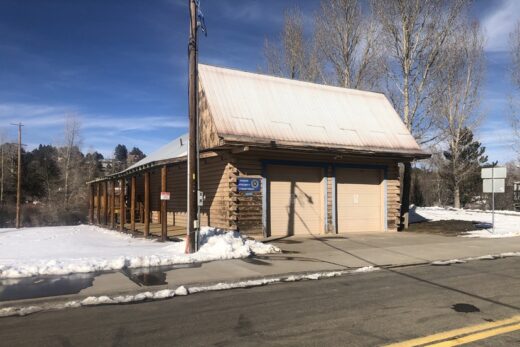
Nevertheless, PSMC is currently raising funds to add a downtown ambulance station in the former San Juan Ranger’s building on San Juan Street, to provide more timely service to the eastern side of the county. The remodel will cost about $1.2 million.
“We’ve raised about $400,000 so far…”
Because PSMC is funded mainly by patient fees rather than by tax revenues, the hospital is able to put itself in debt — without voter approval — based on projected future revenues, which is how a two-story office building was added to the PSMC campus in 2017.
But even local governments funded mainly by taxes can find ways to put the community deeper in debt without voter approval — through a scheme known as “Certificates of Participation” or “COPs”. This mechanism was used to fund the new Archuleta County Detention Center in Harman Park, and the new Town of Pagosa Springs Maintenance Complex near the High School. Some consider this a violation of TABOR’s overall intention, but the Colorado courts have allowed it.
When you put the public in debt without their approval, you need to cross your fingers that the local economy keeps growing… and paying more taxes.
You might pray, for example, that gasoline stays a $2.50 a gallon, and you might spend millions of public tax dollars marketing the community as a tourism destination.
Many people believe that the rural town of Pagosa Springs has a “tourism economy”. The reality, however, is more complicated, as we’ve discussed here in the Daily Post.
As discussed in this editorial series, the current series of “Community Conversations” is being sponsored by the Archuleta County Republican Party, the Archuleta County Democratic Party, and the Archuleta County League of Women Voters, and aims to provide information about three different tax measures that may — or may not — appear on the November ballot.
Archuleta School District may — or may not — place a bond issue on the ballot to help fund a new $126 million PreK-8 school facility on Vista Boulevard, which would allow ASD to abandon three functional school buildings in downtown Pagosa.
The Archuleta Board of County Commissioners may place a proposal on the ballot to increase the County Lodging Tax paid mainly by tourists.
PSMC may place an issue on the ballot asking the voters to renew — perhaps perpetually — the “de-Brucing” of the USJHSD tax collections.
The Town of Pagosa Springs was successful, this past April, in getting town voters to approve a new 1% sales tax to fund sewer system repairs and upgrades.
Pagosa Area Water and Sanitation District (PAWSD) has been steadily increasing customer fees to fund major infrastructure projects for water and sanitation.
Which brings us to a true fact about Pagosa Springs. We do not, in fact, have a tourism economy. We have a government economy.
Bill Hudson began sharing his opinions in the Pagosa Daily Post in 2004 and can't seem to break the habit. He claims that, in Pagosa Springs, opinions are like pickup trucks: everybody has one.