

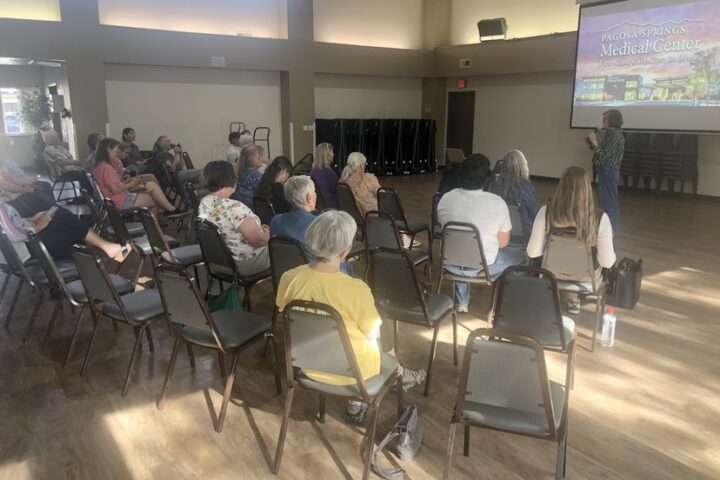
Photo: Pagosa Springs Medical Center CEO Dr. Rhonda Webb, fields audience questions — after a fashion — at a June 1 public presentation.
Back in April, a few political activists in Pagosa Springs began organizing a series of public presentations on the topic of local tax measures that might appear on the November 2026 ballot, and approached the Archuleta County League of Women Voters for possible co-sponsorship of the events. The activists had planned four informational events, that would each include ‘Q&A’ opportunities for the audience.
In Colorado, tax rate increases must be approved by the voters. But there’s a difference between as “tax rate increase” and a “tax increase.” And that difference plays an important part in today’s editorial.
As Daily Post readers may be aware, the League of Women Voters historically defines itself as “non-partisan” and with a mission to support voting access, and participation, for all, regardless of the voter’s political leanings. The League also believes that the ideal voter is a well-informed voter.
The Daily Post has a similar philosophy.
Disclosure: I am a member of the League, here in Archuleta County, but this editorial reflects only my own opinions, and not necessarily the opinions of the our local League.
Last night, the Pagosa Springs Medical Center — the hospital and clinic operated by the tax-supported Upper San Juan Health Services District (USJHSD) — delivered the third presentation, led by PSMC’s CEO, Dr. Rhonda Webb. A modest gathering at the Pagosa Lakes Property Owners Association (PLPOA) Clubhouse: about 25 people.
As Dr. Webb explained in her presentation, PSMC is one of only a few independent hospitals in Colorado. She explained that most of the state’s hospitals are operated by “systems” — networks of hospitals and care facilities run by large, and typically profitable, health care corporations with headquarters in various places. The largest system in Colorado is UCHealth, with 13 hospitals and an annual net patient revenue of about $6.8 billion. That’s “billion” with a “b”.
The next largest system in Colorado is HCA Healthcare, with net patient revenue of $2.8 billion from 10 hospitals within the state. HCA Healthcare runs a total of about 190 hospitals and 2,600 ambulatory facilities in 19 states, with corporate revenues of about $76 billion.
For comparison, PSMC expects net patient revenue this year to be about $50 million. USJHSD also collects about $2.4 million from property taxes. As part of a tax-supported government health district, PSMC does not generate any “profit” for shareholders, but in fact often struggles to ‘break even’.
According to Dr. Webb, PSMC — as the largest employer in Archuleta County — also struggles to recruit and retain staff, due in part to the relatively unaffordable cost of housing here.
But the core of Dr. Webb’s message regarded — not staffing or housing — but TABOR. The Taxpayer Bill of Rights, added to the Colorado Constitution by the state’s voters in 1992.
From that amendment:
Article X, section 20. The Taxpayer’s Bill of Rights. (1) General provisions. This section takes effect December 31, 1992 or as stated. Its preferred interpretation shall reasonably restrain most the growth of government…
Apparently, most people of Colorado felt, in 1992, that the growth of state and local governments was a problem in need of restraining.
Under TABOR, state and local governments cannot raise tax rates without voter approval, and typically cannot spend revenues collected under existing tax rates without voter approval if revenues grow faster than the rate of inflation and population growth. Revenue in excess of the TABOR limit, commonly referred to as the “TABOR surplus”, must be refunded to taxpayers, unless voters approve a revenue change as an offset in a referendum.
Under TABOR, the state has returned more than $2 billion to taxpayers.
TABOR also limits the amount of state and local grants that a “government enterprise” — a business-type unit that generates fee income for the government, such as a hospital — can accept in any calendar year, to no more than 10% of the agency’s total budget.
Many local governments have asked voters to waive TABOR limitations and allow the agencies to retain and spend the full amount of taxes they are able to collect. This voter-approved removal of TABOR limits is typically referred to a “de-Brucing” in honor of the author of the TABOR amendment, Douglas Bruce.
Here in Archuleta County, numerous government districts have been de-Bruced, including the Pagosa Fire Protection District, the Upper San Juan Library District, and the San Juan Water Conservancy District. Pagosa Area Water and Sanitation District (PAWSD) was de-Bruced in 2000, but in 2016, the PAWSD Board asked its voters to reinstate TABOR limits, which the voters were happy to do.
Ten years ago, the Upper San Juan Health Services District — operating at PSMC — asked the voters to de-Bruce the district on a temporary basis, and the voters agreed. But that temporary de-Brucing expires this year.
I believe PSMC’s temporary waiver is the only instance of de-Brucing in Archuleta County that was not perpetual. As Dr. Webb explained, the expiration of the waiver would threaten not only PSMC’s annual tax collections but also its ability to accept grants.
Dr. Webb confessed, at several points in yesterday’s presentation and Q&A, that she has enough on her plate as Chief Medical Officer, and has not become entirely familiar with how the temporary TABOR waiver has been influencing PSMC’s finances. But she was very clear that the waiver will expire this year.
It also became apparent, based on the questions asked by the audience, that very few people in the room understood how TABOR works…
…how it works to limit government growth, and how it affects our annual property taxes.