

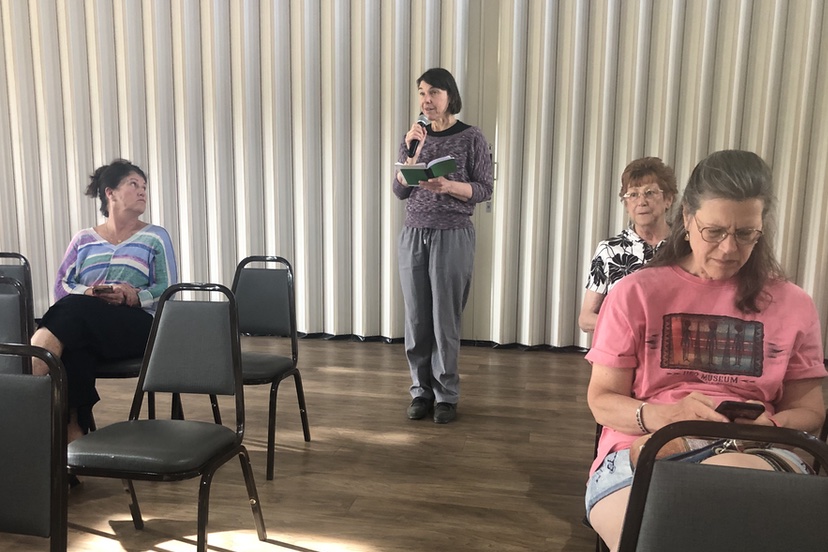
Photo: A fundraising event to benefit Pagosa Springs Medical Center, July 2024.
We shared, in Part One, a few facts about Colorado’s Taxpayer Bill of Rights — typically referred to as TABOR — approved by the state’s voters in 1992 as an amendment to Article X of the Colorado Constitution. At that time, a majority of voters felt that the growth of state and local government was in need of restraint.
Article X, section 20. The Taxpayer’s Bill of Rights. (1) General provisions. This section takes effect December 31, 1992 or as stated. Its preferred interpretation shall reasonably restrain most the growth of government…
On Monday evening, Dr. Rhonda Webb, the CEO and Chief Medical Officer at Pagosa Springs Medical Center (PSMC), led a presentation at the Pagosa Lakes Property Owners Association (PLPOA) Clubhouse to explain a ballot measure that the Upper San Juan Health Service District board of directors might — or might not — place on the ballot, to continue waiving TABOR limits on how much tax revenue PSMC can retain when property taxes increase in Archuleta County.
The explanation was, frankly, a bit confusing.
It was obvious during the presentation that many people at the June 1 presentation — including Dr. Webb — were unfamiliar with the details of how TABOR functions, as a tool for restraining government growth in Colorado. Near the conclusion of the Q&A portion of the meeting, as confusion lingered in the room, Dr. Webb made an appeal to the local media.
“Maybe we can get an article in the paper about TABOR?… I truly don’t know that detail of the law. It just doesn’t stick in my head. It’s not what I normally talk about…”
Audience member:
“That’s okay. You’re a doctor. You don’t have to be a lawyer, too…”
Looking around the room, I recognized a number of the people in the audience as folks who have been actively involved in local politics and political campaigns — presumably, some of the most conscientious and well-informed people in the community. But based on the audience comments, the “details of the law” and the reasons why local voters might — or might not — want to give PSMC a perpetual waiver of TABOR limits, was not well understood.
Can we get an article in the paper? And if we did… would the voters read it?
Here are a few facts about TABOR.
1. In general, state and local governments may collect and spend increasing amounts of revenue, but the increase is limited to the amount of inflation plus the growth of the local population. According to the Colorado State Demographer’s Office, Archuleta County lost population between 2023 and 2024. (The office has not posted 2025 data yet.). When revenue is collected above the TABOR limit during a budget year, the government must adjust its tax rate and refund the excess revenue to the taxpayers. TABOR also limits the amount of state and local grants that a government “enterprise” is allowed to accept during a budget year.
2. Many local governments have obtained voter approval to operate without TABOR limits, allowing them to keep all the revenue they collect and avoid the refunding process. This approval process is referred to a “de-Brucing”. Typically, de-Brucing is perpetual, and here in Archuleta County, certain government districts are permanently de-Bruced.
3. However, when voters de-Bruced the Upper San Juan Health Service District — the entity that operates PSMC — the de-Brucing was temporary, and expires this year in December.
4. On Monday, Dr. Webb was not able to estimate, when asked, the financial impacts to the PSMC budget if the hospital goes back under TABOR limits in 2027. But she asserted that PSMC “needs to keep growing” its revenue stream in order to survive in the current health care environment, which she repeatedly classified as “broken”.
A bit of history.
In November 2016, the following measure appeared on Archuleta County ballots.
SHALL PAGOSA AREA WATER AND SANITATION DISTRICT BE SUBJECT TO THE REVENUE, COLLECTION AND SPENDING LIMITS UNDER ARTICLE X, SECTION 20 OF THE COLORADO CONSTITUTION (OTHERWISE KNOWN AS THE TAXPAYERS BILL OF RIGHTS), SECTION 29-1-301, C.R.S., AND OTHER COLORADO LAWS BY REPEALING THE BALLOT ISSUE APPROVED BY DISTRICT VOTERS ON MAY 2, 2000; PROVIDED THAT 2016 SHALL BE USED AS THE BASE YEAR FOR CALCULATING LIMITS AND SUCH LIMITS SHALL BE EFFECTIVE BEGINNING JANUARY 1, 2017?
As we note, the ballot language did not include the acronym ‘TABOR’, but the measure was intended to put PAWSD back under the taxing and spending controls offered by TABOR, if the voters agreed.
PAWSD board member Glenn Walsh submitted a statement explaining why PAWSD customers might want to vote “Yes.”
A “Yes” vote will reinstate the protections of the Taxpayer’s Bill of Rights (TABOR) to PAWSD customers. Under TABOR protections, increases in general property tax revenue are limited to inflation plus a small growth factor.
The first benefit of TABOR protection is obvious: general property tax revenue is placed under commonsense controls. PAWSD customers saw increases in 2007 and 2009 which totaled more than 60%. A “Yes” vote here will end any future repetition of those large increases if the real estate market has another short-term boom. Should PAWSD require more revenue than modest inflation-based increases provide, there is a clear option: ask the voters for that revenue.
The second benefit is less obvious but more critical: governing boards rarely spend tax windfalls wisely…
Under TABOR, everyone benefits: taxpayers are protected from sudden large increases and governing boards have smaller, more predictable revenue projections which can allow smart long-term planning and fiscally conservative decision-making.
PAWSD board members and staff had indeed exhibited “spending fever” prior to 2010, when TABOR limits had been suspended by the voters and during a period when some people believed (mistakenly) Archuleta County would experience a high rate of population growth forever into the future. Between 2000 and 2010, PAWSD ran up about $38 million in district debt, in an apparent eagerness to build the world’s most expensive small-town rural water district. That was about $4,500 worth of debt for every man, woman and child living in the district.
Some of that debt was financed through property taxes, but much of it — including the controversial $10 million purchase of the Dry Gulch reservoir site, and another $5 million for a “Biosolids Greenhouse” that couldn’t produce commercially viable biosolids — was backed instead by monthly water fees or sewer fees.
While this debt was being accumulated for sometimes-questionable capital projects, the district’s charges for water more than tripled. And perhaps predictably, households and businesses in the district — faced with higher usage fees — began using less and less water. Simultaneously, the PAWSD board was finally revealing the unsettling fact that the district was losing around 40 percent of its treated water — a loss rate much higher than the industry standard of around 10 percent.
Then the local economy crashed during the Great Recession, and local property tax revenue declined for PAWSD and everyone else. Ouch.
As far as I can tell, in 2016, no government district in Colorado that was “de-Bruced” by its voters had ever been “re-Bruced” — meaning, no government entity has ever asked the voters to place government spending back under TABOR controls.
But in 2016 — following a 60% increase in property tax revenue due to rising property valuations — PAWSD board invited district property owners within the district to limit the spending by their local water and sewer district. The voters complied, and reinstated TABOR limits for PAWSD, in an historic ‘first’ for a government district in Colorado. The huge property tax increases seen in 2024 in Archuleta County flowed into the budgets of certain local governments — those that were de-Bruced, including PSMC — but not into the PAWSD budget…
That being said, PSMC faces many financial challenges that PAWSD does not face. And vice versa. Let’s consider some of those PSMC challenges…