
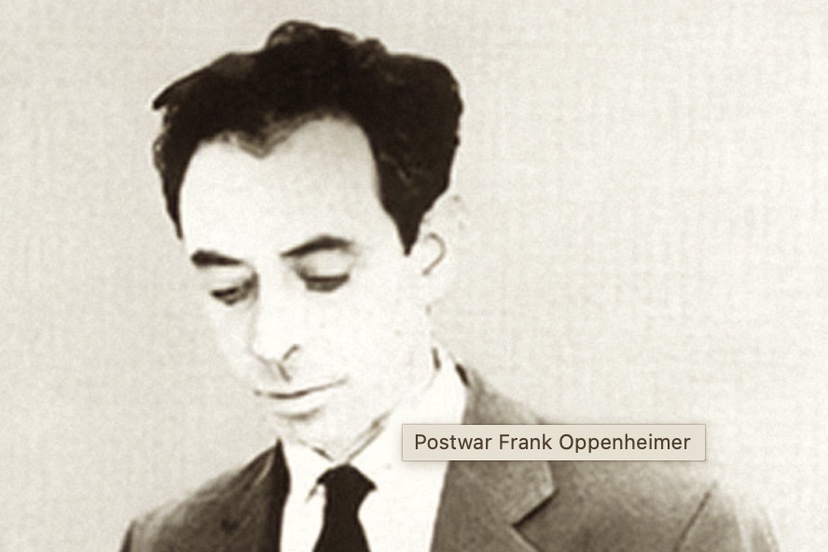
Photo: Frank Oppenheimer, physicist, educator, and former Pagosa Springs High School science teacher, later founded the Exploratorium science museum in San Francisco. Photo credit: Stanley Fowler / Courtesy of KC Cole
There was a point when we almost lost my mother.
Stage 4 colon cancer. Pain that kept escalating. A body telling the truth long before anyone would listen.
At one point, she was told by a local provider that what she was experiencing might be “in her head.”
It wasn’t.
She survived — but not without cost. And not without a question that has stayed with me:
What happens when the body is carrying something the system doesn’t yet recognize — or refuses to see?
On April 7, 2026, a statement from the U.S. President warned that an entire civilization could be wiped out overnight. For a moment, the world leaned toward catastrophic escalation again.
But here in the San Juan Mountains, it’s easy to hear something like that and think: that’s far away.
It isn’t.
The Doomsday Clock was created during the Cold War as a symbol showing how close humanity may be to catastrophic risk, especially nuclear war. The closer it moves toward “midnight,” the greater the danger. Today, it stands at 85 seconds to midnight. Closer than it has ever been. Even during some of the most dangerous moments of the Cold War, including the Cuban Missile Crisis, the clock never moved this close.
But in Southern Colorado and New Mexico — and across the broader borderlands — for some families, midnight already happened.
The morning the sky lit up over southern New Mexico, no one knocked on doors. No one told families to go inside.
Children drank milk that carried what had already fallen.
That “midnight” came at 5:29am on July 16, 1945.
My father was 10 years old then, out in the chile field with my grandfather in the Rio Grande Valley. More than 100 miles away, they saw the sky change — and then felt it — a force that slammed them to the ground before they understood what they were witnessing.
No one explained it. No one came.
The first atomic detonation — part of the Manhattan Project, known as the Trinity test — occurred in the Tularosa Basin of southern New Mexico.
J. Robert Oppenheimer led the scientific effort. His brother, Frank Oppenheimer, later brought some of those lessons into classrooms.
Archuleta County also remains home to the former Oppenheimer ranch — a reminder that this history is not as geographically distant from Pagosa Springs as many might assume.
In 1957, Frank Oppenheimer came to Pagosa Springs High School where he was my mother’s science teacher. He first taught science in a one-room schoolhouse, often using scavenged and improvised materials to help students understand how the world worked. Before long, students from Pagosa Springs were winning state science fairs.
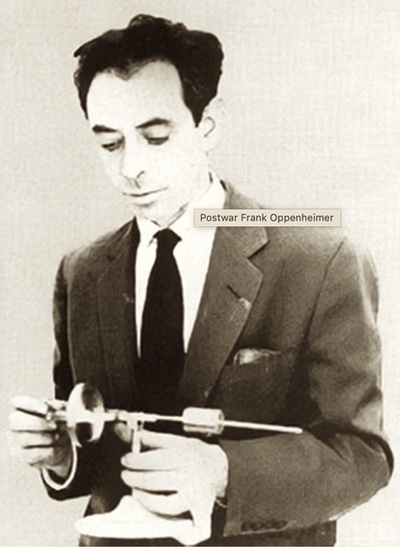
Frank believed something essential: when ordinary people are excluded from understanding the forces shaping their lives, they bear the consequences without the power to respond.
Eventually welcomed into academia at the University of Colorado Boulder, he began building what he called a “library of experiments” from discarded scientific equipment. That vision later grew into the “Exploratorium” in San Francisco, now one of the world’s most influential interactive science centers.
Frank intentionally avoided calling it a museum. He wanted people to touch things, experiment, ask questions, and learn without fear of getting something wrong.
That idea feels especially relevant now, because communities cannot meaningfully respond to environmental risk, public-health crises, or democratic challenges when they are excluded from information or made to feel powerless in the face of it.
My parents were children that morning — my father in the fields near Peralta, my mother here in Pagosa Springs. Rural places, where exposure moves quietly through air, soil, water, and food.
No one warned them. No one monitored what followed.
Pagosa Springs was not outside of this story. It was and is part of the same regional system.
What moved across New Mexico did not stop at a state line.
Fallout does not recognize political boundaries.
In the context of nuclear weapons testing, “fallout” refers to radioactive particles released into the atmosphere after an explosion. Those particles eventually fall back to earth through wind, dust, rain, snow, water systems, soil, crops, livestock, and human bodies.
Fallout is not only the blast itself. It is what lingers afterward.
Between 1945 and 1962, more than 100 atmospheric nuclear weapons tests were conducted in the United States and its territories, resulting in widespread radioactive fallout across much of the country. In that sense, many Americans became “downwinders” without ever realizing it.
In 1953, after a major storm moved across the eastern United States, a college student in New York using a Geiger counter discovered dangerous levels of radioactive contamination on something completely ordinary: his baseball glove.
Fallout had traveled across the country through weather systems and rain.
The lesson was unsettling then, and it remains unsettling now: contamination does not stay where it begins.
In Colorado, that history includes uranium development across the Western Slope and Four Corners region, where workers, Tribal communities, agricultural families, and surrounding ecosystems experienced long-term environmental and occupational exposure.
We pride ourselves on clean air, clean water, and raising families close to the land. But those systems have histories we rarely examine—and they are not just in the past.
As the late Yavonne Sandoval — who nurtured Buenos Para Todos, a land rematriation initiative that continues in Villanueva, New Mexico — often reminded those around her, “healing the land teaches us who we are.”
Archuleta County itself carries pieces of this story. The old coal mine—quiet now—sits as a reminder that extraction has long shaped this landscape.
Just across the border near Chama, renewed interest in uranium development and growing efforts to protect the Chama River basin are raising familiar questions about land, water, extraction, and long-term responsibility.
Increasingly, communities across Northern New Mexico and Southern Colorado are recognizing that these watersheds and ecosystems do not stop at county or state lines. What affects the Chama basin eventually touches broader connected systems tied to water, agriculture, recreation, wildlife habitat, and community health across the region.
These are not only historical questions. They are decisions still being made today, in places not far from here.
Exposure moves through systems, and over time, it settles into bodies and communities alike.
If you live in Pagosa Springs, this is not distant history. It is part of the environmental and public health story of this region.