
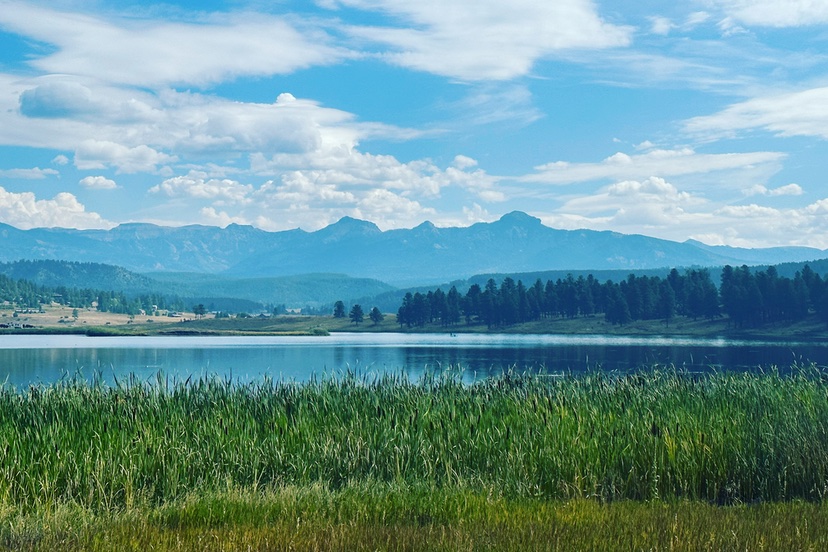
Photo: Echo Lake in Archuleta County, Colorado. Photo credit: Rosa Chávez
Earlier this month, I attended a screening of “First We Bombed New Mexico” at the National Hispanic Cultural Center. Directed by Lois Lipman and centered on the advocacy of Tina Cordova, the film follows families from southern New Mexico who lived downwind of the Trinity test and spent decades fighting for recognition after generations of illness, cancer, and loss.
The film is not simply about the bomb itself. It’s about silence, exclusion, and the long struggle to make invisible harm visible.
Last year, millions of people watched “Oppenheimer”, the Hollywood portrayal of the scientists and political forces behind the creation of the atomic bomb. “First We Bombed New Mexico” feels, in many ways, like the untold companion to that story—not centered on laboratories or the architects of the bomb, but on the rural Hispanic, Indigenous, and borderlands families who carried the fallout in their bodies long after the headlines faded. It is the story of our neighbors, our landscapes, and the communities that continued living with consequences they neither chose nor fully understood.
On April 25, I joined a community workshop in Española hosted by Tewa Women United and Concerned Citizens for Nuclear Safety, where residents gathered to better understand the federal environmental review process connected to plutonium pit production.
Facilitated in part by Environmental Justice Program Coordinator Chenoa Scippio and Dr. Myrriah Gómez, the gathering focused on helping ordinary community members understand how these decisions are made, the role plutonium pits play in nuclear weapons production, potential health and environmental concerns, and how rural communities can meaningfully participate in decisions that may shape their future.
Additional workshops in May and June continue this broader effort to support public understanding and civic participation across Northern New Mexico—and Borderlands Health is extending that invitation into Southern Colorado and the broader Southwest as well.
What stayed with me in both spaces wasn’t just the history. It was the voices. Families described ash settling onto their food, their homes, and their livestock.
Communities left to make sense of illness without information, without warning, and without consent. Many described what happened plainly: they were treated as if they were disposable — not because the science was unknown, but because of who they were, and where they lived.
In my family, this does not show up as a single diagnosis. It shows up as a pattern. My mother developed a benign thyroid tumor before colon cancer. In my generation, multiple daughters have been diagnosed with the autoimmune condition called Graves’ disease. Three of us have undergone full thyroidectomies, surgical removal of the thyroid organ.
And in my own body, the signal has been even more visible. Alongside Graves’ disease, I live with thyroid eye disease — an autoimmune condition that can alter the structure of the face itself. It is something people notice, but rarely understand.
Medicine can describe each condition. What remains harder to fully understand is how exposure, stress, and place continue shaping health across generations.
This is what it means to say the body keeps the fallout. But memory keeps it too. Communities remember what institutions fail to record, acknowledge, or repair.
What happened at Trinity was never confined to a single test site. The impacts spread through labor systems, extraction economies, transportation corridors, and communities across the Southwest.
What happened at Trinity was not just a scientific milestone. It was the creation of a sacrifice zone stretching across rural, largely Hispanic and Indigenous communities who were never asked, never informed, and never protected.
For communities across New Mexico — and now formally recognized across parts of Colorado — this reality is beginning, slowly, to be acknowledged. In 2025, the Radiation Exposure Compensation Act (RECA) was expanded to include all New Mexico counties and broaden eligibility across parts of Colorado and the Four Corners region.
For families like mine, this matters. My mother is now eligible.
Depending on exposure category and illness, qualifying individuals and some surviving family members may receive one-time compensation payments of up to $100,000 through the federal program. But eligibility is not access. And recognition does not undo exposure.
That is the gap. And that gap is where community comes in.
Recently, I also sat down with Tabitha Hrynick, a PhD candidate in anthropology at the University of Amsterdam, whose research explores what meaningful reparation looks like for New Mexicans affected by nuclear harm. One of the questions she posed stayed with me: what does repair look like beyond financial reimbursement alone?
For many families, the answer may also include ongoing and improved healthcare access, access to integrative and holistic medicine, acknowledgment, environmental monitoring, public education, historical truth-telling, easier access to records and care, intergenerational healing, and meaningful participation in decisions that continue shaping affected communities today.
Silence has never protected vulnerable communities for long.
Across the Southwest, decades of investment in weapons development have shaped both the economy and the landscape. But that investment has not been matched by sustained investment in community health, environmental monitoring, or the systems that support ecological and community sustainability.
Environmental health is not separate from this conversation. It is the throughline.
Air, water, soil, food — these systems carry both nourishment and risk. When they are not monitored, protected, or equitably governed, the consequences do not disappear. They settle into bodies. And over time, they show up in communities. Often, only after the damage is done.
In many rural communities, rapid growth and tourism pressures have also intensified displacement and affordability challenges — another reminder that economic development without community sustainability carries its own long-term health consequences.
We have found endless resources for development, tourism expansion, war, and extraction — but far less for health, prevention, affordable housing, and the protection of the ecosystems and communities that sustain life here.
If food is infrastructure, then exposure is infrastructure.
Because the lesson from Trinity — and from what followed — is not just about exposure. It’s also about exclusion. The question is not only how we repair the past; it’s how we prepare the next generation differently.
Community members across the Southwest are continuing to participate in federal environmental review processes connected to proposed plutonium pit production tied to Los Alamos National Laboratory. While the in-person public hearing held in Santa Fe has now passed, public comments on the Draft Programmatic Environmental Impact Statement (PEIS) for plutonium pit production remain open online through July 2026. Information and participation: https://www.energy.gov/nnsa/plutonium-pit-production-peis
Whether people support or oppose these projects, public participation matters. One of the strongest lessons from the Española workshop was that public participation requires more than simply opening a comment period. It requires trusted community spaces where people can ask questions, learn together, and understand how complex environmental decisions may affect land, water, health, and future generations.
This is a moment for Archuleta County to lead — not by reacting later, but by preparing now. Local institutions — including the Ruby M. Sisson Memorial Library, Archuleta County Public Health Department, schools, nonprofits, and regional partners—can play a role by hosting information sessions, supporting RECA navigation, and creating space for community dialogue.
Existing collaborations such as the Archuleta Rural Health Network may also help create trusted pathways for community education, navigation, and support. Because many people do not fail RECA claims due to lack of suffering. They fail because records are fragmented, eligibility categories are confusing, or families do not realize they may qualify.
Care is helping communities understand what they were never told.
The question is no longer whether fallout exists. The question is whether we will continue asking communities to carry it alone.
Cuando el sistema falla, la comunidad sostiene la salud.
Resources (Take Action):
Radiation Exposure Compensation Act (RECA)
The federal RECA program was expanded in 2025 to include all New Mexico counties and broaden eligibility across parts of Colorado and the Four Corners region for certain downwinders and uranium workers. Claims generally must be filed by December 31, 2027.
Information and filing assistance:
U.S. Department of Justice RECA Program
https://www.justice.gov/civil/radiation-exposure-compensation-act
Colorado residents may also contact:
Colorado Department of Public Health & Environment (CDPHE)
Archuleta County Public Health Department
Oncology social workers and regional cancer support services
Healthy Archuleta and the Archuleta Rural Health Network
These organizations may help connect residents with environmental health information, health navigation support, cancer resources, records guidance, and regional community health services.