
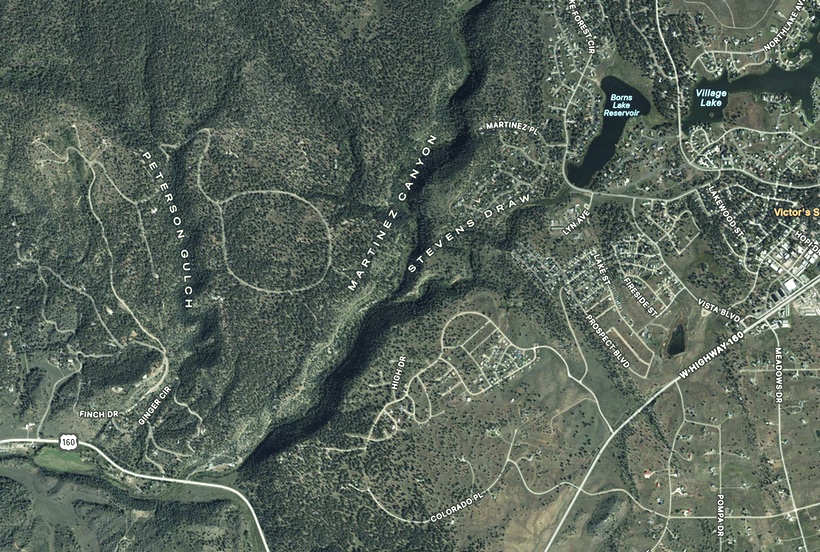
During his report to the Archuleta Board of County Commissioners on May 19, Sheriff Mike Le Roux displayed a map of a potential forest mitigation project and described Martinez Canyon as “this deep, dark vein of untreated fuel, that brings us all the way up into the Lakes area, here…”
Indeed, Martinez Canyon does appear as a deep, dark vein in certain satellite images. And although some of the residents living near the 3-mile-long canyon have begun treating their properties to reduce risk of fire exposure, the canyon itself remains deep, dark and full of flammable vegetation.
The Sheriff referred at the beginning of his presentation to the 2025 Oak Fire that was aggressively treated by firefighters and burned just 75 acres, but could have — give the wrong kind of wind conditions — spread into Martinez Canyon.
“And it’s nasty in there…” the Sheriff asserted.
The Sheriff explained that his office wants to apply for a forest mitigation grant from the Department of Homeland Security next month, with the help of County grant writer Stephen Slade.
“Based on the highest figures we’re looking at, and that’s in cooperation with the Forest Service and looking at fuels thinning… for budgetary purposes and with the total acreage that we’ve selected in this canyon for mitigation — about 300 acres — at the rate, it puts it at about a $750,000 project. Of which we’re looking to apply to FEMA for about $562,000.
“Which ultimately would need a 25% local match, from the County, of about $187,000. That’s what we’re looking for.
“Now, there may be opportunities to [help fund] that match… but we have to take responsibility for the 25% match…”
The Sheriff noted that the portion of the canyon under consideration runs through private property and BLM (Bureau of Land Management) land. BLM appears to be willing to contribute to the project, he said.
“We presented this plan last week at the PLPOA (Pagosa Lakes Property Owners Association) board meeting, and it seems like we have support from the board and from [general manager Allen Roth] and his team…”
He suggested that “everybody” is on board with the idea. I wasn’t clear who he meant by “everybody”.
“The project has to be ‘shovel ready’ by June 30, which means when we submit the [grant] application, ultimately FEMA is going to have to look at what property is involved, and if they are approving what we seek to achieve. It’s going to be a combination of mastication and fuel thinning…”
In other words, the removal of some trees, oak brush, and other understory vegetation.
Of course, when you remove large amounts of flammable fuels from 300 acres of forest… you need to find something to do with the biomass you removed. The idea is, after all, to remove it.
And do what with it?
When mitigating the mixed conifer forests in southwest Colorado, you are typically removing the smaller-diameter trees which are not useful for milling dimensional lumber. Typically, then, you are ending up with large amounts of wood chips. Or slash piles that you burn later.
Sheriff Le Roux:
“We will be treating some of the flatter areas [along the canyon rim] and use that type of equipment. And depending on how steep we are able to go, removing some of the trees, and opening up the canopy. Ultimately, what we’re looking to do, along this canyon rim — and we’re not going to go to the bottom of the canyon; accessing it is not impossible but I think the best bang for the buck is going to be staying at the top and going as far over the edge as we can. And that will give us, on both sides, a thin line or a target area for aerial equipment, if and when we have a fire in that canyon.”
For $750,000.
We will be considering further, the idea of a “thin line” of mitigated forest, in Part Three, tomorrow.
Commissioner John Ransom sounded relieved to hear the projected cost.
“When we talked about a lot bigger number last week…”
For some reason, this comment generated laughter among certain folks in the room.
That “bigger number” was reportedly in the $8 million range and involved helicopter logging.
Sheriff Le Roux:
“We absolutely did. So we met with with Amanda and representatives from the Forest Service, BLM and the Colorado Forest Service, and we did another walk through the guts of the canyon on Friday afternoon, and revised our scope. Initially we thought we’d get right down to the bottom of the canyon. But from a cost point of view, this [revised approach] provides the best bang for the buck.”
I was in the audience at this May 19 presentation, sitting next to local businessman JR Ford.
Mr. Ford’s company, Renewable Forest Energy LLC, was founded in 2005 with a goal of mitigating forest fuels on public and private land and using the resulting biomass to generate electricity in a ‘gasification’ plant. The project was stymied, however, by Tri-State Generation and Transmission, the cooperative that supplied La Plata Electric Association (LPEA) with most of its electricity.
Mr. Ford and his investors then created Forest Health Timber Products LLC in 2012, which has continued to stockpile wood chips and also began producing rough-cut lumber at a 40-acre site near the Archuleta County airport. As I understand it, the latest business plan involves the production of compressed wood ‘bricks’ that can be burned for heat.
I had a chance to sit down with Mr. Ford yesterday and chat about the philosophy currently guiding forest mitigation.
Over the past decade or so, Forest Health has treated about 2,900 acres of private land and about 2,000 acres of Forest Service land in Archuleta County. According to my pocket calculator, that comes to maybe 350 acres per year.
The $750,000 project proposed by Sheriff Le Roux includes about 300 acres.
To put those numbers into perspective, Archuleta County consists of 873,000 acres. Nearly all of it, flammable.