
My friend sent me a link on Sunday, to a curious bit of online news.
But also, believable news.
Apparently, Democrats are more likely to share identical beliefs about various controversial issues with other Democrats, than Republicans typically share with their fellow Republicans.
I believe this graphic, created by scientists, can prove it.

“Blue” being Democrats, of course, and “Red” being Republicans.
This graph appeared in a paper published by the British Journal of Social Psychology, titled “Attitude networks as intergroup realities: Using network-modelling to research attitude-identity relationships in polarized political contexts” and written by Adrian Lüders (University of Hohenheim, Stuttgart, Germany), Dino Carpentras (University of Limerick, Limerick, Ireland), and Michael Quayle (University of KwaZulu-Natal, Durban, South Africa).
In order to believe the graph above, a couple of things are in order. First, we need to believe that the people who generated the graph know what the hell they are talking about.
Secondly, we need to believe that the people who generated the graph are not trying to make us look like ignorant fools.
Call me an ignorant fool if you want. I still believe this graph offers conclusive proof that attitude networks produce intergroup realities.
To support my belief, I offer up the observation that this paper was published in a British journal by non-American researchers who were researching American attitudes about “hot button” political issues. If the paper had been written by American researchers, we would have to assume that some rich billionaire, or corporation, or political think tank had funded the research, and we’d be ignorant fools to believe it.
Here’s the explanation for the graphic:
According to the present findings, Democrats (more than Republicans) tightly center their belief-system around a set of positions at the extremes of these particular items, implying that people who deviate from these positions are likely to be considered as outgroup members (extremity should thereby be understood as a function of both, the formulation of the item and the response). It is possible that holding extreme (and thus unnegotiable) attitudes on important social-political issues has become increasingly identity defining for Democrats, not least in response to Donald Trump’s controversial presidency.
The pattern does not imply that Republicans are more tolerant than Democrats, nor that Republicans could deal better with attitudinal uncertainty. It does imply, however, that – at this particular moment in time – Democrats and Republicans are constructing and managing their partisan identities differently in relation to the topics reflected in these questionnaire items…
What this implies, I believe, is that Republicans are likely to disagree with other Republicans about specific divisive issues — gay marriage, abortion, gun control, new ballrooms, etc. — while Democrats pretty much agree with other Democrats on every single issue across the board, period.
This graphic proves it.
Republicans are kind of all over the map, while Democrats happily fit inside a tiny little Democrat box.
The folks “in between” are of course the independent voters who probably don’t know what to believe about controversial issues. Or about anything, for that matter.
Or else, they don’t want to tell us.
Although I believe that this graphic truly represents America, I’m one of those independent voters who don’t know who to believe… about abortion or gun control or Jeffrey Epstein.
I’m not the first person to struggle with my beliefs, of course.
There’s a story in the Bible about the apostle Thomas (no last name mentioned in the story) who heard that, although Jesus had died on the cross and been buried in a tomb, He had nevertheless appeared to Mary Magdalene and also to some of the disciples.
Thomas had his doubts.
Now Thomas, called the Twin, one of the twelve, was not with them when Jesus came. The other disciples therefore said to him, “We have seen the Lord.”
So he said to them, “Unless I see in His hands the print of the nails, and put my finger into the print of the nails, and put my hand into His side, I will not believe.”
Which is pretty gruesome, in my opinion. Like, sticking your finger in someone’s wound?
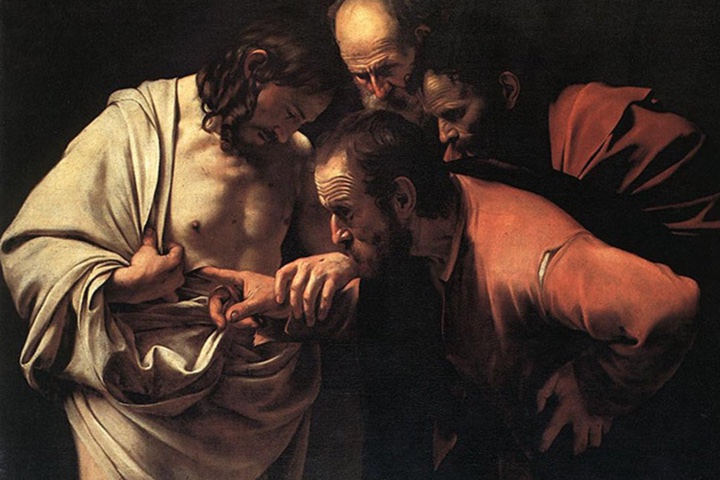
This lack of belief was not because Thomas was a Democrat, or a Republican. Probably, he was an Independent voter, to judge by his need to poke his finger where it didn’t belong.
And after eight days His disciples were again inside, and Thomas with them. Jesus came, the doors being shut, and stood in the midst, and said, “Peace to you!” Then He said to Thomas, “Reach your finger here, and look at My hands; and reach your hand here, and put it into My side. Do not be unbelieving, but believing.”
And Thomas answered and said to Him, “My Lord and my God!”
Jesus said to him, “Thomas, because you have seen Me, you have believed. Blessed are those who have not seen and yet have believed.”
I can identify with Thomas, and I bet some of my readers can, as well. We appreciate seeing the proof — such as a printed graphic from a British scientific journal, with appropriate color coding. And we don’t even need to stick our finger in the wound.
Once we believe, we can easily keep on believing.
Underrated writer Louis Cannon grew up in the vast American West, although his ex-wife, given the slightest opportunity, will deny that he ever grew up at all. You can read more stories on his Substack account.