
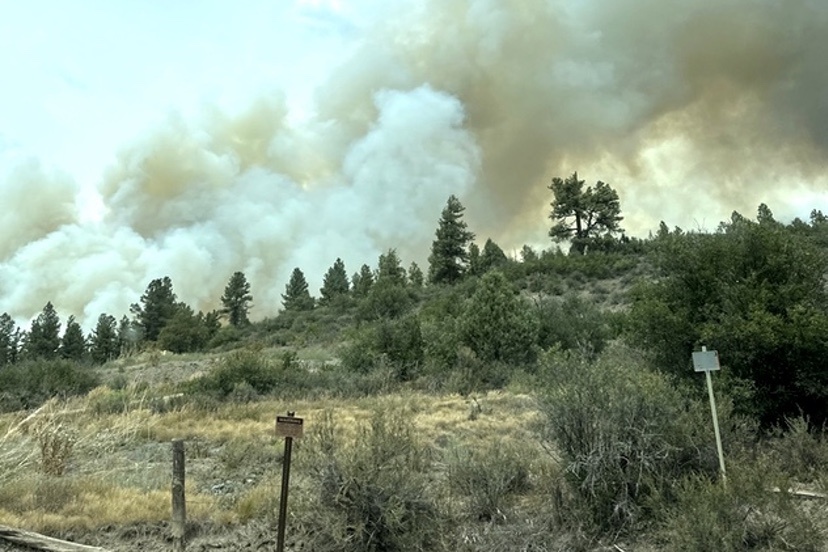
Photo: The August 2025 Oak Fire at the east end of Aspen Springs threatened to spread into the Pagosa Lakes area, but was contained to 75 acres.
As forest managers and firefighting agencies will gladly point out, the cost of mitigating a possible future wildfire is somewhat less than attempting to contain a wildfire.
Here’s Sheriff Mike Le Roux, speaking to the Archuleta Board of County Commissioners on May 19 about his plan to spend perhaps $750,000 removing some of the trees and undergrowth along the edges of Martinez Canyon. He refers to the August 2025 Oak Fire in Aspen Springs, which burned about 75 acres.
“The Oak Fire, broadly speaking, was about $2 million in suppression. And that lasted three days. $660,000 was spent on the first Sunday afternoon, on what was flying around in the sky.”

“So when we look at a $750,000 project that will cover almost three miles [along the rim of Martinez Canyon] it’s not bad, in the scheme of things, right? So collectively, since the Plumtaw Fire, we have spent millions of dollars on suppression, on federal land and on private land, far exceeding what it would take to mitigate the high risk areas.”
This proposed Martinez Canyon mitigation project would be funded largely through a federal grant — if such a grant can be obtained — with about 25% matched with local funding. So maybe $187,000 in Archuleta County funds. The Sheriff expressed some confidence that additional grants might be obtained to help cover the County match to a potential Homeland Security grant.
As mentioned yesterday in Part Two, the Sheriff had previously been talking to the County commissioners about an $8 million mitigation project that would involve expensive helicopter logging in the bottom of Martinez Canyon. This scaled-back $750,000 project would remove some trees and undergrowth only along the edges of the canyon using ground-based equipment.
A “thin line” of mitigated forest, in other words.
We also noted yesterday that, over the past decade or so, the local forest-mitigation company Forest Health Timber Products LLC has mitigated about 2,900 acres of private land and about 2,000 acres of U.S. Forest Service land in Archuleta County. According to my pocket calculator, that comes to about 500 acres per year.
The $750,000 project proposed by Sheriff Le Roux would involve about 300 acres.
To put those numbers into perspective, Archuleta County consists of 873,000 acres of mostly flammable landscape. But also, treatable landscape.
Forest Health Timber Products was recently awarded a contract to treat the landscape along the Upper Blanco Basin road and on a couple of ranches in the Upper Blanco. The project involves relatively severe treatment of the vegetation within 50 feet of the road, and a somewhat less severe treatment up to 300 feet from the road. Right next to the road, only occasional larger trees will remain; within the next 250 feet, more trees will be left and undergrowth will be minimized, according to certain specifications.
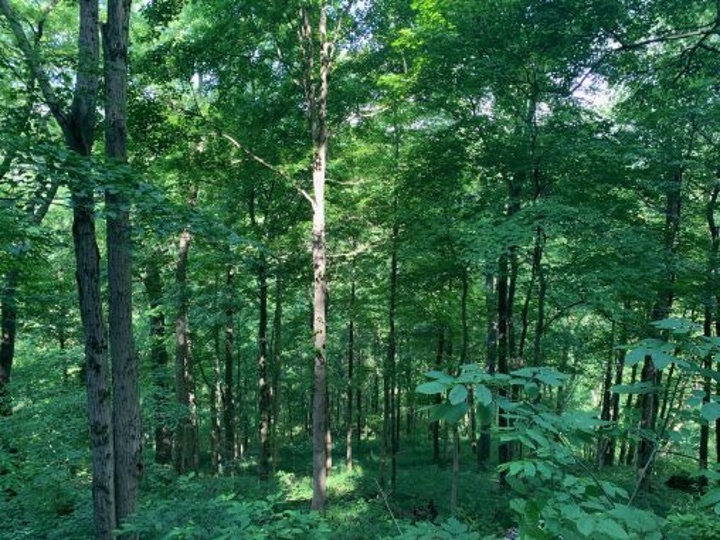
Here’s an example of an overgrown forest, such as we often see in Archuleta County, thanks in part to 100 years of preventing forest fires:
Here’s is what the mixed conifer forests in southwestern Colorado looked like, historically… and what forest managers now call a “healthy forest”:
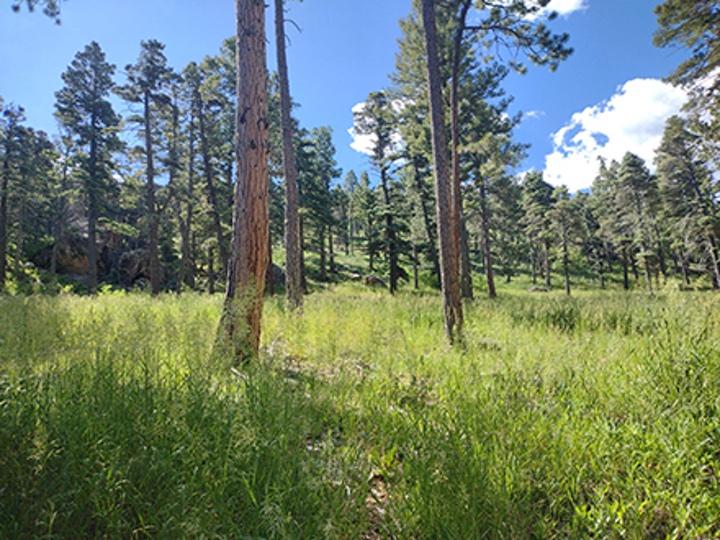
The mitigation treatments specified by federal and state grants aim to create forest areas that look more like the second example.
Obviously, neither the Archuleta County government nor the state of Colorado nor the federal government can easily treat the 873,000 acres within Archuleta County. The best we can do is maybe 1,000 acres a year? Maybe 1,500 acres?
Which acres?
Here’s Forest Health Timber Products founder JR Ford, sharing a bit of forest mitigation history.
“Out of all [the forested acres] in Archuleta County… when we very first started thinking about all this, back in 2007, we paid a consultant to come in and we asked them two things. We asked them how many acres in the county — public and private — that could actually be treated, out of the 568,000 forested acres, there were about 70,000 acres that this consultant thought could be treated…”
In 2007, Mr. Ford’s company was known as Renewable Forest Energy LLC and was hoping to use the removed biomass to generate electricity. For reasons previously explained, that didn’t pan out, but Forest Health Timber Products continued to bid on forest mitigation projects on public and private land and has treated close to 5,000 acres since about 2012. Other companies have also done treatments in Archuleta County.
“The 70,000 treatable acres were mostly in the WUI (Wildland Urban Interface), below 9,000 feet, mostly Ponderosa pine and white fir, less than 35% slope. All the [Roadless Wilderness] was taken out. When you pull everything out, there’s really only about 15% of the acreage that can actually be treated. So that’s what really got us started. If there were really only about 70,000 acres than could be treated, then we would design a company that could treat those 70,000 acres over a 40-year period…
“And the other thing we asked them, was to look all around the world and tell us what technologies are coming down the pike that could use that biomass waste. Because, at the time, there were some burner plants but they weren’t going to pass EPA. So they looked at all kinds of technologies and the one they focused on was ‘gasification’ and we were going to use that technology to generate electricity and make biochar…
“Which, if we could have pulled it off, would have been perfect for the community. Everybody says we’re a tourist community but I just don’t buy that. We’re more a second-home market than we are a tourist market.
“The community doesn’t make money with tourism. In my opinion, it’s a net negative.
“So really, we’ve got the forest…”