
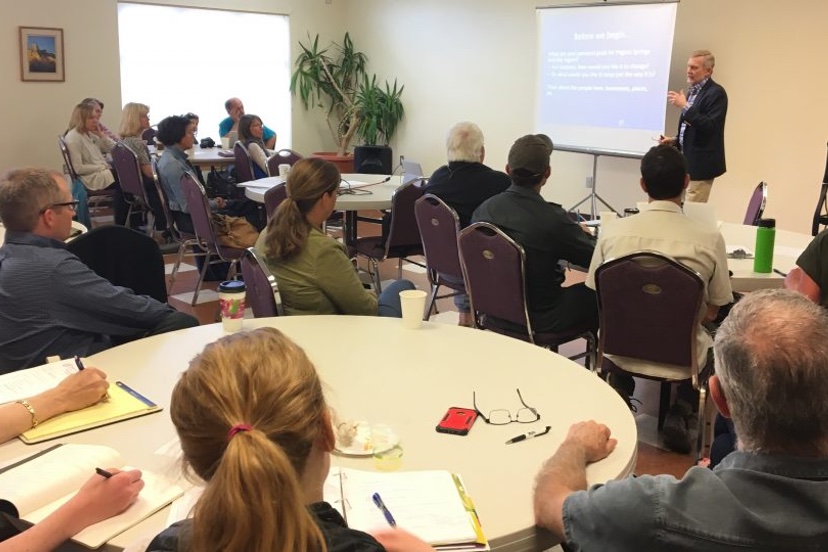
Photo: Smart Growth America’s John Robert Smith addresses workshop participants in Pagosa Springs, March 2022.
My friend Mark Weiler often shared a certain perspective on achieving success.
“There’s no romance without finance.”
But finance by itself, without any possibility for romance, seems to me like an empty proposition.
In modern America, very little progress takes place without access to money, and any kind of solution to a serious housing crisis will invariably involve clever financial arrangements. But money won’t help matters, if governments have made housing illegal.
After spending about 90 minutes last week kicking around possible ways to extract more money from the state government and from local taxpayers, the Housing Action Plan (HAP) Strategic Work Group switched gears slightly and began discussing ADUs.
Accessory Dwelling Units… those separate living units attached to, or tucked inside, a single family home, or sharing the property as a small detached unit… are having a rock star moment in many communities.
Scores of cities and counties — and at least nine states — have changed or adopted laws that make it easier and more attractive for homeowners to build ADUs.
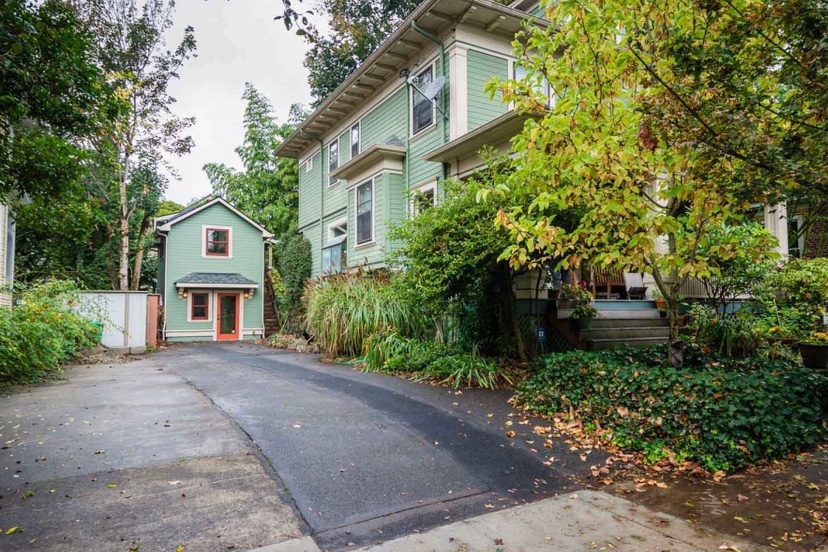
About 15 years ago, I moved to Salida, Colorado and spent some time getting to know the real estate market there. My romantic partner at the time had come to the conclusion that Salida offered a more promising future than Pagosa, in terms of property investments. We soon discovered that many of the homes in the older part of town had been built with an additional bedroom attached to the house, with a separate entrance. These additional bedrooms were typically rented out to workers on the Denver & Rio Grande Railroad, as their ‘home away from home’ whenever the train made an overnight stop in town.
In this case, a simple bedroom with an exterior door was sufficient for temporary accommodations. A kitchen was unnecessary. The town had plenty of cafés and restaurants to serve the railroad workers’ nutritional needs.
Pagosa Springs once had a railroad station near the intersection of Piedra and South Seventh and Durango streets. The railroad carried mainly lumber products between 1900 and 1916. The line remained in occasional use until 1935.
During that period of Pagosa’s history, property owners had considerable freedom regarding the use of their real estate property. If someone owned a typical 1/6 are parcel in town, they were free to build, on that property, a single-family house, a boarding house, a barber shop, a livery stable, a school, a church, a saloon, a lumber yard, a hardware store…
…the options were, in other words, unrestricted.
Nearly all of the parcels in the tiny downtown core got commercial buildings, but outside of the commercial core, people built mostly single-family homes. Occasionally, those homes included an accessory dwelling unit (ADU) in the back yard, that could be rented out for additional income. In other cases, a shop or small commercial space was located on the property.
I can’t say that neighbors always got along, when property owners had this much freedom and control. Disputes have always been a facet of human existence.
But by the time I arrived in Pagosa Springs in 1993, the Town and County governments had long since begun restricting how properties could be developed, and how they could not be developed. Gradually, the rules and restriction became more and more onerous.
Government leaders had come to the conclusion that they knew best, how Pagosa Springs should grow. Or more accurately, these leaders had concluded that their Planning Departments knew best how the community should, and should not, unfold.
This approach — government control of land use, rather than property owner control of land use — worked for a while. But we are now experiencing a longer-term result. A serious housing crisis. Not just in Pagosa Springs, but all over Colorado.
Full-time employees and retirees alike, living in RVs and pickup trucks and tents.
Recognizing this crisis, the Colorado legislature passed SB24-174, requiring all jurisdictions with populations of more than 5,000 to develop and submit for approval, a Housing Action Plan (HAP), by December 2028.
Unfortunately, these HAPs will, in many cases, be written at the direction of the same Planning Departments that got us into this mess in the first place.
Disclosure: I’ve been a regular volunteer participant in the HAP Work Group, but this editorial reflects only my own opinions and not necessarily the opinions of the Work Group as a whole.
Back in 2022, the Pagosa Springs Planning Department was searching for new ideas for solving the housing problem they had helped to create, and they were awarded a grant to have a small group of consultants from a non-profit called Smart Growth America come to town and present possible solutions. The outcome of that visit is published on the Smart Growth America website.
After a careful study of our community, the Smart Growth consultants made 10 specific recommendations, including:
1. Invest in the redevelopment of the Adobe site as a catalyst that recognizes downtown as the heart of the community for both locals and tourist. (This site was later privately developed into a sculpture park.)
2. Create a walkable mixed-use development on the Springs Partners site including amenities for both residents and visitors. (The Town government entered into a scheme to provide the Springs Partners with $79 million in tax rebates to develop this project, but the town voters rejected the idea.)
3. Invest in techniques to encourage placemaking and streetscaping in downtown – including taking advantage of the Highway 160 redevelopment project – to establish a more cohesive sense of place. (It’s not yet clear if this will happen.)
4. Develop a sense of place in uptown. (Does anyone know what this means? I sure don’t.)
5. Market the town amenities and lifestyle to bring new residents, economic opportunity, and visitors to town. (The lack of available housing in the community has discouraged new residents and businesses from locating here. But over 1,000 local homes have been converted into vacation rentals for tourists, so at least they are being taken care of.)
6. Invest in broadband Internet access to attract both new residents and new types of businesses. (The Town and County have made significant investments in broadband. This has not, unfortunately, produced any new housing, nor has it attracted new types of businesses. But Netflix is less likely to experience interruptions.)
7. Look for opportunities to increase affordable housing within and connected to downtown – including for Millennials and an aging population – along with the complementary services required to meet daily needs…
Finally… we get to the heart of the problem.
Affordable housing.
Bill Hudson began sharing his opinions in the Pagosa Daily Post in 2004 and can't seem to break the habit. He claims that, in Pagosa Springs, opinions are like pickup trucks: everybody has one.