
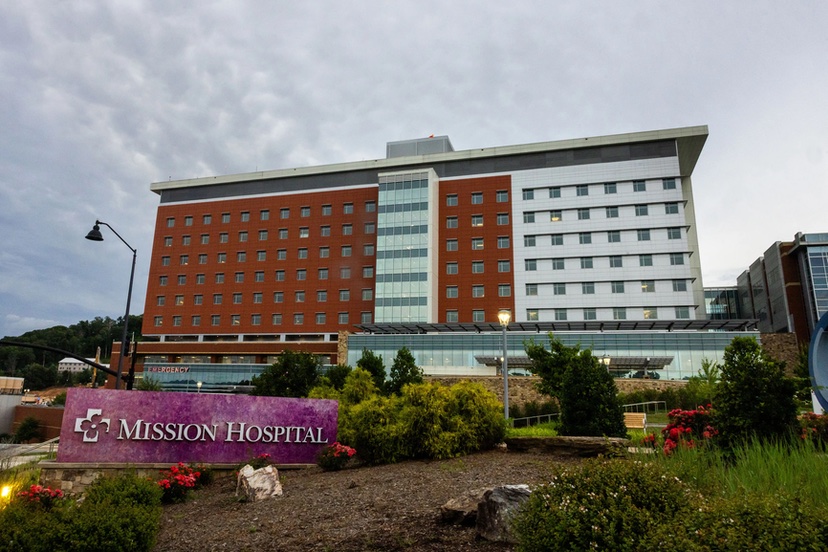
Photo: Data shows a strong link between hospital mergers and higher prices for procedures. By 2016, Mission Hospital had secured a monopoly in Buncombe County and successfully lobbied the state to drop limits on its profits. (Katie Linsky Shaw for KFF Health News)
This story by Peter Whoriskey appeared on KFF Health News on August 10, 2026. We are sharing it in two parts.
Few places in the United States better exemplify how hospital mergers reshape healthcare than Asheville, North Carolina.
In 1998, the state authorized a deal that joined the city’s two acute-care hospitals, St. Joseph’s Hospital and Memorial Mission Medical Center, to create Mission Hospital. Ever since, its effects have been studied and its prices fiercely contested.
Marcelle Crago, a nurse and lactation consultant, is one of many patients who have accused Mission Health, which operates Mission Hospital, of gouging consumers. Last year, she tweaked her knee while cross-country skiing.
“My knee went ‘pop, pop, pop,’” she recalled. She had torn her meniscus, the rubbery cartilage around the knee that acts as a shock absorber. A doctor advised her to have a portion of it removed.
Two days before the surgery, Mission Health told her the total charge would be over $9,000, according to paperwork on her case filed with the state’s Consumer Protection Division.
“I was shocked at the number,” she said.
Crago’s insurance policy from UnitedHealth Group had a high deductible, so she would have had to pay most of the cost. She decided to postpone the surgery and shop around, eventually arranging to have it done at an outpatient center not affiliated with Mission. There, the bill came to less than a third of the price Mission Health charged, according to paperwork she kept.
“The way Mission Health handled the whole thing felt predatory,” Crago recalled, noting that when she balked at the $9,000 figure, the hospital offered a 20% discount if she paid up-front. “It makes you wonder how much they are playing with prices.”
In responding to Crago’s complaint with the state, an attorney for Mission and HCA Healthcare, which owns the hospital, wrote that hospital charges “represent the cost for supporting the entire episode of care” and must cover the hospital’s investments in advanced technology, training, staff, and other critical needs.
“Patients are certainly entitled to ‘shop around’ for surgical procedures,” wrote the attorney, Phillip Jackson.
It is not just patients who bear the burden of rising hospital prices. Over time, anyone who pays for health insurance pays a price for hospital monopolies, as insurers boost premiums as medical costs rise. The full cost for an employer to pay for an average family health insurance plan rose to more than $27,000 in 2025, up from $21,000 just six years ago, according to figures from KFF.
Around Asheville, employers and employees complain that their insurance premiums are higher because Mission’s prices are so high.
As the chef and co-founder of Cúrate restaurant in Asheville, a business with about 100 employees, Katie Button provides employee health coverage and believes she has been paying for Mission Hospital’s excessive prices, according to a pending class-action lawsuit she filed in 2021 with five residents who say the monopoly has harmed them.
Any insurance plan in Asheville must include Mission Hospital, she said, because it is the only one around. This makes the burden of its prices unavoidable.
“We are where we are because we don’t have a choice of hospitals,” Button said. “There is no other option.”
The steady creep of healthcare costs is top of mind not just in Asheville but for most U.S. voters, according to an April KFF poll. Nearly two-thirds of U.S. adults were worried about being able to afford healthcare, the poll found.
Yet while federal law allows regulators to step in and block mergers deemed to create monopolies, the FTC intervened in only about 1% of such cases from 2002 to 2020 to stop a hospital merger, according to a Yale University study. The FTC has since announced challenges to five other hospital mergers.
Birth of a Monopoly
When Mission Health was formed by a merger in 1998, state officials recognized that Asheville’s new dominant hospital system would have the power to raise prices and required Mission to sign an agreement to limit spending and profit margins.
Even with these restrictions, the hospital substantially hiked prices, according to economic research cited by the FTC. But Mission’s prices were about to go up even more. In 2015, Mission Health lobbied the state legislature to drop the state restrictions, abandoning the profit limits.
“After 20 years of the hospital behaving itself, the state decided to terminate its oversight,” said Mark Hall, a professor emeritus at Wake Forest University who has written an account of the hospital’s merger history. Then, three years later, HCA, the largest hospital corporation in the country, bought Mission Health. (The Dogwood Health Trust, a nonprofit established as part of HCA’s purchase of Mission Health, helps fund KFF Health News’ coverage.)
“This put a prepackaged monopoly into the hands of the world’s largest for-profit hospital corporation,” Hall said.
Across a range of services, Mission Hospital charges more than other North Carolina hospitals, according to figures from Serif Health.
Consider the prices that Mission negotiated with UnitedHealthcare compared with those the insurer pays at Catawba Valley Medical Center. For a breast biopsy, UnitedHealth pays $7,500 at Mission and $1,700 at Catawba, according to Serif. For a hernia repair, it pays $17,700 at Mission and $9,600 at Catawba.
“The prices hospitals charge are one of the leading drivers of rising healthcare costs,” according to a UnitedHealthcare statement sent by spokesperson Cole Manbeck.
Mission spokesperson Katie Czerwinski, in a statement, said that it can be misleading to compare one hospital with another.
Mission Hospital is almost three times as large as Catawba Valley Health and is a Level 1 trauma center serving a different population, Czerwinski said. She also said that pulling individual rates for comparison paints an incomplete picture.
But other figures indicate that prices at Mission Hospital are relatively high, even when viewed collectively.
A team at the think tank Rand, led by Christopher Whaley, now a Brown University health economist, uses commercial insurance records to compare average hospital prices across the U.S. relative to those paid by Medicare. According to the Rand figures, Mission Hospital in 2024 charged prices that were 334% of prices set by Medicare. Catawba Valley Medical Center charged 237%. The state benchmark for prices is 280% of Medicare, Rand figures showed.
“The prices we pay for healthcare vary tremendously and are uncorrelated to the value we receive,” according to the Rand website.
For many in Asheville, the primary complaints about Mission Hospital focus on the quality of patient care. This is consistent with academic studies showing that the quality of care declines when hospitals have little competition.
Amid rising complaints about hospital services, North Carolina state Sen. Julie Mayfield, a Democrat, helped launch a nonprofit organization two years ago called Reclaim Healthcare WNC to hold Mission “accountable for its harmful practices.”
“Within a year of the HCA sale, I started hearing stories from physicians and other friends about all the terrible things that were happening there,” Mayfield said, most of them caused by severe staff cuts and physicians leaving.
Three times since 2024, state health inspectors working on behalf of CMS have issued “immediate jeopardy” findings to Mission Hospital, indicating problems so severe that they posed an imminent risk of serious injury or death to patients.
In the most recent CMS report, an 88-year-old woman recovering from a fall and hip surgery at Mission Hospital died after going a night without receiving a blood transfusion.
Czerwinski, the Mission Hospital spokesperson, said a proposed plan of correction “allows Mission to address the findings from the survey and complete a comprehensive review of operations.”
As more hospitals across the United States plan to merge, Mayfield said, the experience in Asheville represents a cautionary tale.
“Unregulated monopolies have never gone well for the public.”
KFF Health News is a national newsroom that produces in-depth journalism about health issues and is one of the core operating programs at KFF—an independent source of health policy research, polling, and journalism. Learn more about KFF.
This article first appeared on KFF Health News and is republished here under a Creative Commons Attribution-NonCommercial-NoDerivatives 4.0 International License.
The Pagosa Daily Post welcomes submissions, photos, letters and videos from people who love, and care about, Pagosa Springs, Colorado. More information available at 970-903-2673 or pagosadailypost@gmail.com