
In 2017, the Archuleta Board of County Commissioners passed a resolution that attempted to address ongoing complaints about road maintenance coming mainly from the subdivisions within the Pagosa Lakes Property Owners Association (PLPOA).
That resolution directed County Road & Bridge to provide minimal maintenance on Secondary Roads — instead of zero maintenance — for subdivisions that have not yet created metro districts to maintain their own neighborhood roads.
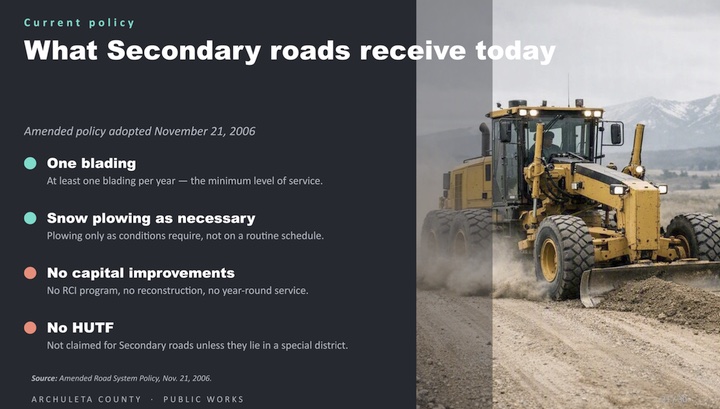
Since 2017, if you live on a Secondary Road in Archuleta County, your road may have received “one blading” per summer, “snow plowing as necessary”, “no capital improvements” and “No HUTF” funding. But this ongoing “minimal” maintenance of Secondary Roads has confused subdivision residents, causing some of them to believe their roads qualify for the same level of maintenance as Primary Roads.
And in fact, it would appear that Road & Bridge has indeed made capital improvements to certain Secondary Roads, in violation of the 2017 resolution. Secondary Roads that have recently received capital improvements include Navajo Trail Drive, Lake Forest Blvd, Cloman Blvd, Vista Blvd, Carlee Place, Saturn Drive, and Pines Drive… among others.
Obviously, it’s not only local residents and taxpayers who have been confused about County road policies. The BOCC and Road & Bridge Department appear to be equally confused.
As mentioned many times previously here in the Daily Post, a number of local subdivisions have created metro districts to tax their residents for road maintenance, and as a result, those subdivisions have some of the best-maintained roads in Archuleta County. The County distributes a potion of Colorado’s Highway User Tax Fund (HUTF) disbursements to those subdivisions, based on the road mileage the subdivisions maintain.
But certain subdivisions have not yet created metro districts — including all of the 27 subdivisions with the PLPOA.
At a Board of County Commissioners work session on August 4, County Public Works Director Mike Torres gave a presentation that clarified the original definition of two road types in the county. Designated Primary Roads supposedly receive full maintenance efforts by the County, while Secondary Roads supposedly receive no County maintenance. Most of the roads in the unincorporated county are designated as Secondary.
But County Road & Bridge has been providing some level of maintenance to Secondary Roads since 1998, in obvious contradiction to the official definition. As a result, Road & Bridge funding and efforts have been diverted from Primary Roads, leaving all of the county roads in “less than excellent” condition.
In some cases, “much less than excellent” condition.
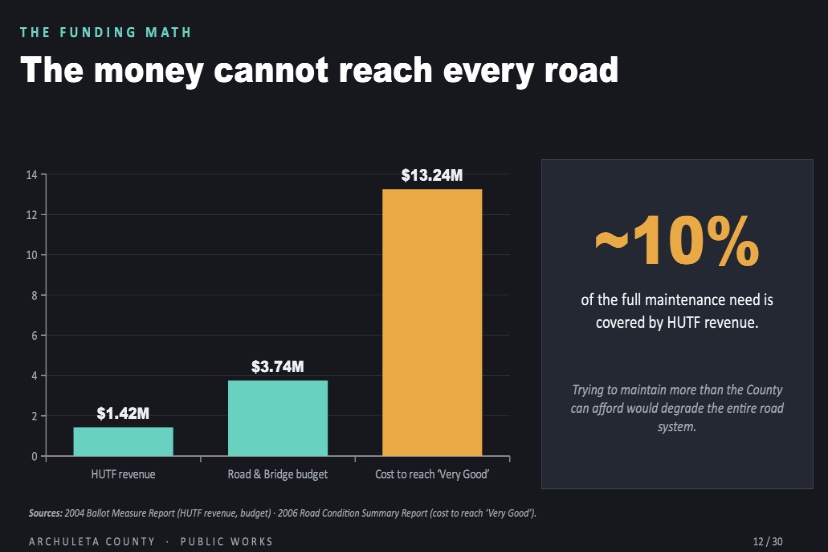
Here’s one of the PowerPoint slides from Mr. Torres’ presentation, illustrating that Colorado state HUTF funding provides only about 10% of the estimated amount the Road & Bridge Department would need ($13.24 million annually) to maintain all Primary and Secondary Roads in “very good” condition.
But as mentioned, Secondary Roads are — by the original definition — supposed to receive zero maintenance by County Road & Bridge.
Meaning that Secondary Roads ought to be maintained by metro districts.
Sadly, this same discussion has been going on at the BOCC since 1998, without any final resolution. County commissioners typically serve between 4 and 8 years, which means they spend 4 to 8 years listening to complaints regarding subdivision roads that were meant to be maintained by metro districts, but those metro districts have never been formed.
Will our current commissioners act any differently from those in the past, and require that PLPOA subdivisions form their own metro district?
They would presumably do this by simply ceasing — completely — to maintain Secondary Roads, and making their expectations clear to the PLPOA subdivision residents.
That specific action was not actually suggested anywhere in Mr. Torres’ 40 page presentation. But it was certainly strongly hinted at.
You can download the 40-page presentation here. (Large file, may take a while to download.)
I live within the town limits, so my streets are maintained (more or less) by the Town Streets Department. That department is funded independently from County Road & Bridge. Which is to say, the outcome of the dispute over PLPOA road maintenance does not directly affect my neighborhood streets.
Nevertheless, I’ve advocated for a County policy requiring PLPOA subdivisions to create metro districts and maintain their own local roads in whatever condition the residents are willing to pay for. I’ve been making that argument for at least 15 years here in the Daily Post. Has anyone taken my suggestions seriously? Not so far.
Will they take Mr. Torres’ arguments seriously? That remains to be seen.
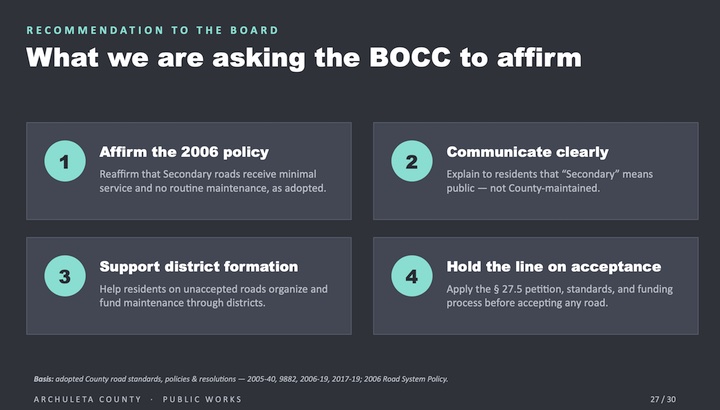
We might presume that if the BOCC affirms these recommendations from the Public Works Department…
… affirm that, per the 2006 resolution, Secondary Roads will receive minimal (or zero) maintenance from the County, and…
… explain to the taxpayers why this policy is necessary, and…
… support and encourage PLPOA neighborhoods to form metro districts similar to those formed by other county subdivisions, and…
… hold the line on accepting roads for maintenance…
… well, then, we might someday have well-maintained roads everywhere in the county.
As Mr. Torres’ final informational slide argued on August 4:
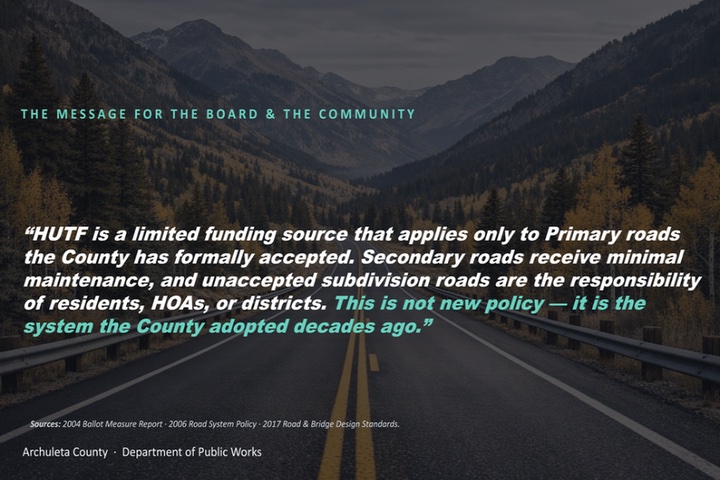
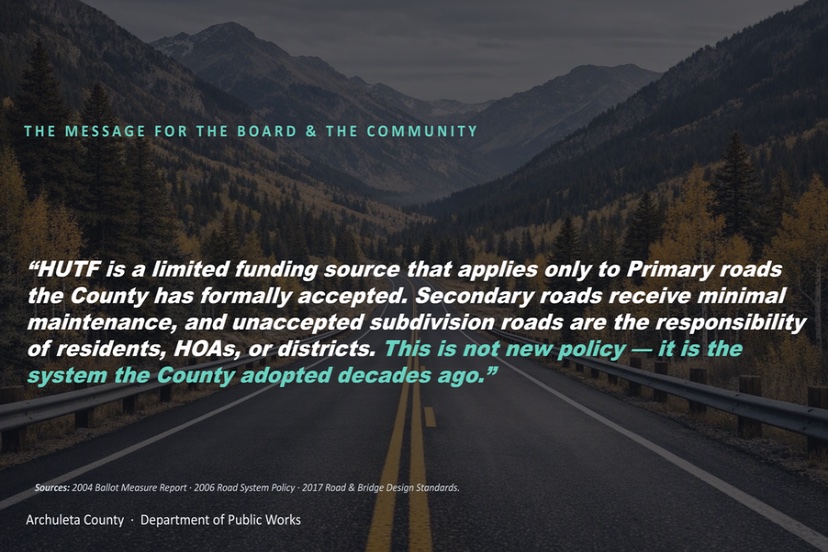
“HUTF is a limited funding source that applies only to Primary roads the County has formally accepted. Secondary roads receive minimal maintenance, and unaccepted subdivision roads are the responsibility of residents, HOAs, or districts.
“This is not new policy — it is the system the County adopted decades ago.”
I assume that any County commissioner who endorses this decades-old policy will have a hard time getting re-elected, considering the number of voters within the PLPOA.
At the current moment, Commissioner Veronica Medina has lost her bid for re-election based on other concerns, and will be replaced in January.
Commissioner Warren Brown is serving his second term and is now term limited.
Only Commissioner John Ranson has to worry about getting re-elected — if that’s even something he’s considering.
A few things are obvious here.
For 22 years, past commissioners have not had the cojones to fully follow a reasonable road policy, and as a result, have allowed Archuleta County’s road system to deteriorate.
There’s a way out of this mess, but the way out will be financially painful for a majority of county voters.
So we might still be talking about this same problem 22 years from now.
Bill Hudson began sharing his opinions in the Pagosa Daily Post in 2004 and can't seem to break the habit. He claims that, in Pagosa Springs, opinions are like pickup trucks: everybody has one.