
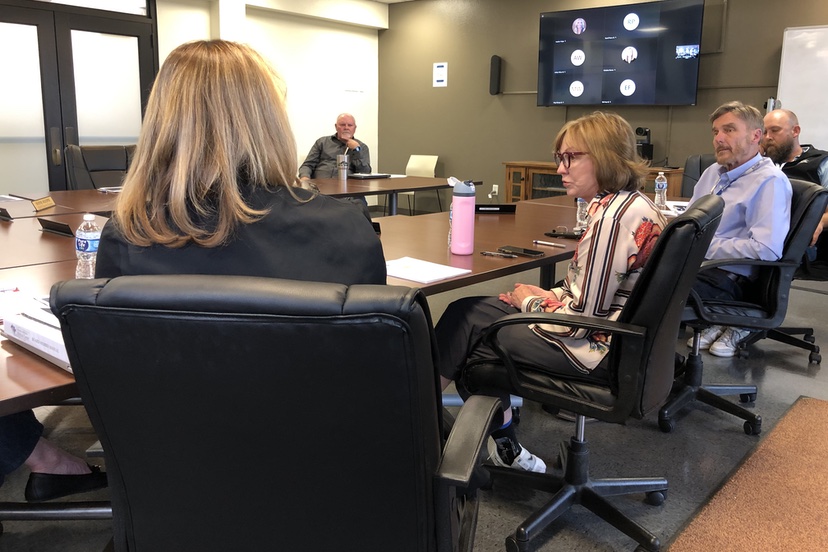
Meeting of the Upper San Juan Health Service District board of directors and staff, October 8, 2026.
Today, Governor Jared Polis and the Colorado Department of Health Care Policy & Financing announced that Colorado is directing $169,587,181 in Rural Health Transformation Program (RHTP) grants to rural healthcare providers across Colorado. This significant investment… will help protect access to care and support better health outcomes in Colorado’s rural and frontier communities…
— from a press release from the Colorado Department of Health Care Policy & Financing, September 28, 2026.
We’re listening to the conversation, on October 8, about the proposed 2027 budget for the Upper San Juan Health Service District (USJHSD) — the tax-supported government entity that operates the Pagosa Springs Medical Center (PSMC) and the EMS ambulance service.
Board member Matt Mees gave a quick summary of the proposed schedule for remodeling the old San Juan Rangers building near the Healing Water Resort and adjacent to Dr. Mary Fisher Park downtown. USJHSD obtained the building to create a ‘satellite’ EMS facility at the east end of Pagosa Springs, to cut down response times to that part of the community. The facility might be ready for service this coming summer if all goes as planned. At a cost of $1.3 million.
We then heard from Chief Administrative Officer Ann Bruzzese additional facility remodeling and a proposed new monument sign to help folks (especially, perhaps, tourists unfamiliar with Pagosa) find the Medical Center.
Again, from Mr. Mees:
“Next thing is the Women’s Health remodel of existing space. You all were notified in late September that there’s $400,000 for remodeling an exist space…”
This $400,000 comes from the federal Rural Health Transformation Program (RHTP). The renovation of an office space — currently occupied for other purposes — would have to be completed by September 30, 2027. But the cost of project has not been analyzed or priced out, and the staff currently occupying the planned space would need to be relocated.
Board member Mark Floyd:
“What I want to make clear, in the whole concept of this [RHTP funding], is that we are going to be doing ‘new things’ to make ourselves look better, and to make our community better in terms of health care. We will be doing things, and we will be spending money, and we will be reimbursed for that.
“But we will not be getting new [sustaining] revenue. We will be paid back for investments that we make, that we believe will be valuable to us in the long run… broader services, for example, in women’s health; better contact with patients who have transportation difficulties…
“Over the first years, it’s possible that we might get checks for over $4 million. But that will not be ‘free’ money. That will be for money that we’ve already spent to do these programs.”
As noted in Part One, the dramatic reductions made to Medicaid and other programs in 2025 by the ‘One Big Beautiful Bill’ — H.R. 1 — hit health care systems in rural communities especially hard, no matter whether those communities have agriculture-based or tourism-based economies. People working in those types of rural economies typically earn less than employees working in vibrant urban economies, and are less likely to have employer-supported health insurance plans. Thus, rural families are generally more dependent on Medicaid — meaning that the hospitals and clinics that serve them are also more dependent on Medicaid.
The Medicaid cuts are expected to create a downward financial spiral. Families without health care coverage often avoid check-ups and treatment until their health issues require an emergency room visit — and then cannot pay the higher cost of that ER visit. The hospital loses out on the Medicare reimbursements, but must provide ER care regardless of a patient’s ability to pay… and then cannot collect from the patient… so it becomes a growing drain on the system’s financial health.
After states were notified about the availability of RHTP funding in late 2025, they had about 30 days to submit revised budgets to Centers for Medicare & Medicaid Services (CMS) reflecting what they intended to do with the money…
…with CMS determining how those funds can, and cannot, be spent.
According to Harold Miller, president and CEO of the Center for Healthcare Quality and Payment Reform, in a Daily Yonder interview:
“That’s a sub-regulatory decision CMS made, that said that no more than 15% of the funds can be used to supplement payment for services that are already being offered. So 85% of the money is essentially not available to go to the single biggest problem that rural hospitals have, which is that they’re losing money on the services that they’re already delivering, which are services that people in the communities need…
“When you go back to the issue of how the [RHTP] program was originally marketed, if you will, Congress was doing things to cut Medicaid, which was going to cause rural hospitals to lose money, so they created a $50 billion fund to help protect rural hospitals from those reductions. But that’s not what CMS decided. CMS is allowing only a very small percentage of the money to be used for that…
“The fundamental problem with the Rural Health Transformation Program is it doesn’t actually enable (hospitals) to get paid…”
From Alan Morgan, CEO of the National Rural Health Association:
“Even if 100% of the [RHTP] funds went directly to the hospitals, that funding amount would not offset the funding reductions in HR 1. Period.”
USJHSD Board member Mark Floyd suggested that the Pagosa Springs Medical Center will know more, next month, about whether the RHTP program will end up helping… or not.
One more quote from Center for Healthcare Quality and Payment Reform president Harold Miller.
“When you cluster people with high health needs and the inability to pay in small towns, and then the financing doesn’t work, you either address the finances or you close the hospital. I think oftentimes politicians are grasping for some magic policy lever, when in fact it’s a simple case of the math is not mathing.”
Bill Hudson began sharing his opinions in the Pagosa Daily Post in 2004 and can't seem to break the habit. He claims that, in Pagosa Springs, opinions are like pickup trucks: everybody has one.