
In November 2025, the voters within the Town of Pagosa Springs approved a 1% Town Sales Tax.
This was in addition to the existing 4% Archuleta County Sales Tax and the 2.9% State Sales Tax, but the new 1% Tax applies only to sales within the town limits. Almost all of the retail businesses in the community are located within the municipal limits, and the Town government believed the new tax might generate up to $3 million a year — to be used exclusively to fund repairs and upgrades to the municipal sewer system operated by the Pagosa Springs Sanitation General Improvement District (PSSGID)… often affectionately referred to as “The GID”.
The needed repairs and upgrades were estimated during the election campaign at $80 million to $100 million, which would include a new sewer treatment plant, someday.
Since 2016, the PSSGID has been without its own sewer treatment facility, and has been pumping its sewage uphill through a 7-mile-long pipeline to the Vista Treatment Plant operated by the Pagosa Area Water and Sanitation District (PAWSD) — but the pipeline has proven enormously expensive to operate and subject to regular pump failures. PAWSD treats the sewage and charges PSSGID for each gallon treated.
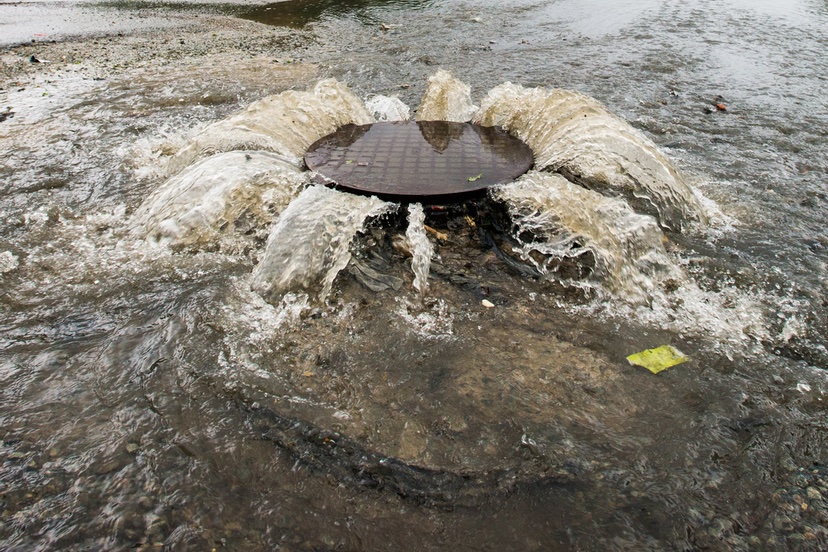
Many of the Town’s underground sewer lines were in poor shape and were allowing groundwater to enter the system, especially during heavy rain events. In those situations, the Town was paying PAWSD to treat sewage mixed with significant quantities of rainwater. This additional (costly) rainwater or groundwater is referred to as “Infiltration and Inflow”.
Commonly called “I-and-I”.
Prior to the 1% Sales Tax approval, the PSSGID took out a $4 million loan to repair some of worst sewer lines (“Category 5” which were in the worst condition, and “Category 4” which were threatening to become “Category 5”.)
Then along came a couple of “100-year floods”.
With that introduction, let’s go to the Tuesday, November 17 meeting of the Town Council, and consider a report from Public Works Director Nick Freelen.
The PSSGID staff has been working with Xylem Inc. to inspect the 7-mile pipeline using a “SmartBall” sensor that gets inserted into the pipeline and travels along with the wastewater, recording system problems such as leaks and gas pockets. The recent inspection process discovered issues within the pipeline that — according to Mr. Freelen’s rough estimate — will cost the Town around $250,000.

After ten years of pipeline problems and breakdown, the Town Council has grown accustomed to spending hundreds of thousands of dollars every time another problem crops up.
And that’s just the pipeline to PAWSD.
PSSGID also maintains miles of underground sewer lines and several lift stations within the town limits, and many of the lines were classified as Category 4 and 5… prior to the flood events. The $4 million loan was meant to address those 4s and 5s.
Here’s more from Mr. Freelen, talking about the flood event:
“We had a huge outpouring of people from around the state, wanting to come and help us. We eventually got to the point where we had to start turning people away, because we had so much help…
“As we were lining that out, people may have noticed that we requested the schools be closed for three additional days. The sewer system was working — there were still several repairs that needed to be made over that weekend — but we also weren’t sure what the system was like inside the sewer lines we couldn’t see. So we had all these other towns coming down and help us jet and scope lines.
“We had been finding pieces of clay pipe in our screens… That means there’s failure somewhere…”
If I have my history correct, the Town of Pagosa Springs began installing its municipal sewer system in the 1950s, when the community was much more… backwoods? rustic? impoverished?… than it is today. Which is certainly not to suggest that the people weren’t enterprising and resourceful — you had to be resourceful to survive here — but I’m assuming that the sewer system was built in the most economical fashion possible and often by people who were inventive, but frugal.
70 years later, we still have clay pipe in parts of the sewer system. Clay pipe, that’s now disintegrating with each major rain event.
Mr. Freelen:
“When school is in session, that adds a potential load to our daily amount of sewage to process. So that combined with the I-and-I coming into our system, that’s when we made the call to the Superintendent to request the delay opening the schools.
“We appreciate the community being flexible. We didn’t think it would be a good idea to bring in port-a-potties for all the students to use.
“You know, as a parent myself who’s kids go to public school, I can appreciate the difficulties that places on parents, especially in a time like this.
Mr. Freelen then gave the Council an inventory of the major sewer repairs undertaken, starting with the sewer line that — once upon a time — ran below the 1st Street Bridge and served the commercial area known as the “East End”. He said the flood had completely destroyed a manhole on the east side of the bridge.
Another major failure occurred when floodwater erosion destroyed a manhole opposite the Springs Resort. A team from Durango was brought in to help with that emergency.
Crews from various town were jetting and scoping different parts of the system and finding additional damage. The video footage has been sent to Roaring Fork Engineering, the Carbondale-based firm that has been advising the PSSGID for the past couple of years.
Some of the damage might be covered by insurance?
Council member Leonard Martinez:
“How many Category 4 and 5 failure points did we have before the flood? And what do you think it looks like now?”
Mr. Freelen said he suspected the number of failed and failing lines has increased.
“There does seem to be a handful more. I haven’t seen the video footage myself, but the team from Salida, specifically, said there were areas that were concerning to them…”
It seems obvious that much of the $4 million loan — maybe all of it? — will be used to simply get the system back to where it was before the flood…
Bill Hudson began sharing his opinions in the Pagosa Daily Post in 2004 and can't seem to break the habit. He claims that, in Pagosa Springs, opinions are like pickup trucks: everybody has one.