
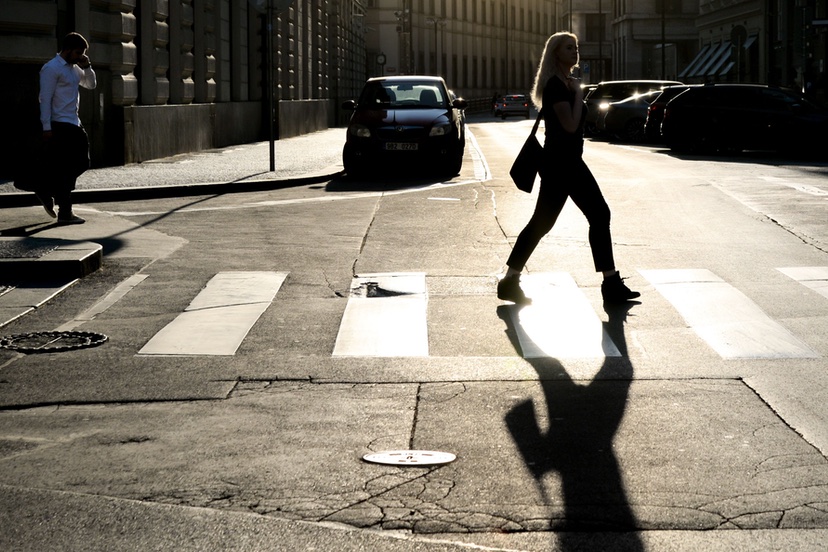
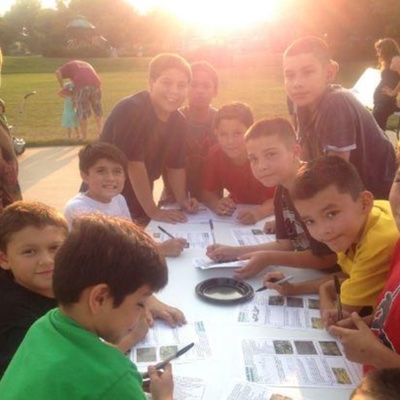
Photo note: The images provided below are from a prior Healthy Places work in Colorado communities are included as examples of resident-led engagement and public-space activation. They are not intended as prescriptions for Pagosa Springs. Parent/participant photo releases were obtained where applicable.
My mother called it Chevrolegs. If we needed to get somewhere and did not have a ride, we used our Chevrolegs. For many years, we did not have a car. Walking was not recreation. It was not a wellness practice. It was not a choice dressed up as simplicity.
It was transportation.
Long before I knew the phrase “active transportation,” I lived it. We moved through Pagosa Springs on foot because that was how life happened.
In 1981, my mother made a brave decision for her children and brought us west by Greyhound from Nebraska back to her hometown of Pagosa Springs. For my younger sisters and me, Pagosa became the place where we grew up. For my older brothers and sisters, it became a place they slowly came to call home.
Home is not always immediate. Sometimes it arrives one walk at a time.
We walked downtown, to the grocery store, to the library, and along the San Juan River, past the sharp smell of sulfur rising from the hot springs. Sometimes the reward was hot chocolate. Sometimes it was chile cheese fries at Dorothy’s. Sometimes we walked to the Hub — now Tequila’s — for snacks.
Most of the time, though, there was no reward. It was simply how we got where life required us to go. And if we complained about the distance, my mother had a standard response: “Nothing to it but to do it.” So we kept walking.
When I was a child, one of those walks changed my life.
I was crossing the street correctly in a school zone when a student driver, running late, ran a stop sign and hit me at about 40 miles an hour. The crash fractured my femur, left me in traction for more than a month, and caused a traumatic brain injury with lifelong implications.
I do not share that for sympathy. I share it because public memory has a job.
Streets are not neutral. Speed is not neutral. The way public space is designed and used shapes whose bodies are protected and whose are treated as acceptable risk. Later, the intersection where I was hit changed from a two-way stop to a four-way stop. That mattered. It was a physical acknowledgement that the built environment shapes safety.
It also left me with a question I still carry: why do communities so often wait until after harm happens to recognize a dangerous place? That question is part of why the Town of Pagosa Springs Parks and Recreation Master Plan matters.
Parks are not only places for play or leisure. They are part of a larger community health system. They connect to sidewalks, downtown, schools, the river, restrooms, benches, shade, bus stops, bike parking, cultural events, farmers markets, and the everyday routes people use to move through town.
This is what is meant by pedestrian dignity: moving through a place without feeling like an afterthought. For an elder, a missing curb cut can mean staying home. For a disabled resident, a steep crossing or lack of seating can say, “This place was not designed with you in mind.” For a working parent without a reliable vehicle, a safe route to school, work, a clinic, or a bus stop is infrastructure for daily life.
This is not only a personal memory. It is also a public safety issue. CDOT reported that 127 pedestrians were killed on Colorado roadways in 2025, about double the number from 10 years earlier. I will not claim Pagosa-specific fatality trends without a local or corridor-level crash-data extract, but the statewide pattern makes prevention worth taking seriously.
In 2023, as part of the Pagosa Springs Main Street Board, I helped invite walking artist, author, and national advocate Jonathan Stalls to Pagosa. A small group of residents, local officials, staff, and community partners gathered at Bookends and walked Main Street and the riverwalk in heavy wet snow, sharing stories about pedestrian dignity, accessibility, human connection, and the many cultures, workers, local businesses, young people, newcomers, longtime residents, and working-class communities that shape this place.
Pagosa is a town made for walking — and also a town where walking can still be harder than it should be.
Some of the work is already happening. A bus shelter may seem small until a person is waiting in the wind, snow, heat, or rain. I want to acknowledge the Pagosa Springs Main Street Board and community partners who helped make at least one shelter downtown happen. A bus shelter is a message: people who ride transit matter here too.
The same is true of the free pedicab rides now being offered downtown through grant support. A pedicab lets people experience downtown at a human pace and reminds us that not every trip through Main Street has to happen inside a car.
As the U.S. 160 reconstruction continues through downtown, this matters even more. A rebuilt Main Street is not just a transportation or business vitality project. It is a test of whether Pagosa can become the kind of community its infrastructure is trying to support.
Concrete alone cannot create pedestrian dignity. Culture matters too.
A pedestrian-friendly downtown only works when drivers respect posted speeds where people are walking, rolling, crossing, shopping, working, visiting, and gathering. The same is true for bicycles and e-bikes. Safe shared spaces require yielding, signaling, riding predictably, using helmets and lights, and knowing where bikes belong.
That education can be practical and joyful: bike rodeos, school partnerships, visitor and neighborhood-facing wayfinding signs with walking and biking times to key destinations, and youth education that treats mobility as a life skill.
It is also public health at its most ordinary. Not scolding people about their bodies, but designing a town where movement becomes easier, safer, and more woven into daily life. A walk to the library. A bike ride to the river. A safe route to school or transit stop. A bench that lets an elder keep going.
These investments can also support downtown vitality, local businesses, tourism, and the long-term value of community development. A town that is easier to walk, roll, bike, rest, and gather in is not only healthier. It is more inviting.
Infrastructure gives us the bones. Community gives it life.
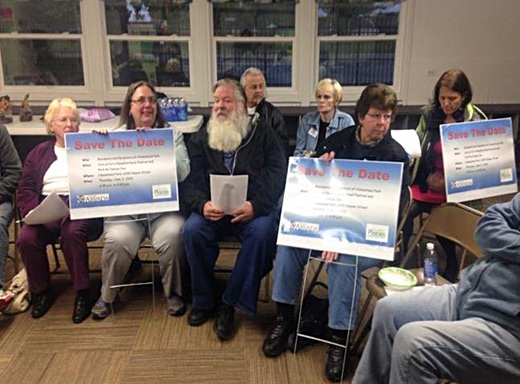
Some of the images I am sharing with this column come from earlier Healthy Places work in other Colorado communities. They show older adults and young people helping shape neighborhood parks and public spaces, not from the sidelines but as participants in the planning itself.
That matters. Good engagement does not wait for people to show up at Town Hall. It goes where people already are — apartment communities, mail cluster boxes, parks, schools, community centers, and everyday gathering places.
Those examples are not prescriptions for Pagosa. They are evidence in action. In one community, children and families helped shape park design in their own neighborhood. In another, older adults were engaged directly around access, safety, and belonging.
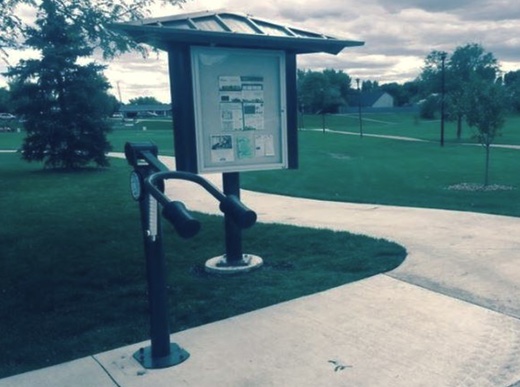
In others, activation strategies helped bring infrastructure to life: bicycle-blended smoothies, bootcamp workouts using benches and park features, walking loops with wayfinding signs, outdoor fitness equipment, park information kiosks, bike repair stations, and community events that encouraged people to move, gather, and use public space in new ways.
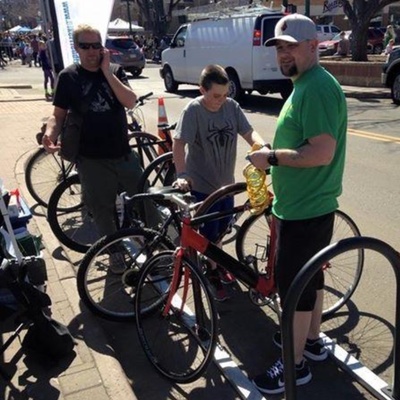
Activation is not extra. It is how infrastructure becomes belonging. Imagine free community dance lessons on the San Juan Overlook, a local food truck nearby, music, neighbors lingering, elders seated nearby, and children moving between families — these are the kinds of small invitations that can turn public space into community life.
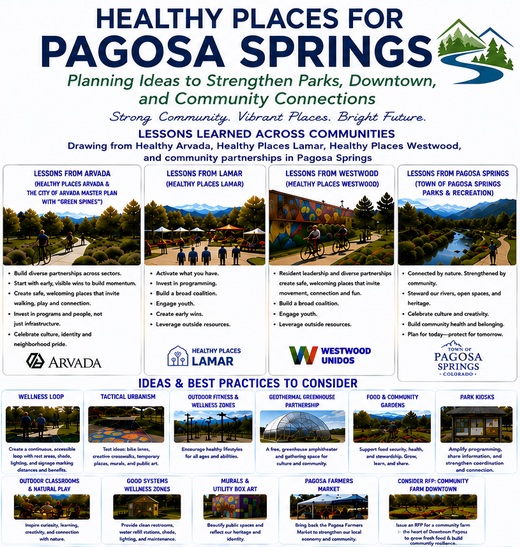
That is the spirit behind the Healthy Places for Pagosa Springs poster and supplemental planning ideas I recently shared as input for the Parks and Recreation Master Plan. The examples from Healthy Places Arvada, Lamar, and Westwood are not meant to tell Pagosa what to do. Pagosa does not need to copy another town. They simply show how small, visible improvements can build momentum when health, downtown, parks, transportation, culture, and local economic vitality are connected.
Borderlands Health is about these ordinary crossings — between memory and policy, between recreation and survival, between infrastructure and belonging.
As the Town moves forward with the Parks and Recreation Master Plan, community members still have time to weigh in. The comment opportunity is open through July 11, 2026. Residents can provide input here.
The form provides a chance to comment beyond “recreation” alone — to speak up for safe crossings, wide connected sidewalk networks, shade, benches, public restrooms, bus shelters, bike access, disability access, working-class mobility, respectful driving, activation of public spaces, and places where people of all ages, incomes, backgrounds, and abilities can belong.
Tourism and business vitality are important. But the vision for Pagosa also has to be about the health and wellbeing of the people who live here year-round.
A vibrant downtown should not require wealth to enjoy. A public park should not require perfect mobility. A healthy town should not require car ownership. Pagosa already has natural beauty, cultural memory, local creativity, downtown assets, trails, river access, and people who care deeply about this place.
Pagosa already has many of the ingredients — DUST2, Main Street, GGP, historic walks, parks planning, public art, schools, CDOT improvements, and local businesses. The opportunity is connecting them through a shared community health and downtown vitality vision.
Walks, bikes, history, parks, river, art, food, benches, bathrooms, businesses, health, and belonging — all working together.
Not just for recreation. Not just for business.
For health. For dignity. For belonging. For everyone.
Nothing to it but to do it.
Sources and disclosure:
The supplemental planning ideas referenced here were submitted by me to the Town as public comment; I previously served on the Pagosa Springs Main Street Board. I have no financial interest in the pedicab, CDOT project, Parks and Recreation Master Plan, or infrastructure improvements discussed here.
CDOT describes the U.S. 160 Pagosa Springs Reconstruction as a downtown project that includes crosswalks with flashing signs, ADA sidewalk ramp improvements, and a March 2025 to November 2026 timeline: https://www.codot.gov/projects/us160pagosasprings.
CDOT also reported that 127 pedestrians were killed on Colorado roadways in 2025: https://www.codot.gov/news/2026/march-2026-news/pedestrian-fatalities-on-the-rise.
Public health resources from the CDC support activity-friendly community design as a way to increase physical activity, support healthy aging, reduce chronic disease risk, and strengthen social connection: https://www.cdc.gov/physical-activity/php/strategies/increasing-physical-activity-through-community-design-prevention-strategies.html.
EPA smart growth resources also note that walkable, connected communities can support local businesses and community development: https://www.epa.gov/smartgrowth/about-smart-growth.
Rosa D. Chávez, MPH, is a public health practitioner and systems leader rooted in the borderlands of Southwest Colorado and northern New Mexico. Her work explores how culture, care, land, power and community infrastructure shape health and belonging.