
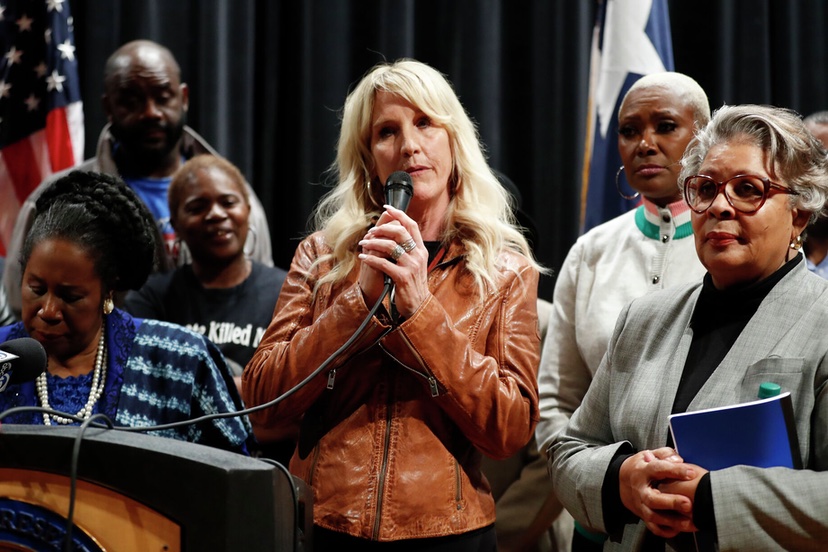
Photo: Erin Brockovich speaking in Conroe, Texas, 2023.
I don’t know if we thought that Santa Claus or Superman was going to come fix it, but that’s not going to happen. It will have to be we, the people…
— Activist Erin Brockovich, quoted by journalist Wanjiku Gatheru in ‘Glamour’ magazine, September 2020.
In her 2020 Glamour magazine interview, environmental activist Erin Brockovich spoke about “stick-to-itiveness” as a framework for making change happen… the willingness to continue working on an issue even when a positive outcome seems doubtful.
That’s one of the themes in her 2020 book, Superman’s Not Coming: Our National Water Crisis and What We the People Can Do About It.
The national water crisis is not the only crisis for which Superman is unlikely to make an appearance. We have a number of crises right here in Pagosa Springs — as peaceful and scenic as it may seem on the surface — that ‘we the people’ will have to address, if we indeed want them addressed.
It’s typical for governments and organizations to conclude that crises can be addressed successfully. only by throwing money at them.
One way to obtain more money: increase local taxes and fees.
Another way: Grants from state, federal and foundation sources.
Archuleta School District, for example, appears primed to ask us in November to help fund a new $126 million PreK-8 facility on Vista Boulevard with a property tax increase. A state grant could potentially provide for about 40% of the project. The School Board views this ‘brand new facility’ approach as preferable to repairing and upgrading three existing school buildings that have been functioning reasonably well for at least 60 years.
Funding the new facility with bake sales is probably not a reasonable alternative. But repairing and upgrading the existing buildings might be.
The Archuleta County government seems ready to place a tax increase on the November ballot, but this increased Lodging Tax would be paid exclusively by tourists and other travelers who book rooms in short-term rentals or motels located outside the town limits. The increase might generate around $1 million annually, which could be used for the purposes approved by the voters in November. Input from the public a several ‘Community Conversation’ events indicated support for spending most of the potential $1 million on road maintenance.
Currently, it costs about $1 million to rebuild one mile of paved road. The County maintains about 320 miles of paved or gravel roads.
Meanwhile, voters within the Town of Pagosa Springs recently approved a new 1% sales tax, to be dedicated to repairing and upgrading the Town’s downtown sewer system. Anyone shopping within the town limits — including at the City Market shopping center and at Walmart — will contribute to the sewer project, although the vast majority of community’s residents live outside the Town’s sanitation district. The Town is constantly chasing grants as well.
On June 25, the Housing Action Plan ‘Strategic Work Group’ — a mix of volunteers, and paid government and non-profit employees — much of the discussion centered on ways to generate more money to address the housing crisis. One idea that got kicked around: is there some way to extract more money from part-time residents, through some type of property tax increase that doesn’t apply to full-time residents? What if our County government asked the voters to approve a property tax increase, with the promise that full-time residents could apply for an exemption from the increase?
Disclosure: I’ve been a regular volunteer participant in the HAP Work Group, but this editorial reflects only my own opinions and not necessarily the opinions of the Work Group as a whole.
It’s certainly tempting to propose taxes and fees on people who cannot vote on the increases.
How about, like, the ‘vacancy tax’ idea that’s been tried in a few communities? A special tax or fee on homes that are not occupied for at least six months of the year? Data from Region 9 suggests that more than 40% of the properties in Archuleta County are owned by non-residents.
Utah has had a functional vacancy tax since 1982. The state exempts 45% of a property’s taxable value, applicable only to residential properties “used as a primary residence for 183 or more consecutive calendar days during the calendar year.”
Voters in three adjacent cities in California — San Francisco, Oakland and Berkeley — imposed special property taxes on homes that sit unoccupied for a large part of the year. In the case of San Francisco’s Empty Homes Tax (EHT), a trial court prohibited the enforcement of the EHT in 2024.
How about increasing the taxes or fees on vacation rentals, as was suggested by the study written by 22-Town-Council-RootPolicy-1Root Policy in 2022?
A group of Pagosa Springs voters circulated a petition to amend the Town Home Rule Charter, and in April 2022, the town voters approved a new ‘Workforce Housing Fee’ to be collected from all Short-Term Rentals (STRs) within the town limits, establishing a fee of $150 per bedroom per month. But a different group — in this case, a group of downtown STR owners — challenged the right of the voters to amend the Charter in this fashion, and won in court.
In the meantime, the Town Council engaged the consultants from Root Policy to analyze the impacts of STRs on the health of the Pagosa Springs housing market, in a manner that could be successfully defended in a courtroom, and Root Policy produced a 31-page report suggesting that the conversion of residential homes into STRs has an obvious financial impact on the community, and that an ‘impact fee’ of $2,687 per year was justified.
The report noted, for example, that between 2017 and 2022, the average rental rate (for long-term renters) had more than doubled.
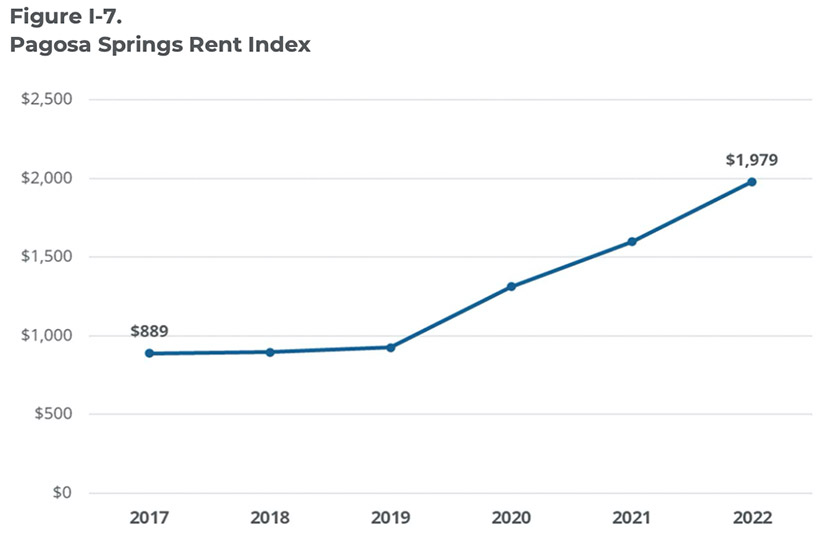
The report asserted that the STR industry is partly responsible for these changes.
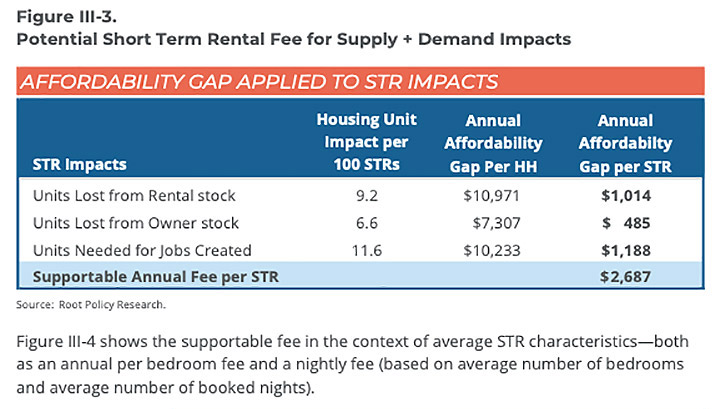
The Town Council, however, chose not to impose the entire $2,687 ‘Workforce Housing Fee’. Instead, they voted to impose a $500 annual fee to address the growing housing crisis. That fee now generates about $50,000 a year.
As noted previously, a single-family home in Pagosa Springs now has a median price of about $575,000. It’s not immediately clear what the Town can accomplish with $50,000, as far as addressing the housing crisis.
There’s a third way to address certain issues, however, that doesn’t necessarily involve increased taxes, fees and grants.
Change the rules.
Bill Hudson began sharing his opinions in the Pagosa Daily Post in 2004 and can't seem to break the habit. He claims that, in Pagosa Springs, opinions are like pickup trucks: everybody has one.