
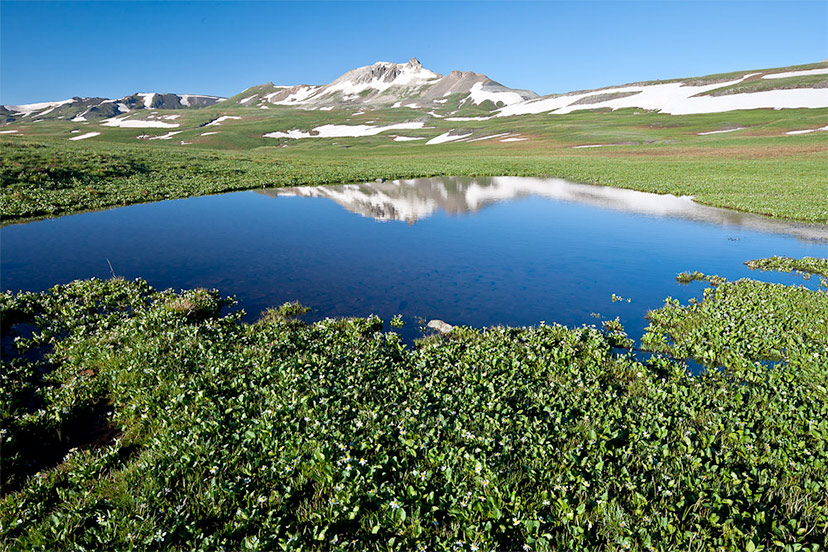
Goal: The scenic beauty of Archuleta County remains intact. The dramatic mountain backdrop with vistas of agricultural buildings, ranches, and open space in the foreground is preserved. The air is clean, rivers run free and clear, and wildlife populations remain healthy through preservation of habitat and migration corridors on public as well as private land…
— from the 2017 Archuleta County Community Plan.
We’re discussing whether people in Archuleta County can “just get along”.
It’s human nature to feel frustrated when a partner, from whom we want cooperation and agreement, refuses to give us what we think we need.
Conversely, when I am the one refusing to cooperate with someone — because they’re trying, in my view, to take things in the wrong direction — I feel totally justified.
I propose that we can’t “just get along” — and furthermore, that we shouldn’t view disagreement as a negative thing. Different people want different things, and though it’s frustrating to negotiate a compromise solution, it’s necessary if we want to be a functional community.
In 2017, the Archuleta County Planning Department updated one of the community’s guiding land use documents, the County Community Plan. In 2024, the Colorado legislature and governor determined that some county comprehensive plans — also known as master plans — were inadequate if they didn’t specifically address the ongoing housing crisis and the ongoing water crisis. (You can read more about the water crisis in yesterday’s article by Allen Best.)
You can download the 2017 plan here.
I fully support the effort to rewrite the Community Plan. We have the opportunity to rethink the issues we’re facing, and design a plan that better meets our needs in 2026.
We can take note of one particular goal of the 2017 plan. To preserve the appearance of a rural ranching community.
Indeed, Archuleta County was once a rural ranching community, with vistas of agricultural buildings and open space set against a dramatic mountain backdrop — so very different in appearance from, say, downtown Denver or downtown Dallas.
But Archuleta County is no longer a rural ranching community. It merely “looks like” a rural ranching community.
According to Region 9 Economic Development District, Archuleta County is inhabited by about 14,500 full-time residents — and many hundreds of part-time residents. Only about 380 people are employed in farming and ranching.
Farming and ranching in Archuleta County (according to USDA, 2022 data) takes up about 174,000 acres — or about 2/3 of all the private land in the county.
That acreage produces about $11.9 million in marketable products, with expenses of $13.9 million. The total domestic product of all industries in Archuleta County in 2024 was about $774 million. The contribution from farming and ranching was less than $12 million.
The simple fact is that many of the “ranches” in our community conduct “ranching activities” — not to contribute to the economy, but merely to qualify for the very-low agricultural property tax rate.
But we have those scenic views to preserve, according to the 2017 Community Plan.
What, exactly, is the value of those scenic views? Obviously, agriculture is not very economically valuable, as an industry. But it has aesthetic values to the community, and for visitation. We like the “feeling” of living in, or visiting, a “rural ranching community”.
The major updates to the Community Plan required by Colorado law SB24-174 concern the housing crisis and “a water supply element and a strategic growth element.”
Disclosure: I currently serve on the Pagosa Area Water and Sanitation District (PAWSD) Board of Directors, but this editorial series reflects only my own opinions, and not necessarily the opinions of the PAWSD Board as a whole or the PAWSD staff.
At a public meeting on Tuesday, Archuleta County Planner Director Eva Kruse made comments critical of PAWSD, telling the County commissioners that PAWSD has refused to share with the County important data about water supply and infrastructure. However, as we learned later, County Planning had never actually requested any data from PAWSD. Apparently, Ms. Kruse’s criticism of PAWSD staff was based on gossip she had heard from other agencies.
Certain other agencies have, in the past, asked PAWSD to provide data about individual customers, but PAWSD cannot legally release such information due to privacy rules — according to the PAWSD attorney Macus Lock.
As far as I can tell, PAWSD is more than happy to provide “general” information about water supplies and infrastructure, and much of that information already available on the PAWSD website.
However, it may be worth noting that PAWSD is responsible for diverting maybe 5% of the water that gets used in Archuleta County. That’s about 1,300 acre-feet annually. The Pagosa Springs Golf Course uses another 300 acre-feet.
About 94% of the water diverted from the San Juan River and its tributaries goes to agricultural users with “senior” water rights. A similar situation exists all across Colorado.
Then another 110,000 acre-feet of water is diverted from the Blanco and Navajo Rivers, here in Archuleta County, to serve New Mexico farmers and cities and towns along the Rio Grande River. That’s nearly 100 times the amount of water used by PAWSD.
There’s a finite amount of water in our rivers and aquifers, and it’s especially finite during an extended drought. But if all the ranches in Archuleta County stopped irrigating their fields of grass this summer, we would theoretically have 20 times as much water to serve municipal residents.
Should a comprehensive analysis of water uses and infrastructure be used to inform the County’s land use plans? Or should the County planners focus only on the 5% of the community’s water treated and delivered by PAWSD?
Certainly, intelligent people can — and should — disagree about how Archuleta County’s future ought to unfold. I hope we do disagree, and vigorously.
It takes a village to raise a child, and it takes a varied community to write the best possible Community Plan.