

There are a lot of things I don’t know. One of them being, not knowing what I don’t know.
In some cases, I know what I don’t know. For example, I know that I don’t know how much the Moon weighs. I could probably Google it, but the fact is, I don’t really care to know how much the Moon weighs. Some people care about that kind of thing, but not me.
But reportedly — and this, according to scientific studies — there are things that I don’t know that I don’t know, but which I mistakenly believe I do know.
This fact was brought to my attention recently, and as a result, I now know that I don’t know what I don’t know.
Unless that’s one of the things I think I know, but don’t actually know. It’s sometimes hard to tell.
This topic came to my attention in a scientific paper titled, “The misunderstood limits of folk science: an illusion of explanatory depth” by Leonid Rozenblit and Frank Keil, which I cannot recommend, because I didn’t understand much of it.
And I know I didn’t understand much of it.
I got the impression, however, that these two Yale professors were talking mainly about “folks” who were not scientists but who had somehow formed ideas about science, and also, about something called “misunderstood limits”.
During the COVID crisis, an awful lot of us had to instantly become “folk scientists” because we didn’t trust the actual scientists with our health. We suspected that they didn’t know what they didn’t know, but were acting like they did.
There are always going to be misunderstood limits, whether we’re actual scientists or “folk scientists”. That’s something we know, but don’t always want to admit.
I propose that the inconsistency between “science” and “folk science” will always be with us.
Another conflict is between “politics” and “folk politics”.
Back during the US-Iraq War, Secretary of Defense Donald Rumsfeld tried to clarify a problem at a press conference at NATO Headquarters. The problem being that the U.S. knew that Iraq was stockpiling weapons of mass destruction but couldn’t seem to find them.
There are things we know that we know.
There are known unknowns. That is to say there are things that we now know we don’t know.
But there are also unknown unknowns. There are things we do not know we don’t know. So when we do the best we can and we pull all this information together, and we then say, well, that’s basically what we see as the situation, that is really only the known knowns and the known unknowns. And each year, we discover a few more of those unknown unknowns.
There’s another way to phrase that and that is that the absence of evidence is not evidence of absence. That’s basically saying the same thing in a different way. Simply because you do not have evidence that something exists does not mean that you have evidence that it doesn’t exist.
I doubt anyone has ever clarified the problem more clearly.
When the Yale professors ran a series of psychological tests on 16 graduate students, to find out how the students felt about things they didn’t know they didn’t know, their first series of five tests (T1 through T5) generated this graph.
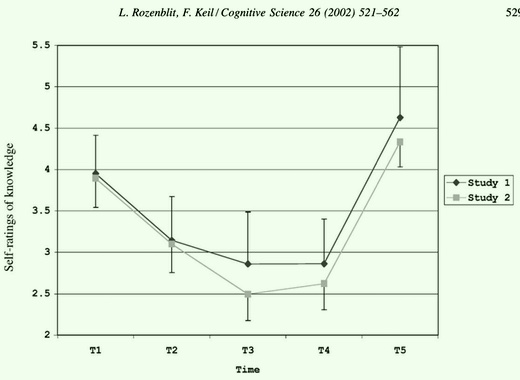
Eight participants were asked questions about a speedometer, a zipper, a piano key, and a flush toilet. Eight were asked about a cylinder lock, a helicopter, a quartz watch, and a sewing machine. They were then asked explain how these mechanisms worked.
If they were like me (except smart enough to attend Yale) they didn’t know much about how these things worked. But at first they thought they did. By the fourth test, they understood very well that they didn’t know squat about how a speedometer works, nor any of the other devices. The professors then had them read a detailed explanation, about each of the items, from David McCauley’s famous book, How Things Work.
As we note, their sense of knowing how a zipper or a helicopter works skyrocketed after reading the book (Test 5). These ratings were “self-ratings” — how much they thought they knew about that they knew, on some kind of arbitrary scale. Presumably, the professors know what the numbers mean.
Whether the graduate students were able to retain any of their new-found knowledge, about how a piano key or a zipper works? Who knows? I certainly don’t know how a zipper works — but so long as it works, I’m happy as a clam.
Unfortunately, the professors didn’t ask the students if they knew how their government works.
Of course, no one can actually explain that particular mechanism. Lord knows, we’ve tried. But we don’t know what we don’t know.
Underrated writer Louis Cannon grew up in the vast American West, although his ex-wife, given the slightest opportunity, will deny that he ever grew up at all. You can read more stories on his Substack account.