
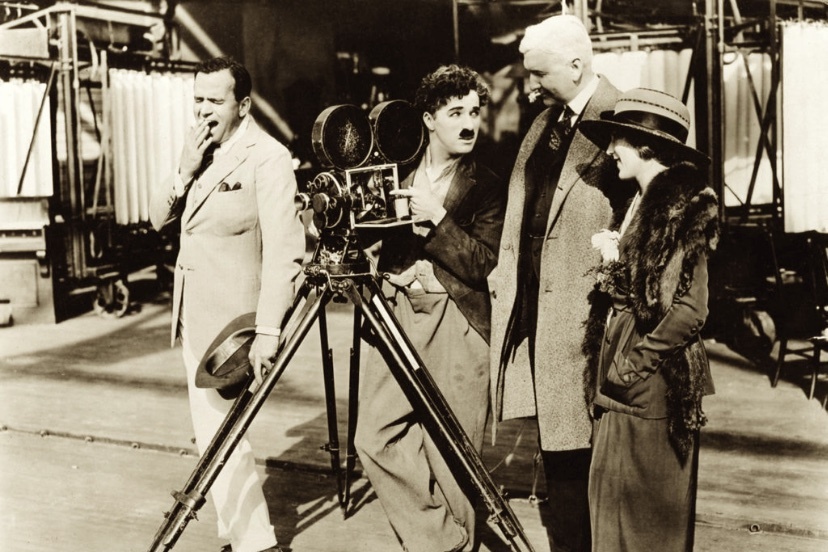
I noticed there’s going to be an Earth Day film festival of sorts at the Liberty Theater next week, on April 22. Environmental films. Birds, rivers, global warming. Typical Earth Day stuff.
But I don’t expect any actual “films” will be shown. I suspect what the festival will be showing will be “videos”.
As far as I know, movie theaters no longer show films. They show videos. As we all know, “film” runs through a film projector, and film projectors have pretty much gone the way of the dinosaur, except 60 million years later.
Yes, I realize everyone still calls these events “film festivals” but, believe me, they are not showing films. If we want to be honest — and we do want to be honest — what we see now in movie theaters are high definition videos.
A video is not a film. “Film” is a particular product made by Kodak or Agfa or FujiFilm or some other film manufacturer.
My dad had a Super8 movie camera when I was a kid, and we had a shelf full of family movies by the time I went off to college. This was back when film was really film.
Later, my dad got a VHS movie camera that he brought out at Thanksgiving and Christmas, much to everyone’s annoyance and embarrassment. His pop-up movie projector screen just gathered dust from that point on, because we watched ourselves on the TV. Not because we wanted to, but you know how families are. We were obligated.
Thomas Edison and William Dickson came up with the Kinetograph in 1891 that involved perforated celluloid film strips for precise movement, an ingenious sprocket system ensuring smooth film transport, continuous recording capability and a frame rate of 40 frames per second. A few years later the Lumière brothers, Auguste & Louis, patented a similar device that recorded at 16 frames per second. The French naturally had different ideas about what was suitable to be filmed.
These early pioneers had to overcome some interesting technical challenges, like moving a fragile celluloid strip at a carefully controlled speed, without tearing it to shreds. Later advancements allowed a soundtrack to be added to the film. Which could be in English or French or whatever language you wanted. Once again, the French had different ideas, especially about pronunciation.
But film hasn’t disappeared completely, like the dinosaurs may have. (Maybe they didn’t after all?) A news outlet in the City of Rochester, New York — home to the Eastman Kodak Company — provided a list of movies nominated for 2026 Oscar awards, that were shot on Kodak film.
- Sinners: (16 Oscar nominations, four wins)
- One Battle After Another: (13 Oscar nominations, six wins)
- Marty Supreme: (Nine Oscar nominations)
- Sentimental Value: (Nine Oscar nominations, one win)
- Bugonia (Four Oscar nominations)
- Sirat (Two Oscar nominations)
- Smashing Machine: (One Oscar nomination)
- If I Had Legs I’d Kick You (One Oscar nomination)
- The Singers (One Oscar nomination, one win)
Are movies more likely to win an Oscar if they are shot on film? To judge from that list, it would appear the answer is “No”.
A few years before I was born, NBC introduced “Saturday Night at the Movies,” the first major initiative to show films on television, and encourage viewers to stay home and watch TV. The series premiered with the 1953 Marilyn Monroe – Lauren Bacall – Betty Grable film, How to Marry a Millionaire, presented “In Living Color”. Some of the other movies shown were The Day the Earth Stood Still (March 3, 1962) and No Highway in the Sky (March 24, 1962). (Having been filmed in Cinemascope, a Fox specialty from 1953 to 1967, many of these films had to be severely panned-and-scanned to fit the invariable full screen television aspect ratio of the time.
Of course, the movies had been originally shot on film, in color, and often in a wide-screen format like Cinemascope, and actually looked pretty horrible on a color TV, especially when they had to be “panned-and-scanned” to fit a TV screen. And with commercials.
This was a small step in getting the American public adjusted to ugly-looking entertainment viewed on undersized screen, at home, instead of going to the theater and watching movies they way they were intended to be watched. Projected with a real film projector.
The trend continues.
Underrated writer Louis Cannon grew up in the vast American West, although his ex-wife, given the slightest opportunity, will deny that he ever grew up at all. You can read more stories on his Substack account.