

Image: Detail of the cover of the 2012 Stevens Field Economic Impact Study.
Based on what I heard at Archuleta County’s ‘Interactive Community Forum’ in February, and on what I’ve heard from various sources about the March event (which I was unable to attend) I assume the Board of County Commissioners (BOCC) will be submitting a ballot issue for the November election, asking local voters to approve an increase in the County Lodging Tax, from the current 1.9% to a new 6%, and will specify that most or all of the new revenues will be used for road maintenance and road capital projects.
If the voters approve such a ballot measure… a 6% tax, paid mainly by tourists, might generate about $1 million a year.
During the 1970s, a previous BOCC allowed the creation of hundreds of miles of new County roads in the Pagosa Lakes area, apparently under the assumption that the subdivisions themselves would be maintaining those roads. But the development company, Fairfield Pagosa, filed for bankruptcy in the 1980s, and the obligation to maintain the roads fell to County taxpayers — many of whom do not live in the Pagosa Lakes area.
This may not have seemed like a big deal, back then, when the county had a population of only about 5,000 people using the roads…
…but in 2026, with a population nearly triple that size, and with thousands upon thousands of tourists using the roads every summer and ski season, the situation has gotten truly unmanageable.
Since 2023, the BOCC has been spending down the R&B reserves to complete some major projects. As of 2026, the R&B Fund savings are essentially gone. Thus, the budget for “Maintenance & Capital Projects” in 2026 is but a fraction of the amount spent in 2023.
Annual R&B Budget (Maintenance & Capital Projects):
• 2023 = $7,614,975
• 2024 = $5,634,255
• 2025 = $4,796,112
• 2026 = $2,446,500
Over the past year, Commissioner John Ranson has been warning us that the BOCC must find additional revenues for Road & Bridge. As mentioned, it’s possible that up to $1 million could be generated by an increased Lodging Tax, if the voters approve the change.
But $1 million is not going to get us where we want to be. More likely, we need $80 million to bring all of our community roads up to “good” condition. (That’s my wild guess based on what was a $40 million estimate by the County’s then-Public Works Director 15 years ago… with inflation added.)
But from what I can tell from my information sources, the March 25 ‘Interactive Community Forum’ did not get around to discussing one particular two-mile stretch of pavement.
That particular stretch of pavement is the main runway at Stevens Field, the County-owned airport just east of the Pagosa Lakes neighborhoods. It’s a somewhat private stretch of pavement, even though it’s owned by the taxpayers.
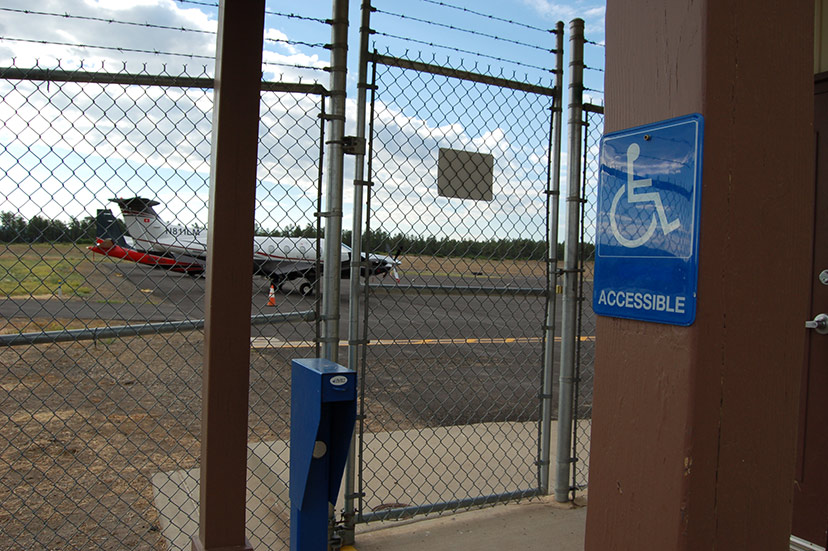
Stevens Field is not a commercial airport, and most likely will never be a commercial airport, due to its close proximity to the San Juan Mountains — a potential hazard for commercial planes trying to perform a landing.
Most of the people who use our County roads are ordinary folks, not millionaires… but a significant number of the people who use the two-mile stretch of pavement at Stevens Field are millionaires. Or billionaires.
Nevertheless, according to an “economic impact study” performed back in 2012 by some local pilots, our airport is an economic boon to the community, because the millionaires and billionaires who use the airport spend money in our county, building large homes, hiring hunting and fishing guides, and entertaining one another at local restaurants. From the 2012 EIS (Economic Impact Study):
As the “Baby Boomer” generation retires, the demographics of the country will change as a result of their desire to move to less congested locales. A great number of pilots are now looking for aviation retirement destinations similar in nature to the Pagosa Springs area. We have seen in the last few years more and more pilots choosing Pagosa Springs as their new home. With this in mind, it was decided to also see what the impact of this aviation community had on the local economy and include the data in the study as well…
…To ensure that the information was truly qualified, the first question on the survey asked if they ‘would have moved to Pagosa had the airport not been here.’ If any of the respondents answered that they would have moved here regardless of there being an airport here, none of their financial data was used in this study. It’s important to note at this time that to prevent a single respondent from skewing the results too far in one direction, no “qualified heavy hitters” were included in this impact study. i.e.: Boot Jack Ranch, Bass Bros. etc.
On July 5, 2023, the Archuleta Board of County Commissioners accepted a proposal from the Airport Advisory Commission to produce a new EIS, reportedly to be completed by the summer of 2024. Reportedly, that study is yet to be delivered.
The timing of this new EIS might be — might be — related to plans to spend perhaps $15.5 million in upgrades and maintenance at Stevens Field in 2027. Here are a couple of graphs from the 2019 Archuleta County Budget:
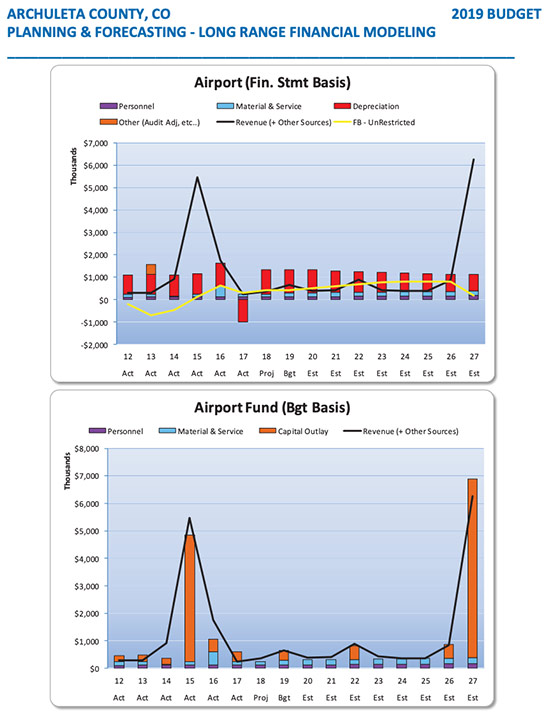
These graphs illustrate, in a graphic form, a $5 million investment in 2015, and something big that was planned for 2027. According to a 2020 estimate from Jviation, the 2027 project entailed reconstruction and paving of the runway, and was actually going to cost about $13.8 million.
At a March 17 BOCC work session, Airport Manager Chris Torres and two representatives from Jviation, Mark Lobato and Mark Miller, discussed the upcoming runway project. (You can find a video of the presentation on the County website.)
My experience, reporting on government projects, suggests that we need not take price estimates on large projects as a final number. But according to the March 17 discussion, the runway project is going to cost $15.5 million.
Jviation is now owned by the Ohio-based engineering firm Woolpert, which has charged Archuleta County $1.1 million to design the runway project. About half of that cost will be covered by an FAA (Federal Aviation Administration) grant.
That’s just for the design. The project itself is estimated to cost $15.5 million. The FAA has reportedly promised up to $11 million. (I wasn’t clear from the presentation who would be paying the additional $4.5 million.)
We might assume that the airport users themselves will be paying the remainder.
But I’m pretty sure we would be wrong.
Bill Hudson began sharing his opinions in the Pagosa Daily Post in 2004 and can't seem to break the habit. He claims that, in Pagosa Springs, opinions are like pickup trucks: everybody has one.