
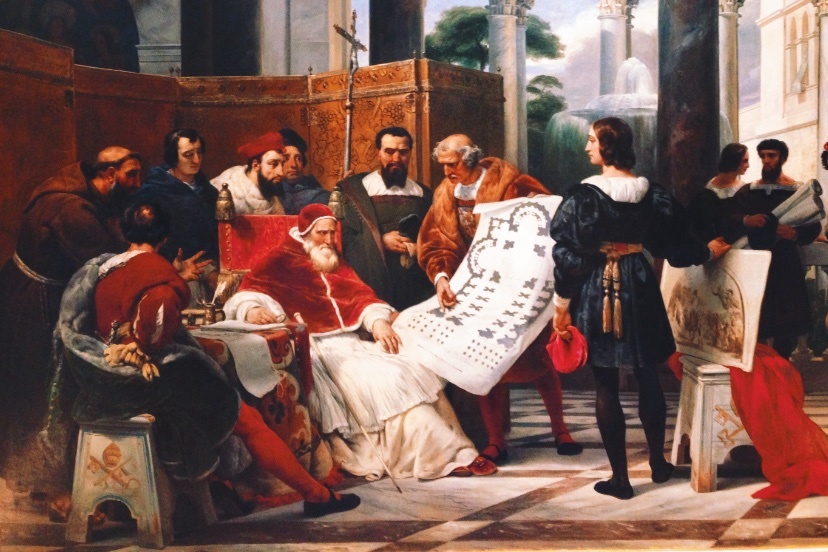
Image: Pope Julius II — the Warrior Pope — commissioning works from Bramante and Raphael, as painted in 1827 by Alexander Baranov.
That was one of my dad’s favorite responses to a question, when the answer was obvious.
“Is the Pope Catholic?”
If you asked a question like, “Will we see increased inflation because of the Iran War?” my dad would respond, “Is the Pope Catholic?”
Which actually doesn’t make a whole lot of sense, because the current Pope — although he is definitely Catholic — doesn’t appear to be fond of war. But previous Popes, way back in history, were big fans of going to war, partly as a way of spreading the Catholic religion and the message of love and brotherhood.
Pope Julius II, for example — nicknamed the ‘Warrior Pope’, or the ‘Battle Pope’ — personally led the papal armed forces at the victorious Siege of Mirandola in 1511 and ultimately forced the French troops of Louis XII to retreat across the Alps. Some speculated that he’d chosen his papal name not in honor of Pope Julius I but in emulation of Julius Caesar.
Religion was serious business, in those days. If you wanted converts, you actually had to kill them.
My dad was not Catholic, by the way. He came from a long line of Protestants. Out of respect for Catholics, he probably could have used a different response, like, “Was John Calvin Protestant?” But I suspect some people don’t know who John Calvin was.
I’ve been thinking about the Roman Catholic religion lately, for a couple of reasons.
For one thing, I recently went on a date with a nice Catholic girl.
We didn’t talk much about religion, but she mentioned in passing that she’d been raised Catholic, and I mentioned in passing that I was raised Protestant but was willing to convert, if the right situation arose. This was our first date, and I often say things on a first date that never pan out over the long haul.
My other reason for thinking lately about Catholicism is that… it’s been in the news.
Like, a story by Elizabeth Dias in The New York Times, March 26:
This Easter the Archdiocese of Detroit will receive 1,428 new Catholics into the church, its highest number in 21 years. The Archdiocese of Galveston-Houston will have its most in 15 years. In the Diocese of Des Moines, the count is jumping 51 percent from last year, from 265 people to 400.
The first year after the election of Pope Leo XIV, the first pontiff from the United States, many Catholic churches across America are welcoming their highest numbers of new Catholics in recent years. The newcomers are set to officially be received into the church during the Easter Vigil Mass, the night before Easter Sunday on April 5.
Bishops are buzzing about the surge, and confounded by what is behind it.
“Of course we think the Holy Spirit is,” Cardinal Robert McElroy of Washington said. “But we are kind of stymied.”
Obviously, numerous newcomers were welcomed on Saturday, and enjoyed Easter Mass as full-fledged Catholics. The Holy Spirit works in mysterious ways.
Maybe choosing Robert Francis Prevost from Dolton, Illinois as the new Pope was a good move? By the Holy Spirit, I mean. If the Holy Spirit wanted to encourage more Americans to convert?
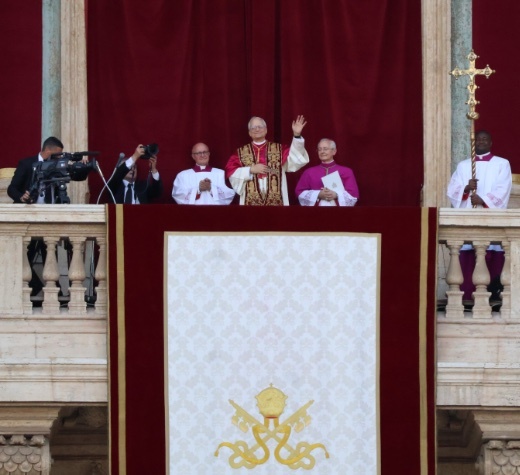
There’s nothing quite like having a Pope with an Illinois accent, to make Americans sit up and take notice.
The Washington Post also took notice of the influx of new Catholics, in a story by Shane O’Neill on April 2. He titled his article, “Why Catholicism is drawing in Gen Z men”.
Young men in their 20s and 30s are increasingly drawn to the Catholic Church as they seek truth, beauty and, yes, girlfriends.
The photos illustrating by O’Neill’s article, by photographer Brian Anselm, suggest that the young men attending Catholic churches for the first time will have their pick of attractive young women also attending for the first time. But they will also have a lot to learn. About Catholicism.
To become a full-fledged Catholic means going through a catechetical course called the Order of Christian Initiation for Adults. Classes typically start in September, with Confirmation occurring at the Easter Vigil, making it roughly a six month commitment.
I’ve not taken this course, and reading out about it has made me rethink my comment the other night, that I might be willing to convert.
My date was really good looking, however. And smart.
I don’t really have anything else on my calendar, come September.
Mr. O’Neill ends his Washington Post article with a quote from author Andrew Lohse, who was doling out generous pours of fine brandy to the young potential-Catholics in New York.
During the early days of the coronavirus pandemic, he said, he remembers feeling particularly disillusioned. “Society is maybe going through that at scale, where we’re like, ‘Well, wait a minute: The economy doesn’t work for almost everyone. The money is worth less. There’s a war on beauty; we don’t make beautiful things; we don’t make beautiful buildings; it’s black cubes everywhere; what’s that all about? There’s a war on truth, a war on human life in every form.”
I couldn’t agree more.
Except for the black cubes everywhere. Maybe that’s in New York? I haven’t seen any of these black cubes where I live.
But yes, there’s the occasional cute Catholic girl.
Underrated writer Louis Cannon grew up in the vast American West, although his ex-wife, given the slightest opportunity, will deny that he ever grew up at all. You can read more stories on his Substack account.