

In Part One, I shared a small portion of a more lengthy report delivered to the Archuleta Board of County Commissioners last week, related to the EMS ambulance service operated by Pagosa Springs Medical Center. We heard about the Southwest Regional Emergency and Trauma Advisory Council (SWRETAC) and various local issues, from EMS Deputy Chief Connie Cook and EMS Medical Director Dr. Dan Renner, MD.
Part One focused on a a potential $400,000 grant that would help establish a regional peer support network that might help first responders — EMS, search and rescue, law enforcement, firefighters — deal with, or recover from, traumatic experiences.
The next part of the presentation concerned an enhancement to the utilization of AEDs — ‘automated external defibrillator’ devices that assess a person’s heart and delivers an electric shock if it has stopped beating normally. A person who suddenly collapses may be suffering from sudden cardiac arrest (SCA) — and if an AED device is located nearby, and a person trained in its use is also nearby or can responded quickly to the event location, a life can be saved. Heart Safe La Plata has been implementing a program called Pulse Point, which a a free, downloadable app that can inform a CPR-certified person — be they professional or a lay person — that an emergency has occurred nearby, where an AED unit is available.
Ms. Cook:
“We train a ton of people within Archuleta County, and we’ve been instrumental in getting AEDs placed throughout the community. So bringing these two things together can really have an impact on people’s lives, both our visitors and our residents.”
There’s a cost to the software implementation, but for people in the community, it’s free.
“You download the app, it’s voluntary, and you can feel confident when you walk out of a CPR class that you want to be there to help somebody…”
There’s also a cost to maintaining a community-wide system of AED units. Commissioner Medina asked about an AED unit that was located in the Old County Courthouse — which the County has abandoned following an arson event. What happened to that AED unit? Does anyone know?
“That’s a good question. Right now, we don’t really have [a maintenance program] in place. That’s why this program could be so important. Because we would then be able to go from beginning of life of an AED, getting it placed into an agency or business, and doing the training. making sure everybody is up to speed, that they know where it’s at, it’s integrated into the CAD system all the way through to the end of life.”
The end of life for the AED unit, that is.
“There’s a lot of AEDs out in the community that are probably collecting dust that are… that have expired things on them. And we need a management program. And right now, we just don’t have the bandwidth or resources to do that. We’ve been doing the best we can, and so this program will help us solve some of those problems.”
The next topic was “Pre-hospital whole blood and plasma” — the delivery of whole blood or blood components by EMS clinicians to a patient who is bleeding severely. This care can be administered at the scene of injury or en route to definitive medical care.
Ms. Cook said the EMS faces a lot of challenges “being as remote as we are.”
“Mostly, it has to do with cost, storage, and availability of these products. But research has shown that if we’re able to administer whole blood products ‘pre-hospital’ to people who need it, we can improve outcomes and save lives. It’s a nationwide push on this program.”
Cost and availability are “tough”.
“The hospital carries — what? — a max of 6 units at a time? … So trying to balance the need for the hospital to have blood, and for us to have that out in the field, is a challenge. And not just for us, but across the region…”
Next item: A regional critical care symposium. Coming sometime this year.
This ‘first annual’ event, supported by SWRETAC, will provide continuing education for paramedics and emergency department staff across the region “for things like pediatrics, respiratory, cardiac, obstetrics and critical care components.”
“We’re a Level 4 critical access hospital… we have a few critical care medics in our department as well, and it’s been really tough to find qualified training that helps people maintain certifications, while also diving into the critical care components of those things. These are very, very sick patients who require a high level of care, and they will all need to be transferred out to somewhere else, because we can’t provide the sustained critical care here — but to stabilize and initiate critical car treatment within the region is what is going to give them the best possible chances for survival and good outcomes.”
Speaking of survival and outcomes, the U.S. population has the lowest life expectancy at birth, the highest death rates for avoidable or treatable conditions, and the highest maternal and infant mortality, among Organization for Economic Co-operation and Development (OECD) countries — that is to say, among high-income countries.
The U.S. has the highest rate of people with multiple chronic conditions and an obesity rate nearly twice the OECD average.
Americans see physicians less often than people in most other countries and have among the lowest rate of practicing physicians and hospital beds per 1,000 population.
At the same time, our spending on health care is far higher than in similar OECD countries. What’s the deal?
Here’s a chart from the Commonwealth Fund.
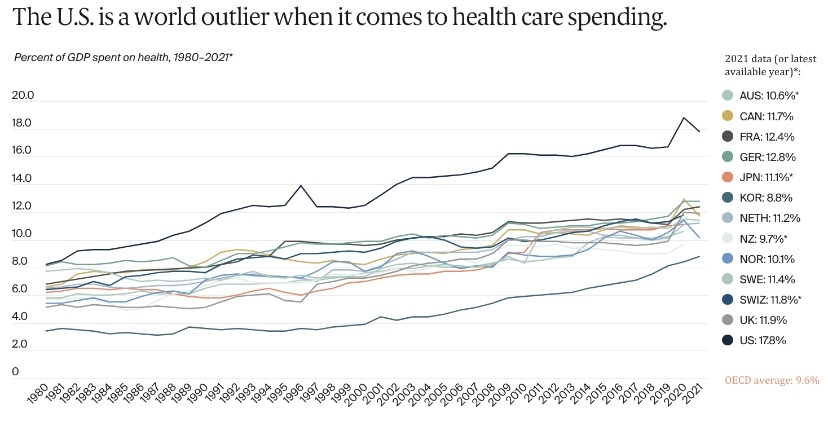
Is it possible that a capitalist system of health care is the worst possible choice?
Regardless of how EMS and Pagosa Springs Medical Center strive to serve our aging community — where our median age is now about 52 years, compared to about 38 years in Colorado as a whole — we should probably expect worse outcomes than in many other wealthy countries.
We should naturally expect to pay more, to be less healthy, and to die sooner.
Bill Hudson began sharing his opinions in the Pagosa Daily Post in 2004 and can't seem to break the habit. He claims that, in Pagosa Springs, opinions are like pickup trucks: everybody has one.