

The Archuleta Board of County Commissioners had a chance, earlier this week, to discuss a report from our local Emergency Management System (EMS) operators.
EMS has some history in Archuleta County. The Upper San Juan Health Service District (USJHSD) had its beginnings in 1981 as an ambulance service… during a time when Pagosa Springs had no hospital, nor even a medical clinic, and was served by local family physicians with limited ability to address acute medical emergencies… making an ambulance trip to the hospital in Durango an hour-long but life-saving option.
About twenty years ago, USJHSD went to Archuleta County voters with a proposal to expand the recently-built Dr. Mary Fisher clinic into a “rural access hospital” — initially named the Pagosa Mountain Hospital, later to become the Pagosa Springs Medical Center (PSMC).
The EMS and ambulance service was retained by USJHSD and got rolled into the PSMC budget as one of its services that rather consistently lost money, and thus needed to be subsidized by other PSMC revenue streams.
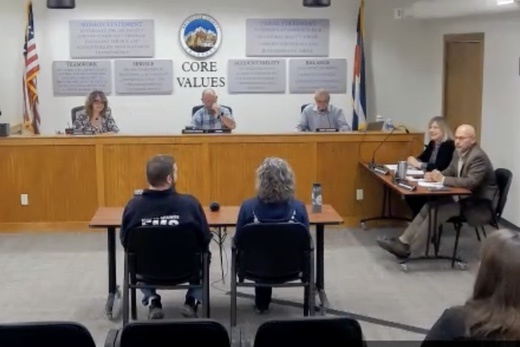
Presenting the report on the Southwest Regional Emergency and Trauma Advisory Council (SWRETAC) and related local issues, and fielding BOCC questions, were EMS Deputy Chief Connie Cook and EMS Medical Director Dr. Dan Renner, MD.
The SWRETAC collaborates to improve emergency medical services in a five-county region, covering about 6,500 square miles and a total population of about 100,000 residents.
From their website:
Southwest Regional Emergency and Trauma Advisory Council (SWRETAC) will maintain, improve and expand EMTS (Emergency Medical and Trauma Services) system development in Southwest Colorado.
One of the local grant-supported projects was a $400,000 training program to help generate a system of peer support for all Archuleta County emergency responders — fire, EMS, law enforcement, ski patrol, and “everything in between”.
(I’m not sure what “everything in between” might be, but a quote is a quote.)
Ms. Cook:
“We’ve learned over the years that smaller agencies — like all of us here in the region — maintaining an internal peer support network is tough, because one day you might be providing peer support to someone, and the next day you may be riding in the truck with them.
“That can be a little bit awkward, and we’re a very resistant bunch when it comes to that. We help people. People don’t help us. So if someone were to actually reach out and overcome the vulnerability that comes with that, it’s nice to have that degree of separation…”
As I understand these comments, Ms. Cook is reminding us that people who dedicate their lives to dealing with trauma situations are pretty much required to develop emotional techniques, that can provide a sense of detachment from sometimes horrific situations.
Their peers may fully understand the stresses involved, may have shared the same difficult experiences… but at the same time, may have a tendency to be emotionally detached.
“We’ve got eight people from our county registered right now [in the peer support network], and that covers the police department, Sheriff’s office, search and rescue… ski patrol EMS, and fire.
The upcoming peer support training is a week-long seminar, that will hopefully result in the creation of a regional peer support network. A grant application has been submitted to support the program for the next three years.
“Hopefully, we’ll hear about that [$400,000 grant] in May or June, so we’ll see. And that will give us the Cadillac version of the program.
“If we don’t get that, we’ll be on a bare bones, Ford Pinto version of the program. But we’ll make it work as best we can.”
What might “success” look like, resulting from a three-year program?
“Success would be metrics that show people actually using the system, that people are accessing and using peer support…and also wellness and other resiliency things we’d like to provide…
“Not crisis-oriented programs, but informal, voluntary things like financial health for first responders.
“And end-of-life timing for first responders.
“Horrible topic for us to talk about. But the risks we face every day going to work, we need to make sure we’re planning ahead, and our families are taken care of. That we’re taken care of.
“So, providing some of those kinds of training and education opportunities…”
“In general, for first responders… people are very hesitant to access employee assistance programs because they feel that could impact their jobs, and the stigma that goes along with that. If you’re accessing mental health, then maybe you’re not strong enough to perform this job.
“And that’s a huge fear that we all carry around.
So a system that provides assistance, while also ensuring a measure of anonymity, may be the most appropriate?
“We want to provide a resource that allows people to have that moment to talk with a person who really knows what it’s like to be in this business, and the things we face every day and the burdens we carry.
“If we don’t get this grant, we’ll keep loking for a way to fund it, somewhere else.”
Bill Hudson began sharing his opinions in the Pagosa Daily Post in 2004 and can't seem to break the habit. He claims that, in Pagosa Springs, opinions are like pickup trucks: everybody has one.