
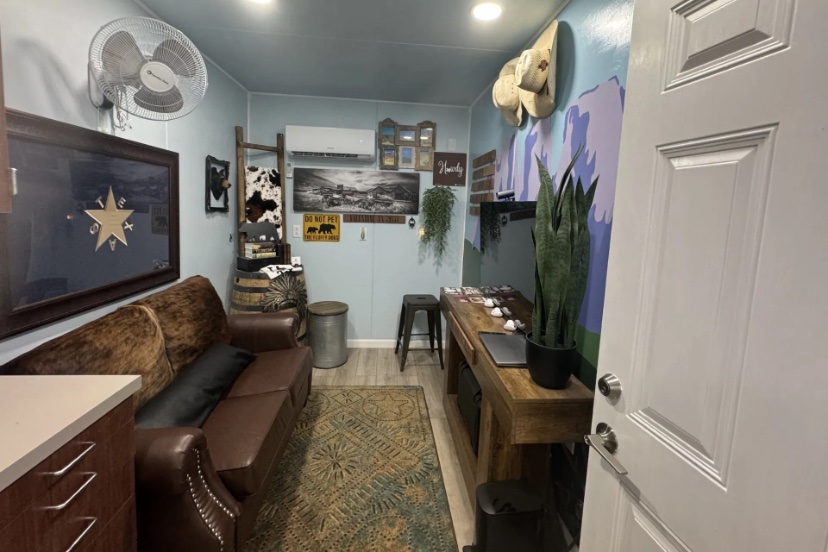
Photo: The Davis Mountain Clinic in Fort Davis, housed in a shipping container, serves as a telehealth hub, supported by Texas A&M University and Texas Tech University. (Photo by Carol Brewer)
This story by Madeline de Figueiredo appeared on The Daily Yonder on March 30, 2026. We are sharing it in three parts.
Across rural Texas, distance is more than a matter of miles, it can be the difference between receiving timely care or going without it. In the Permian Basin, a region in southwestern Texas, older adults can travel hours for a routine doctor’s visit. Limited broadband access, few primary care providers, and scarce public transportation create steep barriers.
Alma Montes, director of Area Agency on Aging of the Permian Basin, is tackling these issues head-on with a commitment to helping older people in rural Texas age in place.
“In these rural towns, they really are the best places to age. In all my years doing this work, smaller communities are where you want to be when you’re older. You can drive longer, there’s no traffic, and everything, from your house to the senior center, is just a few blocks away,” Montes said. “You feel empowered longer. You’re connected to a community where people check in on you, know your routine, and notice if something’s off. It’s just a shame primary care isn’t there for them, because it truly is a great place to grow old.”
In these Permian Basin communities, social cohesion is strong, but health infrastructure is thin. Residents lean on neighbors and family, yet often have to leave town for basic services. Montes found that older adults’ struggles with telehealth weren’t just about access to broadband or devices.
Through a partnership with Aetna, her team distributed tablets and trained about 50 seniors to use email and access virtual care. The bigger barrier wasn’t connectivity, she said; it was unfamiliarity. Many older residents were wary of technology they haven’t used before, making ongoing support essential for the successful implementation of telehealth.
Montes said that investing in these skills, tools, and community partnerships paid dividends beyond just telehealth access.
“We want to improve their overall well-being. Even if we didn’t fully get them to telehealth, there were gains along the way. They can now email family, send and receive photos, connect on social media, even Skype with loved ones. And we know, especially after COVID, that social connection has a real impact on health,” Montes said. “So even if they’re not all doing telehealth visits, they’re using technology in ways that positively affect their health.”
Community Health Workers
In many rural communities, and particularly among immigrant families, concerns about privacy, scams, and surveillance shape how residents engage with new systems. That’s where trusted local resources, like community health workers, become essential.
Community health workers are trained, certified locals who help residents navigate care, connect to services and access basic health support.
“Out in these rural communities, part of the [telehealth implementation] has to do with trust and whether you know the person,” Philips said. “Some patients have heritages that make them potential targets for law enforcement operations or other authorities. So you need a trusted figure–a navigator or community health worker–that’s known to that community and trusted. We equip those individuals to serve as a bridge, helping people understand and use the technology available to them.”
Training programs across rural Texas aim to expand the pool of community health workers and equip them both to be a local resource and a facilitator to accessing more expansive care virtually.
Practicing Telemedicine
For Dr. Ariel Santos, a trauma and acute care surgeon and director of the Texas Tech Telemedicine Program, telemedicine allows him to triage patients across rural West Texas, determining when situations demand air ambulances or when a patient can be treated locally.
“As a trauma surgeon, I’d rather be consulted earlier when there’s a trauma patient,” Dr. Santos said. “Telemedicine can be used to triage patients…It can either expedite treatment, or it can help determine that a patient doesn’t need to be transferred.”
Dr. Santos said these calls can save tens of thousands of dollars in unnecessary medical transfers and also reduce the number of visits a patient has to make as they receive continuity of care.
“I could use [telemedicine] to pre-op the patient, meaning to prepare them before seeing them in person,” Dr. Santos said. “And postoperatively, I could see the patient and check on the wound easily, without them needing to spend time and money traveling.”
Dr. Santos also sees telemedicine’s potential beyond trauma. One key example is Project ECHO (Extension for Community Healthcare Outcomes), a virtual collaboration model designed to support rural providers in caring for complex patients.
In rural Texas, caring for older adults with dementia often means working without nearby specialists. The Dementia Care ECHO program uses a hub-and-spoke structure, connecting geriatric experts at a central “hub” with local primary care teams, long-term care staff, and community providers, the “spokes,” through virtual sessions. Multidisciplinary teams, including doctors, dietitians, pharmacists, and social workers, guide providers through real patient cases, helping them deliver specialized care that might otherwise be out of reach.
“Through the ECHO program, we can leverage geriatricians’ speciality using technology,” Dr. Santos said.
For patients and caregivers, it brings expert support closer to home, though limited broadband continues to challenge access in many communities.
The Future of Rural Telehealth
Telehealth offers an alternative pathway for delivering care for both patients and providers. However, experts warned that telehealth should not be seen as a replacement for in-person care, but rather a supplemental service that expands access, especially for rural populations.
“Telehealth is not a substitute for good, high quality primary care,” said Brock Slabach, chief operations officer at the National Rural Health Association (NRHA). “So in my opinion, it should be delivered as a tool for primary care and for specialists to be able to enhance the care continuum and hopefully, in many cases, reduce the need for in-person visits.”
The Davis Mountain Clinic offers one example of balancing telehealth with in-person care delivery.
“I think it’s a great model for other rural communities,” Brewer said. “The physicians we work with are very supportive. They’re very helpful, and they are also invested beyond just the services that they’re providing. They’re wanting to help in the community, they’re asking for ways that they can serve the community.”
As rural communities continue to innovate in healthcare, discovering new ways to better serve their patient populations, they also face threats from cuts to broadband, health care, and education funding.
Philips said that without sustained investment, rural communities may struggle to maintain the trajectory of growing telehealth programs and broadband access, putting patients’ health and the progress made in digital care at risk.
“A lot of these opportunities to adopt and adapt technology were funded by federal resources that are now heavily constrained,” Philips. “As a country, we have to decide whether we value rural people enough to supply them with the healthcare and other kinds of essentials, including digital literacy, that will allow us to keep them healthy…”
This article was written with the support of a journalism fellowship from The Gerontological Society of America, The Journalists Network on Generations, and The Commonwealth Fund. It first appeared on The Daily Yonder and is republished here under a Creative Commons Attribution-NoDerivatives 4.0 International License.
The Daily Yonder provides news, commentary, and analysis about and for rural America. They welcome photos, tips, observations, and links to stories about rural America. Reach them at news@dailyyonder.com