
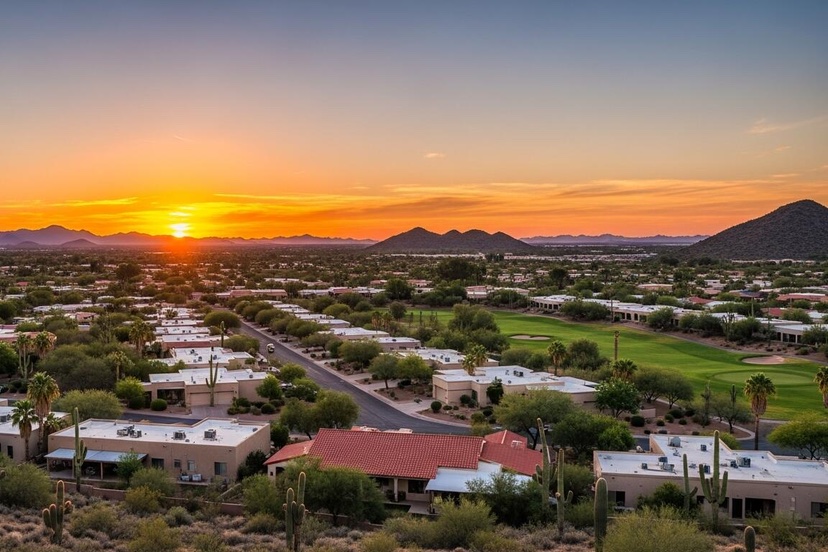
Photo: Green Valley, Arizona.
The question, “Can Archuleta County Save Itself?” suggests that our community might not, in fact, be able to.
But we remain hopeful.
Yesterday, I shared some information about an Arizona retirement community known as Green Valley, located about 20 minutes south of Tucson. An unincorporated community, controlled mainly by various Home Owner Associations.
Approximate size, 23 square miles. Population 22,600. Median age, 74. Median home price, $281,000. Median rents are about $1,200 a month.
Housing is not a serious issue in Green Valley, I suspect. But this desert community could be facing serious water supply issues in the near future.
Green Valley was conceived, from the start, as a ‘retirement community’ and many of the subdivisions are restricted to people age 55+. Why anyone would want to live in a community devoid of children, I cannot imagine. But apparently, at least 22,600 people are seeking that kind of lifestyle.
It seems, to me, unlikely that Green Valley will ever be anything other than a retirement community.
Also yesterday, I shared some information about a community known as Pagosa Springs, located in southwest Colorado, located in pretty much the middle of nowhere, an hour’s drive from the nearest ‘city’ (Durango) and four hours from the nearest major city (Albuquerque, NM).
The residential core of Pagosa Springs is known as Pagosa Lakes, an unincorporated area controlled by the Pagosa Lakes Property Owners Association (PLPOA). Approximate size, 21 square miles. Population, about 8,500. Median age, 52. Median home price, $575,000. Median rents about $2,000 a month.
A community that could be facing serious water supply issues in the future.
PLPOA was conceived, from the start, as a ‘recreational community’ that would be attractive to retirees and second-home buyers… but unlike Green Valley HOAs, the PLPOA community is not age-restricted, and it’s near a hot springs resort area in downtown Pagosa Springs. It’s also surrounded by agricultural and semi-rural properties, and a vast national forest covering about half of Archuleta County.
Perhaps unlike the community of Green Valley, housing in Archuleta County is indeed a critical issue. We already noted the median home price, and median rental prices. Taxes have been increasing. Utilities have been increasing. In general, the cost of living has been increasing.
Can Archuleta County save itself?
The forces causing this Colorado community to become unaffordable and economically fragile appear to be largely beyond control. That is to say, beyond the control of Archuleta County itself.
Up until the about 2008, the Archuleta County government and the Town of Pagosa Springs approved pretty much every subdivision proposal that came their way, without requiring developers to promise a mix of housing types. As a result, many neighborhoods consisted entirely of single-family homes on large parcels.
Very few apartments were built. This fact is important, because a functional American community includes rental opportunities priced affordably for younger individuals and families, and typically, apartments can be rented for a lower monthly price than a rental house — and for much less than purchasing a single family home.
In most American communities, it’s more affordable for a younger individual or family to rent, than to try and buy a house. That appears to be the case here in Pagosa Springs. Even though our typical $2,000 monthly rent places a serious strain on a typical tourism-industry employee’s budget, the mortgage on the median priced home in Pagosa ($575,000) will run about $4,000 a month, according to the Fannie Mae mortgage calculator.
In a healthy economy with an affordable cost of living, enough rental units exist to maintain a decent vacancy rate and keep rents low enough to serve all population segments. Unfortunately, in the tourism-driven mountain resort economy of Pagosa Springs, hundreds of homes have been converted into vacation rentals — mini-motels — and essentially removed from the available housing stock.
As of this morning, AirDNA lists 1,134 vacation rentals in Archuleta County.
On June 24 and 25, Archuleta County, the Town of Pagosa Springs, and the Pagosa Springs Community Development Corporation invited the public to learn about, and give input into, the Archuleta County-Pagosa Springs Housing Action Plan, currently being written by some out-of-town consultants.
I didn’t attend those open houses, but I heard from the organizers that the turnout was rather light.
Archuleta County is required, by state law SB24-174, to submit a ‘Housing Action Plan’ to the Colorado Division of Local Affairs (DOLA) by January 1, 2028. DOLA has published a guidance document, specifying the elements that must be included in the Plan. You can learn more about the HAP requirements here.
Although I didn’t attend the HAP open house events, I did attend a subsequent meeting of the HAP “Strategic Work Group” — a mix of local employees and volunteers involved in, or with a strong interest in, the housing crisis. The committee has been meeting monthly since January, to discuss the strategies that might be included in the Housing Action Plan.
Disclosure: I’ve been a regular volunteer participant in the HAP Work Group, but this editorial reflects only my own opinions and not necessarily the opinions of the Work Group as a whole.
About 20 local leaders attended the initial January 22 Work Group meeting. Fewer than ten were in attendance on the evening of June 25, the most recent meeting for the committee. This seems to be a typical dynamic, when convening a mixed committee of volunteers and paid employees to address a local issue. The paid employees keep showing up. The volunteers, maybe not so much.
The central question facing the Work Group and the consultants:
Can Archuleta County Save Itself?