
“By legalizing ADUs across single-family home areas, we are sending a strong message that we will use bold, creative solutions to address the housing crisis facing our residents…”
— from the Chicago.gov website, December 2025.
Back in 2006, the Pagosa Springs Town Council determined that the community was headed for a housing crisis, and they began cooperating with the Archuleta Board of County Commissioners to commission a professional survey of the problem, with suggested steps that local governments could take to mitigate the worst effects.
One of the worst effects being, that younger family would no longer be able to locate in Pagosa Springs. At the rate things were going, this seemed like a very real possibility. The study was conducted by Economic and Planning Systems, and the 95-page Housing Needs Assessment was approved and adopted in 2008.
That same year, it became apparent to some folks that the Pagosa Springs real estate market — and the overall local economy — was going to be hit hard by the Great Recession, and indeed, that did happen. The Town and County governments began scrambling to address their declining tax collections, and dropped the ball on the housing problem. (The County government was also teetering on bankruptcy, which didn’t help matters.)
If you read the 2008 Housing Needs Assessment, you might notice that it doesn’t mention ADUs. Accessory dwelling units.
In the years since 2008, our local governments have commissioned at least four ‘housing needs studies’ and have taken small steps to address the worsening housing crisis. But the idea of promoting ADUs — granny flats, garden cottages, carriage houses, in-law suites — never really took off.
But they’ve taken off in other communities…
From UrbanNestRealty.com:
ADUs aren’t exactly new — they’ve been around in various forms for decades — but recent regulatory changes, housing shortages, and shifting lifestyle priorities have created the perfect storm for their popularity. In Portland, zoning reforms have made it significantly easier to add an ADU to your property. The city eliminated system development charges for ADUs, reduced permitting barriers, and generally made the process more accessible for homeowners who want to maximize their land’s potential.
Vancouver has followed suit with its own supportive policies, recognizing that ADUs provide flexible housing options in a region where affordability and availability are constant challenges. The result? Homeowners across the metro area are seeing ADUs not just as extra space, but as smart financial moves that increase property value, generate rental income, and provide flexible living arrangements for family members.
ADUs are not new in Pagosa Springs either. A walk down Hermosa Street reveals numerous “backyard cottages” that probably date back to the 1940s or earlier… a time when property owners were not limited by land use codes designed by professional planning departments.
As mentioned yesterday, Archuleta County is in the process of updating their ‘Community Plan’. A community plan is meant to lay out the general direction a county hopes to see development — and by inference, its economy — unfold in the coming years. Typically, this plan provides guidelines for the Land Use Regulations, which are the actual laws controlling what kind of development can happen where.
The update is being required by a new Colorado law. But it provides an opportunity for the community to seriously re-think its development patterns — and by inference, its economy. (As suggested.)
Like, for example, what’s more important to our economy? Housing that workers and retirees can afford? Or protecting the ‘property values’ of our existing homeowners? Because those two goal are sometimes in conflict.
When I reviewed the Town of Pagosa Springs Land Use and Development Code yesterday, I could find only three specific references to ADUs. One mentioned a requirement that a dedicated parking space is required when adding an ADU. Another reference gave a definition of an Accessory Dwelling Unit:
Accessory dwelling unit (ADU). A secondary residential dwelling unit with its own kitchen, bathroom, living area and separate entrance that shares the building lot of a larger primary residential dwelling structure. The ADU may be attached to an existing dwelling structure (house), garage or accessory structure, or it may be a stand-alone structure, using the same utility connections of the primary house and may be rented separately.
A third reference mentioned the minimum size for an ADU.
The Archuleta County Land Use Regulations make no mention whatsoever of Accessory Dwelling Units (ADUs).
The Archuleta ‘Community Plan’ makes one single mention:
Action Items:
…Provide for Accessory Dwelling Units (attached or detached) on smaller lots in Medium and High Density areas with infrastructure (roads, water and sewer).
Both governments — the Town of Pagosa Springs and Archuleta County — are well aware of the community’s housing crisis, and some of the leadership may be aware that ADUs have been effective in other communities for addressing the lack of affordable housing. One of the most attractive aspects of ADU development: they are typically owner-financed and do not need government subsidies.
Maybe I should repeat that statement.
“Do not need government subsidies.”
They mainly need to be allowed. Or even, God forbid, encouraged.
From a 2017 report by the Terner Center for Housing Innovation:
Three factors are key to the success of ADU implementation. First, in cities that have reformed their zoning regulations, particularly minimum lot size and floor area, production has jumped. Also important are minimizing design review and easing owner occupancy requirements. Second, waiving fees, such as permit or utility connection fees, can spur homeowners to build. Finally, cities that take steps to educate homeowners (for instance, via ADU manuals and prototype plans), as well as providing technical assistance, will likely see a payoff for relatively minimal cost and effort.
The biggest challenge faced by homeowners is lack of financing. To finance their ADU project, 30% of respondents used only their own cash and an additional 15% drew entirely on other personal resources such as credit cards. Among the remainder, 40% of respondents reported borrowing against the existing equity in their property. Just 4% reported borrowing against the future expected value of the un-built ADU to help finance its construction…
Here’s the photo I shared at the top of this article.
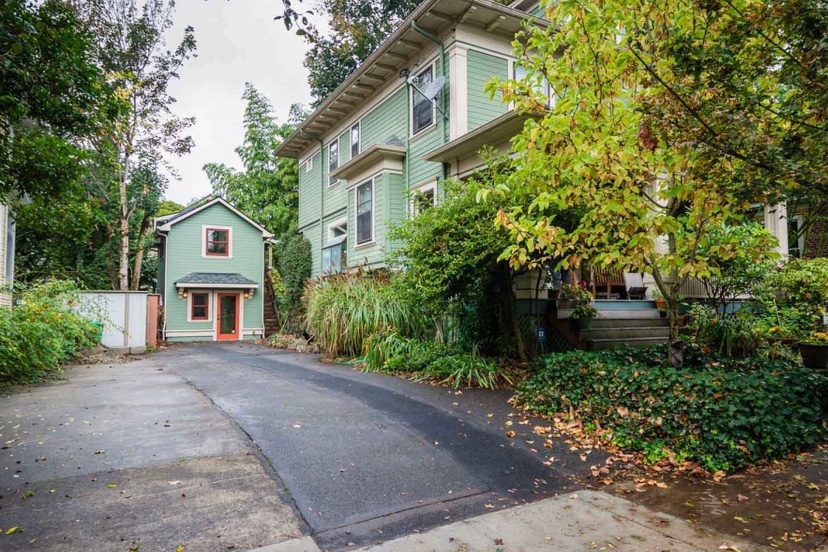
Would such an ADU, erected in a neighborhood, cause anyone to freak out? Would it cause the neighbor’s property values to be ravaged?
If ADUs are one of the best and most affordable solutions to a housing crisis…
…what are we waiting for?
Bill Hudson began sharing his opinions in the Pagosa Daily Post in 2004 and can't seem to break the habit. He claims that, in Pagosa Springs, opinions are like pickup trucks: everybody has one.