

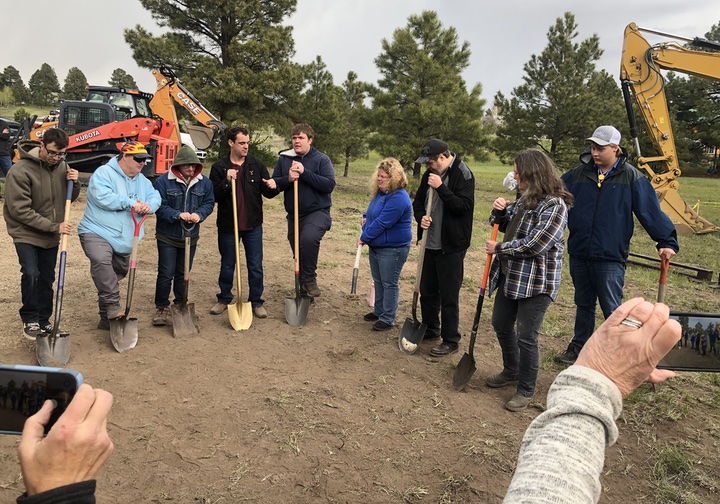
Today at 5pm, the Pagosa Area Water and Sanitation District board will meet at the PAWSD offices, and will consider a possible waiver to certain fees for Aspen House — a group home for adults with developmental disabilities now under construction.
I attended a ‘listening session’ at The Studios on Hot Springs Boulevard earlier this week. Alex Kelloff, a Democratic candidate for Congress, running against Representative Jeff Hurd for the CD3 seat this year, had come to town to hear from, and speak to, fellow Democrats. What’s going well in Archuleta County? What’s not going well? What change would they like to see, if Mr. Kelloff gets elected?
The give-and-take conversation was lively, and left-leaning.
I can’t say for sure that everyone in the room was a Democrat. I can safely say that very few of the three dozen people in the room appeared to be under the age of 60. Maybe three, or four?
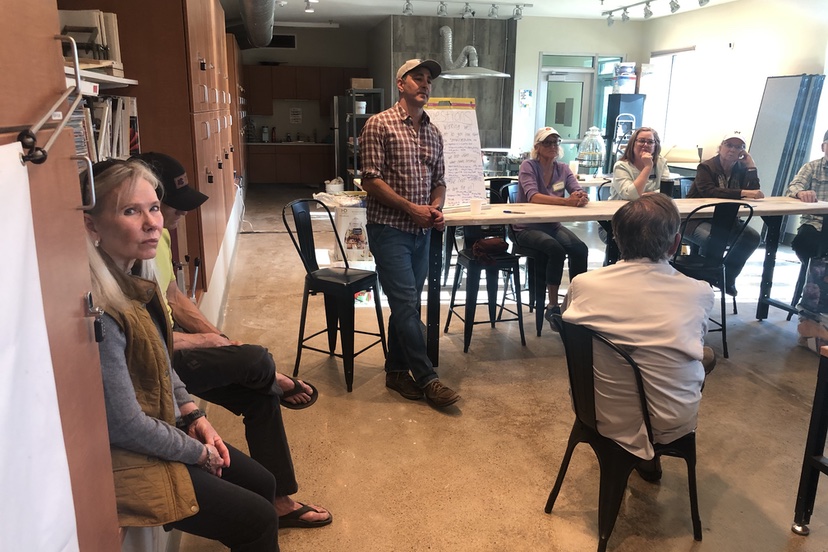
Mr. Kelloff is running against Democrat Dwayne Romero in the June primary.
Does this campaign event relate to the groundbreaking for the Aspen House group home on Vista Boulevard? In a way, yes. Mr. Kelloff asked the audience members to tell him what they believe needs to be fixed in Washington, and the audience tossed out well more than three dozen key issues.
I don’t recall the care of adults with developmental disabilities being among the issues mentioned.
In a 2023 report, the Centers for Disease Control and Prevention (CDC) noted growing prevalence of developmental disabilities diagnosed among children in the United States. According to the CDC’s National Health Interview Survey, conducted between 2019 and 2021, the prevalence of any diagnosed developmental disability in children aged 3 to 17 years rose from 7.4% in 2019 to 8.6% in 2021. A measurable change… over a span of just two years?
The report highlights that boys are more likely to receive a developmental disability diagnosis than girls, with more than 1 in 10 boys having been diagnosed with intellectual disability, autism spectrum disorder, or other developmental delay in 2021.
I was able to sit down, earlier this week, with Pattie Copenhaver, executive director for Aspen House and Aspen Services, and discuss the group home now under construction. Specifically, we discussed the non-profit’s fundraising efforts, and the way Colorado provides support for children and adults with intellectual disabilities.
Constructing a group home is one piece of the puzzle. Funding the operations of a group home is another piece, and the operational funding for the future Aspen House will apparently depend on Developmental Disability (“DD”) Medicaid waivers from the state of Colorado. The waiver was introduced in the state of Colorado in 1983 as part of a national effort to move people with Intellectual and Developmental Disabilities from institutions to community-based settings. The state has a limited number of these waivers, which — once obtained — last for a person’s lifetime. The waiting list to obtain a waiver is quite long, and the wait, according to new policies recently put in place, could be as long as 12 to 20 years.
Ms. Copenhaver explained that there are three young men in Archuleta County who currently have “DD” waivers and who could be housed in the future Aspen House group home. A fourth young man has no waiver but could be supported by a family trust fund. The other four bedrooms in Aspen House, once it’s finished, could be offered to young men who have DD waivers but who have been displaced from Archuleta County to care situations outside the county.
Essentially, the housing and 24/7 services that Aspen House will be providing depends mainly on state of Colorado funding — the DD Medicaid waivers.
Ms. Copenhaver:
“So people that don’t have a DD waiver right now, are looking at extended time frames. It was already terrible, at 6 to 10 years on the waitlist. Now, if we’re really looking at 12-20 years? That means that once somebody applies and is determined to have a disability, they could be on the waitlist for that length of time, until a space opens up for them.
“And my understanding is, the reason for that, the care is very expensive. They estimate around $150,000 a year — to care for a person with disabilities for a year, because their care is round-the-clock care. So that waiver costs the state $150,000 per individual. And there’s only so much money in that budget. So a spot has to open up.
“Once it opens up, the next person on the waitlist then gets their waiver…”
The waiver lasts for the person’s lifetime. So perhaps 70 years? At the going rate, that would mean a lifetime subsidy of $10 million.
According to the Colorado Sun article by Jennifer Brown, the state recently changed its waitlist policy. The state used to grant one new DD waiver, each time an individual left the system, The new policy now requires two individuals to leave the system before one new individual can be given a waiver. Thus, the wait times have doubled, from about 7-10 years to about 14-20 years.
Ms. Copenhaver:
“Part of the problem in rural communities — families aren’t as well educated about the benefits of these programs, at an early age. In the bigger cities, children are identified as having a disability that could be assisted with these waivers, when they are still in elementary school. And if a family is helped through the [diagnosis process] — and they need to be helped, because it’s a very complicated process. It takes a lot of time, and it can be frustrating. So it the family is helped while the child is young, that child can get on the wait list. Then the person is in their early 20s, or early 30s, and the family then — if there’s an illness in the family, or a death or something — that child can go right into an assisted living situation, with a group home.
“Whereas, if they don’t have a waiver… the people that we’ve helped who have been displaced from our community, they become homeless. And there’s nothing here for the, and we don’t want to just send them to a shelter in Durango, on their own. So what has happened is, they’ve had to find housing in other communities that have host homes available…”
A “host home” is something like a “foster home” where an adult with a DD waiver is cared for by a family in a private home.
Aspen House is taking a different tack, and working to create a supportive group home situation here in Pagosa Springs, on Vista Boulevard.