
Last night’s meeting agenda for the Pagosa Area Water and Sanitation District (PAWSD) mentioned a presentation by the district’s comptroller, Jack Dossett.
Consideration of Presentation of Q1 Financial Statements
This presentation was somewhat unusual, because — unlike some other government agencies in Pagosa Springs — the PAWSD Board has not had regular monthly or quarterly financial reports as part of their agendas. This lack of regular reporting might seem, to some, like a potentially serious omission, considering the organization’s $23 million budget.
Boards in recent years presumably felt that regular financial reports were unnecessary, on the assumption that the staff was keeping sufficient track of revenues and expenditures.
As it turns out, the PAWSD budget this year is facing some possible challenges, based mainly on an apparent economic slowdown in the construction industry. Much of PAWSD annual revenues come from fees paid by new development. When construction slows down, fees are slow coming in.
Another challenge to the district budget are the current Drought Level 1 restrictions, which is meant to discourage excessive water use. Less water sold can mean less revenue from existing customers. If the precipitation picture doesn’t improve soon, the district might shift into Drought Level 2 restrictions within the next month.
Disclosure: I currently serve as a volunteer on the PAWSD Board of Directors, but this editorial reflects only my own opinions, and not necessarily the opinions of the PAWSD Board and staff.
We’re going to dig into the PAWSD budget discussion in my next editorial, on Monday. But there was an item on last night’s agenda that had a potential impact on the PAWSD budget.
Consideration of Presentation – Aspen House
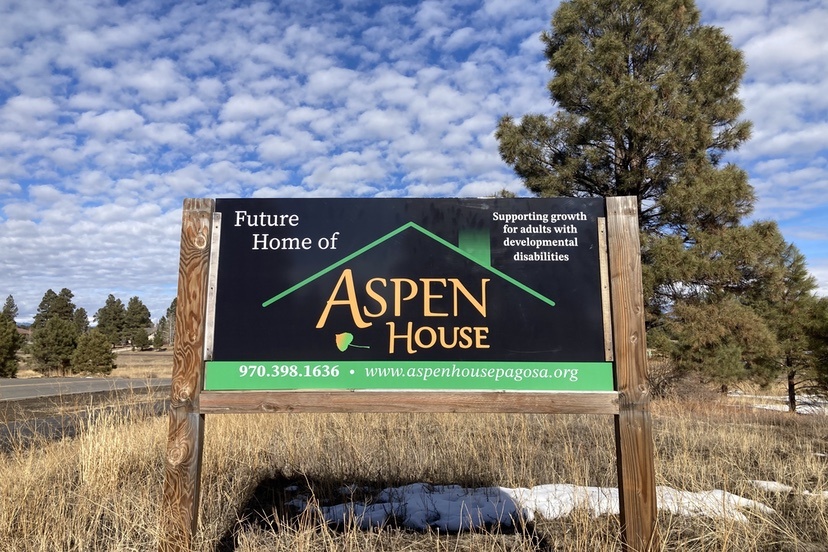
We’ve been discussing the Aspen House project in this editorial series. The $2.4 million group home project broke ground on May 1, after 14 years of planning and fundraising and permitting. The nonprofit A Safe Place in Pagosa Springs Inc. plans to build and operate a residential home that can accommodate eight adults with developmental disabilities. The home will provide 24/7 care and supervision, and its operations will be funded largely through Developmental Disability Medicaid waivers provided by the state of Colorado..
Here’s Aspen House executive director Pattie Copenhaver, introducing the topic:
“We’re here to ask for your partnership in support of our program. Any dollar… any penny… that you’re willing to waive for us, becomes an investment and goes straight into construction, reducing our construction costs overall. Right now, we’re about $640,000 away from [full funding for] our final build. We’ve raised a lot. And Tim Brown, our general contractor, has been able to reduce our cost by over $1.2 million…”
The PAWSD presentation focused on approximately $76,000 in fees the organization would have to pay to PAWSD, unless the Board of Directors decided to waive the fees. The fees included about $67,000 in Capital Investment Fees (CIFs) and about $9,000 for a water model report.
The PAWSD meeting room was ‘standing room only’ for the Aspen House presentation, which included speeches by Aspen House board members, two Archuleta County commissioners, general contractor Tim Brown, and various other supportive members of the community. Several of the speakers urged the PAWSD board to waive the entire $76,000 amount.
Some of the subsequent ‘give and take’ discussion between the audience and the PAWSD board focused on the fact that Archuleta County had permitted the project as a “commercial” building. Commercial buildings generally pay higher development fees in general — including higher PAWSD fees — for various reasons.
PAWSD board member Glenn Walsh argued that this was not a ‘commercial’ project, but was in fact comparable to a large vacation rental house — which would be classified as “residential” and would likely be charged a CIF fee of only $26,000… and being “residential”, would not be required to pay for a $9,000 water model report.
“I view this through a kind of social welfare, basic health care, provision of medical care, public service lens. We’ve had many projects come to us — hospitals, critical mental health facilities — and we always try to be very reasonable, and often waive fees entirely for projects like that. So I’m open to waiving the fees for this one.
“I appreciate the budgetary issue [scheduled for discussion later in the board meeting] but I think when we get around to the budgetary issue, if we want to deal with it seriously, it has nothing to do with whether this particular project is ‘one equivalent unit’ or ‘2.5 equivalent units’. The budget issue is a much bigger problem, and the potential solutions are going to be much more dramatic. People might not like them, but we’re going to have to pursue them…
“So I’m willing to… but I respect everyone on the [PAWSD board] and I respect the opinions they have. I would hope that we wouldn’t go above one EU here…”
The PAWSD staff had calculated the projected water use for the project — based on ‘fixture count’ — as 2 1/2 times the water and sewer use of a typical residential home. So, 2.5 EUs.
Only four of the five PAWSD board members had attended last night’s meeting — Gene Tautges, Glenn Walsh, Alex Boehmer and Bill Hudson — so some mathematical calculations were in order.
In order for a motion to be approved by a government board, the ‘majority’ of the board must vote in favor. When four board members are present, this requires three affirmative votes. A motion that gets only two votes would fail.
Following a lengthy discussion including the board and audience, it became apparently that Mr. Walsh would not likely get three votes if he moved to waive the fees entirely. Meanwhile, it appeared that reclassifying the project as “residential” rather than “commercial” would save Aspen House about $50,000 — and would likely garner three affirmative votes.
So that was essentially the motion made by Mr. Walsh. Indeed, the vote was 3 in favor, 1 opposed.
Aspen House didn’t get the full waiver they had hoped for. At the same time, their fees were reduced by approximately $50,000.
More about the financial implications of this vote this will be shared on Monday, in a new editorial.