
Good afternoon, everyone.
Thank you for being here today. Your presence means so much to the Aspen House board, to this community, and most importantly, to the adults with developmental disabilities who are standing here with us today…
— from a speech by Aspen House board treasurer Bryan Looper, May 1, 2026.
The skies above us on Friday, May 1, were threatening rain. Rain would be welcome, of course, given the likelihood of water shortages and drought in the American West this year… but we hoped it could delay itself for maybe an hour? To allow a celebration to be completed at a vacant parcel on Vista Boulevard, where several dozen people had gathered to witness a ground-breaking for a housing project 11 years in the making.
The non-profit organization behind the event, A Safe Place in Pagosa Springs, Inc. was founded in 2015 by Patricia Brown and Carolyn Paschal to provide a safe home for their adult children with developmental disabilities. They expanded their vision to include additional families facing the same circumstances in the Pagosa Springs area.
Now, surrounded by community supporters from all walks of life, Patty and Carolyn — with large earth-moving machines waiting in the background — spoke to the crowd about their journey, and toasted the impending groundbreaking with glasses of sparkling grape juice.
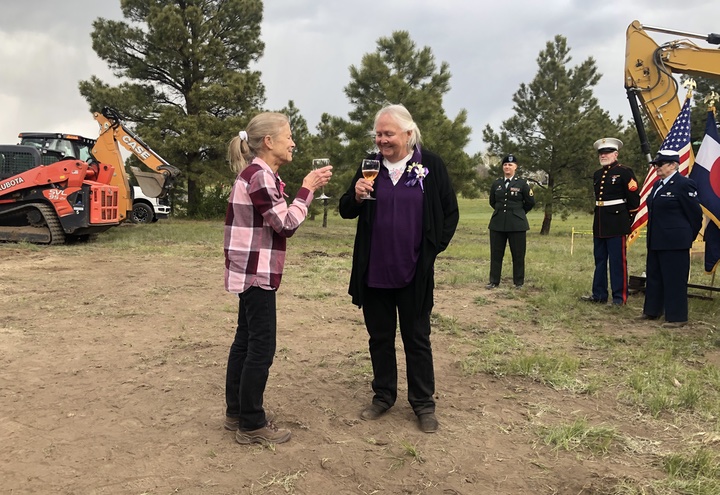
This project wouldn’t be where it is today without the tremendous backing of the whole community. For this, we are ever so thankful and grateful to every single person.
This community made this happen.
— Aspen House founder Patty Brown
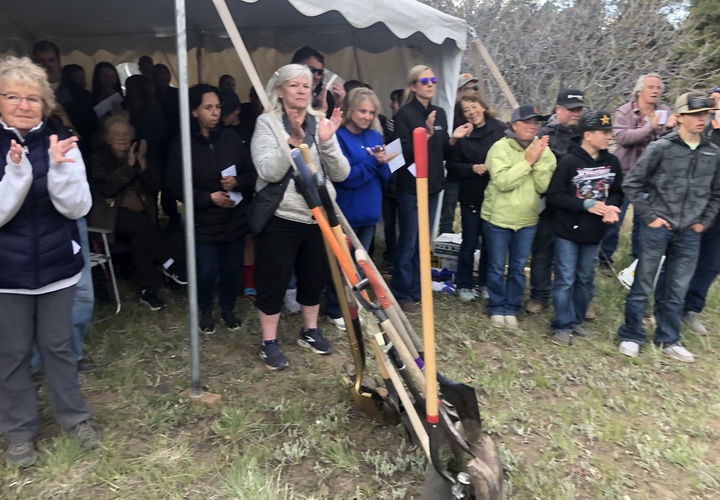
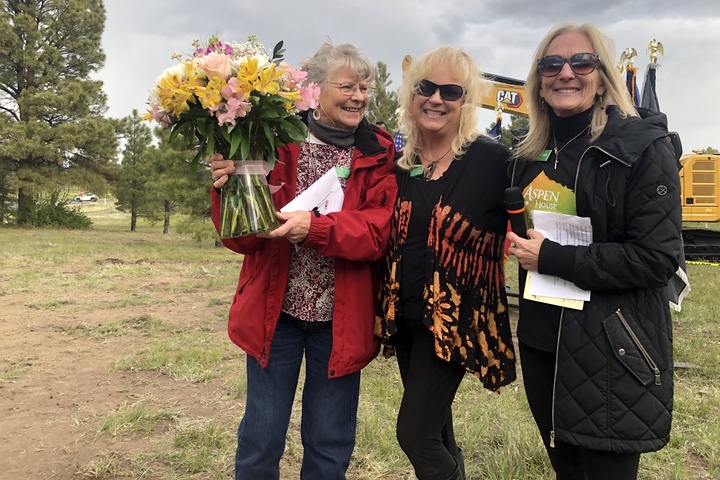
The next folks to elicit applause from the gathered crowd were Marybeth Snyder and Keena Carstensen, who presented a large and beautiful bouquet to the organization’s executive director Pattie Copenhaver.
From the Aspen House website:
Pattie joined the Aspen House team in September of 2023. She spent over two decades in marketing communications working for Texas Instruments. After relocating from Tucson, Arizona to Pagosa Springs, she fell in love with the small town mountain life and realized that raising her family in a kinder, gentler place was truly the right decision and dedicated herself to finding purpose in her work through creative expression and leadership…
…Her goal is to help Aspen House grow and looks forward to being part of the capital campaign that will build Aspen House and make the dreams of the founders, board and families of adults with developmental disabilities a reality.
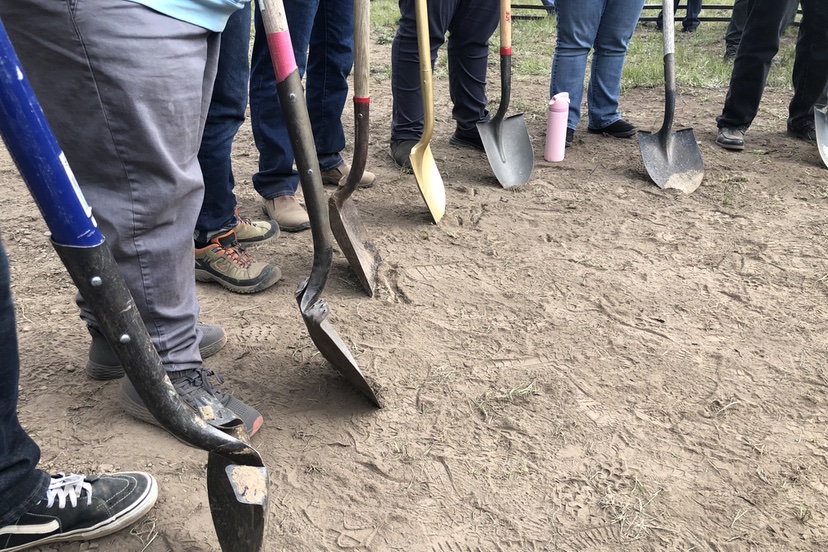
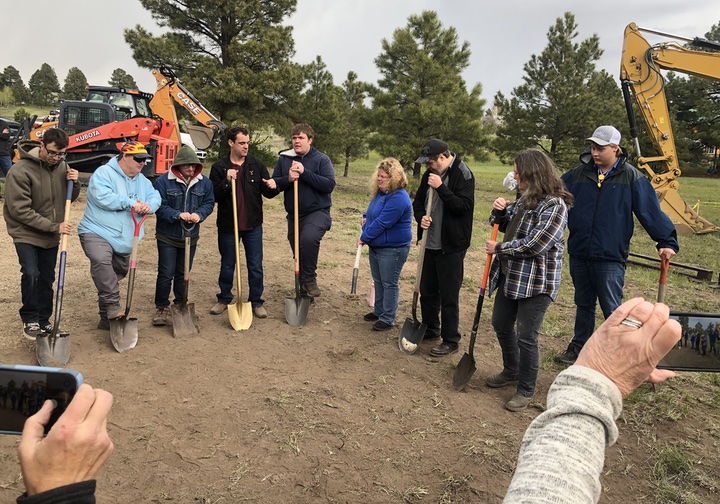
The future residents of the planned group-living home would presently pick up the the ceremonial shovels and scoop up a bit of ceremonial dirt, while many of the construction crew looked on, along with the gathered audience.
A big yellow backhoe waited to scoop up the first mechanical shovelful of Archuleta County soil…
But the $2.4 million project appears to be still seeking a substantial amount of funding before the house can be completed.
According to the Aspen House website, A Safe Place in Pagosa Springs has raised about $500,000 in community donations, and about $1.2 million in “building community sponsorships” — that is to say, in-kind donations from contractors and subcontractors — the project appears to be perhaps $650,000 short of its fundraising goals.
But that concern was not obvious at the May 1 groundbreaking event. Rather, this was a celebration of the progress thus far.
The ceremonial shovels were distributed to the likely future residents, and photos were taken.
From the Aspen House website:
Our goal is to welcome our first Aspen House residents into the completed home by late 2026 – early 2027.
Aspen House Amenities
- Eight Independent Living Suites
- 24/7 Safety/Security Personnel
- Shared Activities Area
- On-site Aspen Services office
- Commercial Kitchen/Meal Prep Services
- Communal Dining Area
- Residential Services Provided On-site
- Non-medical Transportation Services
- Shared Laundry Facilities
- Outside Recreation Areas
- Geothermal Garden Dome
- Easy Access to MET Bus Stop
Our local Pagosa parents, organizers, supporters and volunteers are not the only ones concerned about the future of young adults with developmental disabilities. It’s a national concern.
And a Colorado concern.
From Colorado Sun reporter Jennifer Brown, March 27, 2026: “A waitlist for 24/7 care for Colorado adults with disabilities is 7 years long. State Medicaid cuts could double it.”
Five years ago, when Colorado’s economy was looking far sunnier than predicted, state leaders tackled a problem that for years had troubled those who care for the most vulnerable among us.
State budget writers said there was money, finally, to begin clearing the wait list for 24-hour care for adults with developmental disabilities, which in 2020 was about eight years long with about 2,800 names on the list. Aging parents who had worried they would die before their adult children had someone to take care of them were relieved to the point of tears.
But now, here we are: As Colorado grapples with a state budget forecast so grim that budget writers are trying to trim about $1.5 billion in spending, the prospects for care are headed in the other direction.
The wait list for what’s called the development disabilities Medicaid waiver — now about seven years long, and still with 2,800 names — could quickly double with the latest policy changes.
The people on the waiver, funded with state and federal money, have access to round-the-clock care in their homes, in host homes with a couple of other people, or in group homes with up to eight people. The cost of the residential waiver programs for adults and children pushed over $1 billion this fiscal year, with enrollment climbing to 9,451 people, up 843 people over the previous year, and compared with about 6,700 people in 2020…