
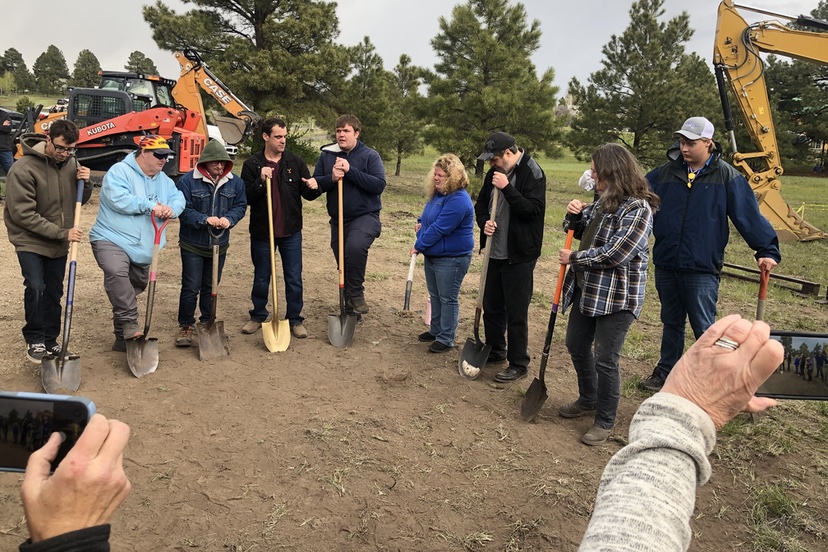
Following the speeches from some of the founders and staff of A Safe Place in Pagosa, Inc. — which included expressions of thanks to retired contractor Tim Brown and the subcontractors he has assembled to donate labor to the ongoing Aspen House project — and the ceremonial shoveling of dirt by the likely future residents of the Aspen House group home, the gathered crowd of several dozen supporters counted down from 10, as a large backhoe prepared to scoop up a shovelful of soil where the foundation for the home will be located.
As mentioned previously, the skies above us on Friday, May 1, were threatening rain. And indeed, a light rain did start to fall, just as the groundbreaking ceremony came to an end.
But before it ended, we were treated to a sometimes emotional speech from A Safe Place board treasurer Bryan Looper about the importance of this community-supported project.
Good afternoon, everyone.
Thank you for being here today. Your presence means so much to the Aspen House board, to this community, and most importantly, to the adults with developmental disabilities who are standing here with us today.
Aspen House has been a dream, a hope, and a much-needed project for 11 years. For more than a decade, this board has faced resistance, delays, and a lack of government grant funding. But we have kept pushing forward. Not just because we want to, but because this home is needed.
As a financial advisor and planner, l often talk with my clients about the difference between wants and needs. Wants are nice to have. Needs are the things we cannot go without: a job, transportation, food, clothing, and most importantly, a safe place to live.
Everyone deserves a home. Everyone deserves a safe place where they are protected, known, supported, and loved. For adults with developmental disabilities, that need becomes even more urgent when they reach adulthood. Many age out of support systems. Families may wait up to 10 years or longer for residential placement. And right now, Pagosa Springs does not have a group home or residential facility for these adults.
That creates a heartbreaking reality. When parents or caregivers are no longer able to provide care, these adults may be forced to leave the community they know and love. They may be sent to larger cities, into unfamiliar systems, unfamiliar homes, and unfamiliar surroundings. They lose the support network that has helped them thrive.
Aspen House is our opportunity to change that.
This home will provide a safe, local, supportive place for eight adults with developmental disabilities. It will allow them to remain in the community that has raised them, supported them, and loved them. That is not just a good project. It is an imperative need.
Today, we are 60-70% of the way toward getting this home built. That progress has happened because of the incredible generosity of this community. People have given labor, materials, donations, time, and encouragement. Every contribution has brought Aspen House closer to becoming a reality.
But we are not finished yet. We still need help to complete the home, and we also need support for the long-term sustainability of Aspen House so it can serve residents for years to come. So I am asking you today: if you can help with labor, materials, funding, donations, or if you know someone who can, please reach out to us. Every gift matters. Every hour matters. Every connection matters.
Thank you again for being here this afternoon. It means more than you know. It means a great deal to the board. It means a great deal to our community. But most of all, it means everything to the adults with developmental disabilities who deserve to remain right here, at home.
Thank you, and God bless.
As mentioned in Part One yesterday, the groundbreaking has taken place but the fundraising for this $2.4 million group home is not complete. According to the Aspen House website, the non-profit corporation financing the project is still about $644,000 short of the necessary funds to complete the construction project.
And that shortfall may be only the beginning of an ongoing challenge.
Once the facility is completed and the young men with disabilities move in, A Safe Place in Pagosa will need consistent funding to staff and operate the home. I understand that much of the funding will likely come through Developmental Disabilities (“DD”) Medicaid waivers.
Additionally, A Safe Place has been operating a frozen yogurt business in downtown Pagosa — PS Froyo — which donates its profits to the Aspen House project and where some of the future residents have found employment. We might assume that business has been slow this past year, as it has been for so many downtown businesses due to the Highway 160 reconstruction.
In Part One, I quoted a March 2026 Colorado Sun article by Jennifer Brown, discussing Colorado’s Medicaid waivers for developmentally disabled people and the struggle in the Colorado legislature to produce a balanced state budget for next year. Cuts were made in state services. I’m not clear which programs took the biggest hit. Here are Ms. Brown’s comments again…
The wait list for what’s called the Developmental Disabilities Medicaid waiver — now about seven years long, and still with 2,800 names — could quickly double with the latest policy changes.
The people on the waiver, funded with state and federal money, have access to round-the-clock care in their homes, in host homes with a couple of other people, or in group homes with up to eight people. The cost of the residential waiver programs for adults and children pushed over $1 billion this fiscal year, with enrollment climbing to 9,451 people, up 843 people over the previous year, and compared with about 6,700 people in 2020…
…Instead of enrolling a new person in the adult development disabilities waiver each time one person exits or dies, Colorado will now enroll one person for every two who exit. Reducing the “churn” rate by 50% could mean a doubling of the waitlist to 14 years…
During his speech at the groundbreaking, Mr. Looper drew a distinction between “wants” and “needs”. Most of us would characterize “a roof over our heads” as a “need”… but we typically expect individuals and families to take responsibility for finding, and paying for, said “roof”.
Sometimes, however, it takes a village to provide the roof.