
The availability of affordable renewable generation also opens up vast possibilities for reducing economy-wide emissions by switching from burning polluting fuels to using pollution-free electricity in our cars, homes and businesses— all while saving Coloradans money…
— from Colorado Energy Office Annual Report FY 2019
No source of energy is without its challenges.
Cost can be one such challenge.
Gasoline here in Pagosa was priced between $3.93 and $4.16 per gallon last week, depending on which gas station you visited. Nationally, the average cost of gasoline, since the year 1999, has fluctuated between $0.91 per gallon and $4.80 per gallon. The national average for natural gas, since 1999, has varied between $1.54 and $14.84 per million BTUs.
If the cost of other necessities was as volatile as oil and gas, we would be pulling our hair out. But volatile pricing isn’t the only problem with fossil fuels. From Colorado’s Greenhouse Gas Pollution Reduction Roadmap 2.0:
In addition to reducing Greenhouse Gas emissions, the Near Term Actions will reduce emissions of nitrogen oxides, sulfur oxides, particulate matter, and other pollutants, resulting in an estimated 500 avoided deaths between now and 2050 and more than 10,000 avoided asthma attacks over the same period. These actions will also create more than 95,000 new jobs between now and 2050…
As mentioned on Friday in Part One, the Colorado Energy Office has been tasked with developing ways to reduce the state’s dependence on fossil fuels, which means increasing its dependence on electrical energy.
The Trump administration, meanwhile, has focused its policies for the past year on increasing America’s dependence on fossil fuels, and discouraging the transition to renewable electrical energy.
When we think about electricity, we probably don’t imagine such price volatility as we see in fossil fuel markets. We expect our electric bill to remain about the same, month after month. Maybe an increase at the rate of inflation? U.S. inflation was around 3.3% last month… while gasoline prices increased by more than 20%.
Ideally, of course, we’d like to see the cost of energy falling, instead of rising. Unless we were an oil and gas company, that is.
From Fortune magazine, March 12:
The market capitalization values of Exxon Mobil, Chevron, and a bevy of other U.S. oil and gas producers, refiners, and exporters surged to all-time highs this week amid the Iran war and fears of growing fuel and power costs and shortages worldwide…
…U.S. benchmark for crude oil pricing is up a whopping 70% since the beginning of the year when the industry was still concerned about weaker prices and global oil oversupplies. All the talk had been on utility prices replacing prices at the pump as the new political bellwether in a midterm election year, but now fuel prices are skyrocketing as well.
As such, industry leader Exxon’s market cap it up nearly 30% this year to a new high of $643 billion. Chevron is up over 30% to almost $400 billion. Occidental Petroleum, which was struggling in market performance, is up 43% this year…
Surely, we hated to see the big oil companies struggling with weaker prices and global oversupply earlier this year.
The Iran War to the rescue.
And maybe we’re okay with paying higher prices at the pump, if it can boost Exxon’s market capitalization.
As 2025 came to a close and 2026 began, I had been reading plenty of stories about rising electricity prices. I’d also been hearing comments about our local electric cooperative, La Plata Electric Association, buying its independence from the regional cooperative Tri-State Generation and Transmission. LPEA joined Tri-State as a member in 1992, and extended its contract in 2007, which would have run through 2050. LPEA officially left Tri-State on April 1, 2026.
Tri-State members can terminate their wholesale electric service contracts and withdraw from Tri-State by providing an unconditional two-year notice, and by making a contract termination payment under a formula ordered by the Federal Energy Regulatory Commission (FERC). The LPEA Board provided its unconditional notice to leave Tri-State in March 2024. LPEA’s termination payment to Tri-State is approximately $208 million. In addition, LPEA received a credit for its patronage capital in Tri-State, resulting in a net payment of approximately $159 million.
Will this exit result in LPEA having to raise our monthly electric bills? Some folks have expressed that worry.
I spent some time, over the weekend, educating myself about America’s complicated energy landscape. Reportedly, about 88% of increased electric capacity in 2025 — about 33 GW of additional generation — came from solar and wind installations. That’s according to a March update from FERC.
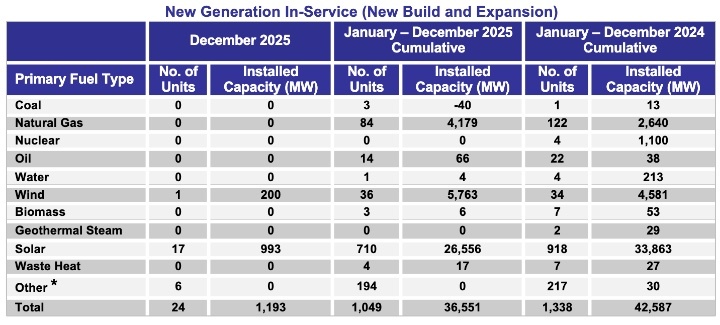
Natural gas was in third place with about 4.2 GW of new capacity. Coal-fired capacity declined slightly, by -40 MW.
FERC predicts that the U.S. is likely to add 107 GW of new solar and wind capacity over the next two years… three times the amount added in 2025. 23 GW of new natural gas capacity is also likely to be added.
We might ask ourselves, “Why are electric utilities focusing on solar and wind installations over the next two years?’ …when the Trump administration and the ‘One Big Beautiful Bill Act’ are specifically aimed at discouraging renewable energy in favor of fossil fuel energy…
A simple answer seems to be: renewable energy is now more cost-effective than fossil-fuel energy, and getting ever more cost-effective, as oil wells get more and more expensive to drill, given that oil companies have to drill deeper and deeper to hit new reserves. The average cost of a new oil well in 2014 — adjusted for inflation — was about three times what it cost back in 1994. The average cost in 2014 — adjusted for inflation — was about 10 times the cost compared to 1976. The world has plenty of oil at the moment, but new sources are getting… expensive.
Another part of the answer to the growing investment in renewables might be: renewable energy is less polluting of the atmosphere. In particular, ‘greenhouse gas pollution’.