
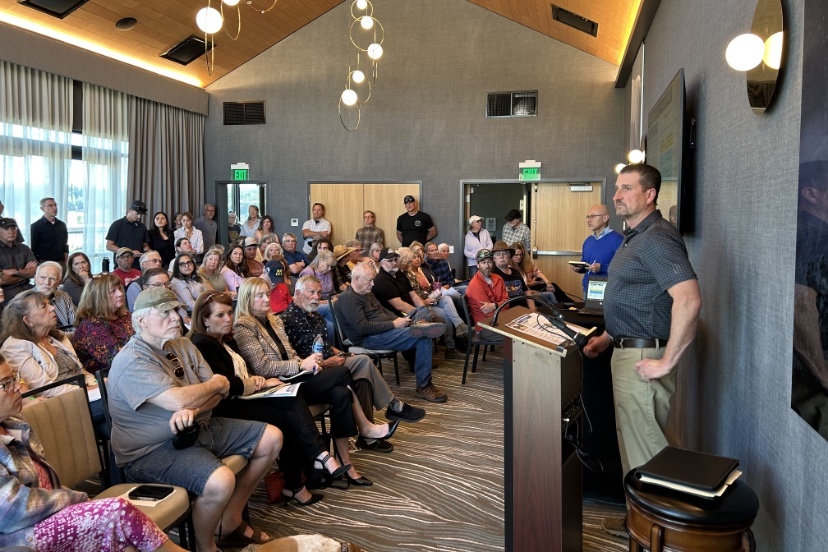
Photo: Housing Coordinator Jeff Sams shares information about the local housing crisis at the March 25 ‘Interactive Community Forum’ hosted by Archuleta County.
Even people who care, and who are paying close attention to their community, do not always agree on the facts. For one thing, the “facts” are not always easy to discover… and are also easy to misinterpret… and are also easy to ignore, when they don’t align with your agenda.
Earlier in the editorial series, I shared a few comments from Joel Hellwege, one of the thoughtful and caring people who attended the March 25 ‘Interactive Community Forum’ hosted by County Commissioner John Ranson and County Manager Longinos Gonzalez Jr. at the Springs Resort on March 25. I did not attend the forum — I was out of town that night — so I need to rely on other people’s interpretation of the “fact”. The discussion ranged across a number of issues, including water resources, road maintenance, housing policy, government planning and, of course, potential future tax increases.
Mr. Hellwege had posted a short essay about the forum on his social media account. Here are some additional comments from him:
There was also a discussion about low-cost housing, which one of the attendees correctly identified as government subsidized housing. I know, and I believe the general consensus in the room was, that there needs to be less regulation, which would be the best and most effective long-term way of reducing the cost of housing.
I partly agree with Mr. Hellwege’s assessment. The idea that governments can address poverty in various ways, such as through subsidized housing, is not a new idea. During the 1800s in America, government involvement in housing for the poor was chiefly in the area of building code enforcement, requiring new buildings to meet certain standards for decent livability (proper ventilation, fire escapes, etc.)
Early tenement reform — primarily a philanthropic venture — attempted to use new architectural and management models to address the physical and social problems of the slums. These attempts were limited by available resources, and early efforts were soon redirected towards building code reform. The New York Tenement Act of 1895 and Tenement Law of 1901 were early attempts to address building codes in New York City, which were then copied in Chicago, Philadelphia, and other American cities.
The City of Milwaukee, under mayor Daniel Hoan, implemented the country’s first public housing project — Garden Homes — in 1923. This experiment with a municipally-sponsored housing cooperative saw initial success, but was plagued by development and land acquisition problems, and the board overseeing the project dissolved the Gardens Home Corporation just two years after construction on the homes was completed.
100 years later, housing is still a potent and contentious issue in America, even in rural towns like Pagosa Springs. Just yesterday, our local government-funded Housing Coordinator, Jeff Sams, helped to lead a meeting of various housing advocates in a discussion. The Town of Pagosa Springs and the Archuleta County government are cooperating on the writing of a ‘Housing Action Plan’ now required of all communities by state law. The Plan is scheduled to be published and adopted next fall, and yesterday’s meeting focused mainly on ways that local governments can acquire additional money to subsidize housing projects. Property tax increases? Increased fees for vacation rental operators? Increased Lodging Taxes collected from tourists?
But as Mr. Hellwege suggests, another method for encouraging lower-cost housing is through modifications to local land use regulations.
Easier said than done, however. For example, last month, the Archuleta Board of County Commissioners adopted updated building codes written by the International Code Council. From the ICC website:
The International Code Council is the leading global source of model codes and standards and building safety solutions that include product evaluation, accreditation, technology, training, and certification. The International Code Council’s codes, standards, and solutions are used to ensure safe, affordable, and sustainable communities and buildings worldwide.
Balancing “safe” and “affordable” is a juggling act, dating back to the efforts in the late 1800s.
The BOCC also adopted, last month, the Colorado Wildfire Resiliency Code, which will impose new requirements on building construction beginning July 1, 2026. These new requirements will reportedly increase the cost of typical housing built in Archuleta by an estimated 10%-20%. The BOCC expressed their regrets about adopting the CWRC, but saw no way to get around its adoption.
From the CWRC:
The provisions of this code shall apply to the construction, alteration, movement, repair, maintenance and use of any building, structure or premises that contain occupiable and/or habitable space, or change in use resulting in an occupiable and/or habitable space, unless excepted, within the wildland-urban interface areas of Colorado, as designated in this code.
Pretty much all the residential areas of Pagosa Springs are within the so-called ‘wildland-urban interface’, where neighborhoods meet the forest.
Who will end up paying the additional 10%-20% in increased construction costs, if we desperately need lower-cost housing in Pagosa Springs? Good question.
The juggling act also involves another big issue. Everyone wants to see a solution to the housing crisis, but many do not want to see the solution unfold in their own neighborhood, and affect their property values.
A few more comments from Mr. Hellwege’s social media posting:
The lady in the picture with glasses on her head is our brand new planning department head. In fact, she said that she starts today [March 25]. I spoke with her afterwards, along with Randy Betts, currently the head of the building department and now running for County Commissioner.
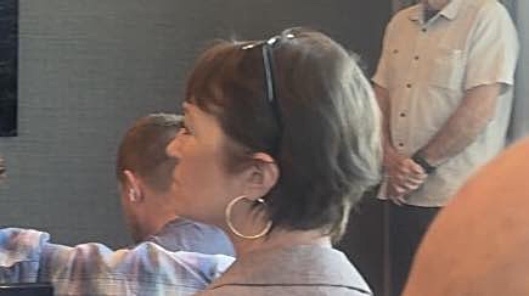
I asked her if she was an “Old Testament rule follower”, or if when she comes across the inevitable rules that don’t make any sense, will she be able to inject common sense into the mix and “do the right thing.” Her answer was that there is quite a bit of conflicting regulatory language in the Planning rules and that she was going to address that in collaboration with the Commissioners.
Department heads like her truly have a dilemma. They ARE bound by following the rules that the commissioners have adopted, but with new commissioners every few years, making up new rules, the rules DO end up getting to be a jumbled up mess. So her job is to follow the rules… but can the commissioners give her a “common sense” permission / exemption to use from time to time help our county progress and not stifle it?
I also asked her if she planned on living here permanently. And the great answer was that she planned on making our amazing County her home long-term, for the rest of her life. Very good. I think her ability to be able to think out of the box and use common sense will be the determining factor whether WE want her to stay or not. We do need continuity in Planning and I really hope and pray that she is the right person. She seems like it…
Bill Hudson began sharing his opinions in the Pagosa Daily Post in 2004 and can't seem to break the habit. He claims that, in Pagosa Springs, opinions are like pickup trucks: everybody has one.