
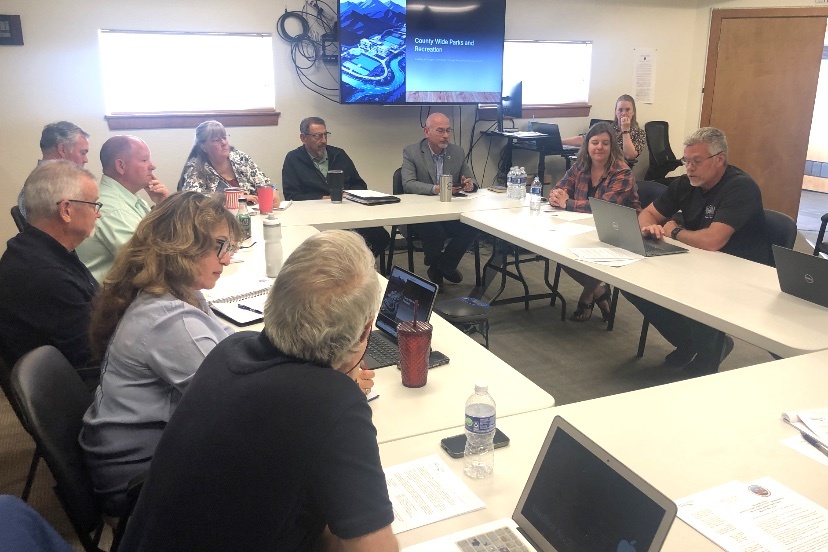
Photo: Town of Pagosa Springs recreation director Darren Lewis, far right, explains the value of recreation amenities to the joint Town-County meeting last night, March 23, at the Archuleta County Admin Office.
I attended a joint work session of the Archuleta Board of County Commissioners and the Pagosa Springs Town Council last night, and heard a discussion about recreation, among other topics.
All three County commissioners were present. Four of the seven Town Council members attended.
The “other topics” included a report from the CDOT public relations team on the Highway 160 reconstruction, and what we might expect this spring in terms of inconveniences; a report on the activities of Region 9 Economic Development District; an announcement of a new Public Works Director at Town Hall; a brief summary of ongoing river restoration following the October 2025 flood events; and a discussion about the funding shortfall faced by the Pagosa Springs Community Development Corporation (PSCDC) housing project resulting from their failure to obtain Capital Investment Fee waivers from Pagosa Area Water and Sanitation District (PAWSD) earlier this month.
So overall, a mix of good news, and bad news.
Region 9 Deputy Director Shak Powers and Executive Director Laura Lewis Marchino reported that Archuleta County had paid dues to Region 9 last year worth about $19,000, and had received in return about $4.5 million in grants and other funding, almost all of which went into broadband development.
An ROI of 240 times the original investment. Not bad.
Probably won’t happen again.
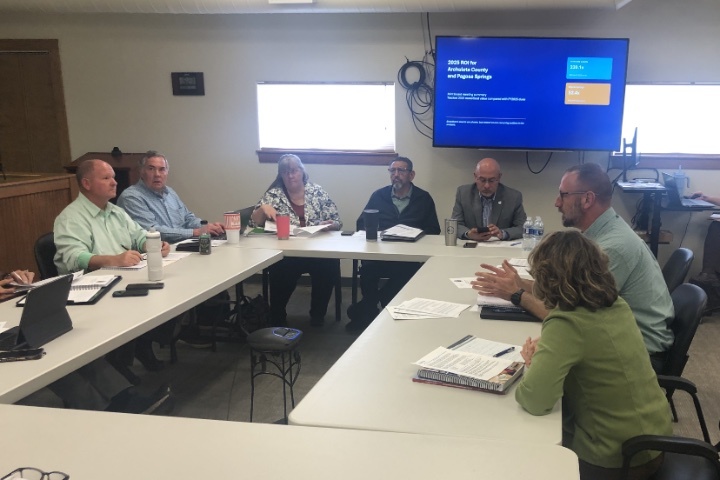
A significant portion of the joint meeting accrued to a presentation by Town Parks & Recreation Director Darren Lewis, Town Recreation Supervisor Amanda Gadomski, and Bob Milford, President of the Pagosa Area Trails Council and lead organizer of the Pagosa Area Recreation Coalition.
This recreation-oriented presentation featured a large number of PowerPoint slides, and what felt, to me, very much like a smooth sales pitch by three talented car salesmen.
I actually found the presentation to be somewhat disturbing. More about that, later.
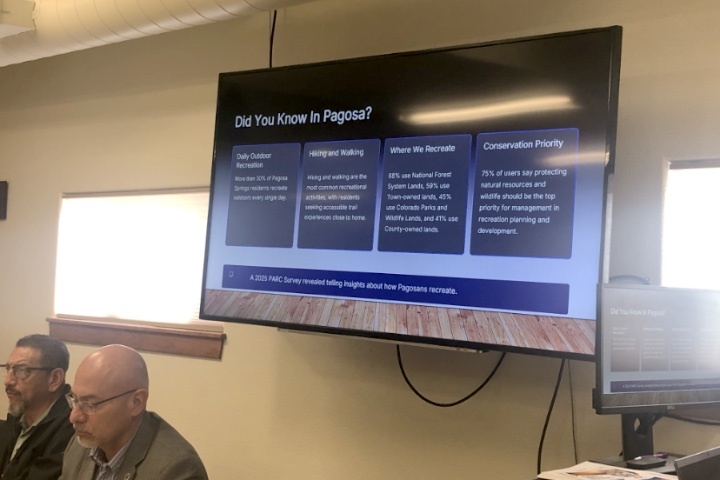
One of the first slides extolled the popularity of outdoor recreation in Archuleta County, as revealed by a recent (unscientific) PARC survey:
Did you know in Pagosa…?
More than 30% of Pagosa Springs residents recreate outdoors every single day?
Hiking and walking are the most common recreational experiences, with residents seeking accessible trail experiences close to home.
68% use National Forest System Lands, 59% use Town-owned lands, 45% use Colorado Parks and Wildlife Lands, and 41% use County-owned lands.
75% of users say protecting natural resources and wildlife should be the top priority for management in recreation planning and development.
The gathered government officials listened politely to the lengthy presentation.
In Part One, I suggested that the phrase, “the Heart of Pagosa Springs”, could refer to a physical location.
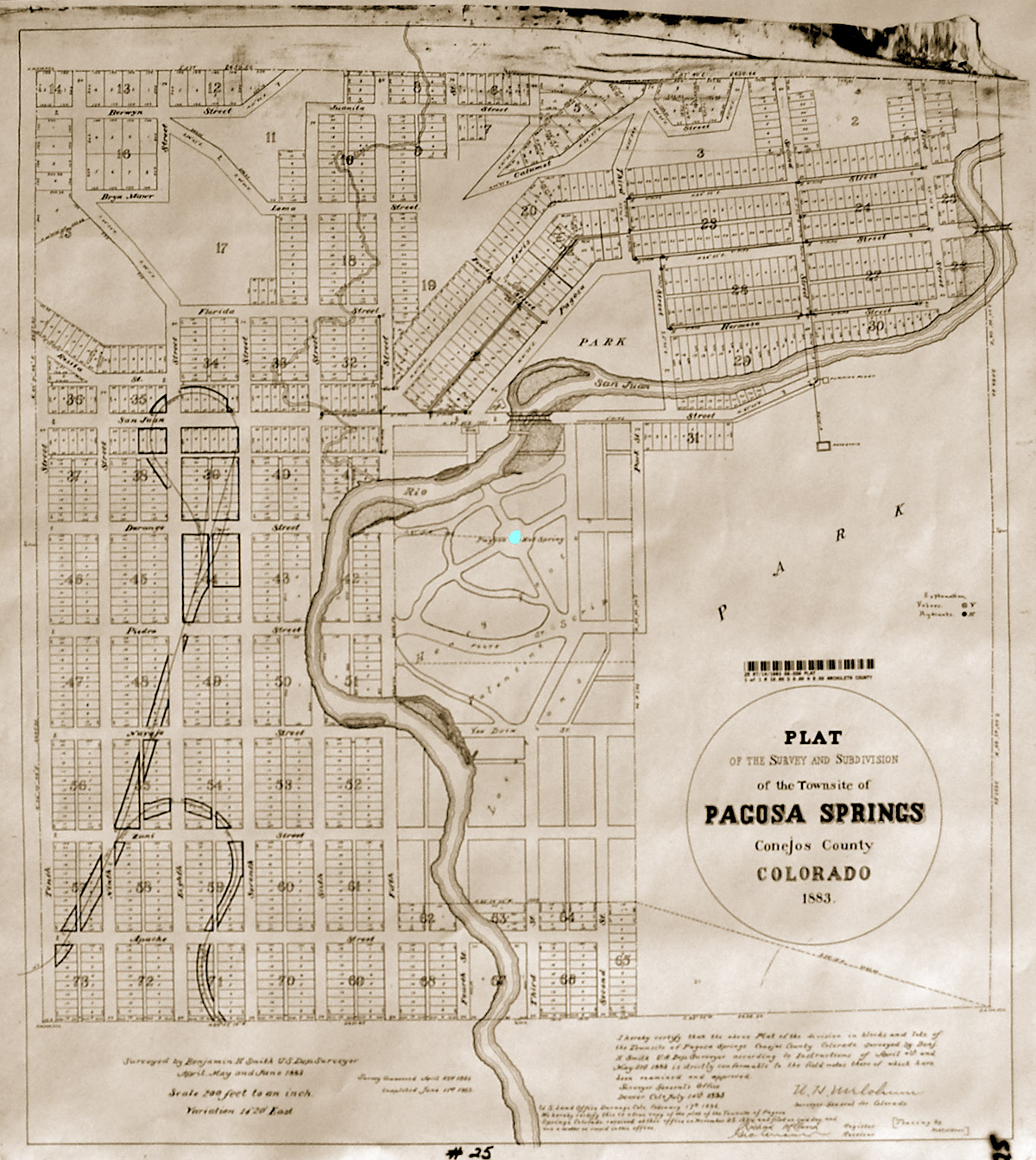
I’ve often heard members of the Town Council refer to downtown as the “heart of Pagosa Springs”, by which they seem to be talking — basically — about the historical one-square mile plat that surrounds the Great Pagosa Hot Springs.
That claim has certain arguments to support it.
Most of our municipal parks are located within that area. Three of our public schools are downtown. Our three hot springs businesses are located downtown. Practically all our tourist gift shops are downtown. The San Juan River flows through downtown.
The offices of the Pagosa Springs SUN newspaper… and the Pagosa Daily Post… are located downtown.
Town Hall is downtown. And of course, our Town Council members typically live downtown.
Then we have uptown. The red headed stepchild of Pagosa Springs. Where most of the population lives, and where the majority of the retail business takes place. Where the majority of the churches are located. Where the majority of lakes and golf courses and walking trails are located.
Most of these people and amenities are located outside the town limits, within the unincorporated county.
But the word “heart” can have other meanings. We sometimes use the word to imply courage, and bravery. It can apply to compassion and empathy. It can refer to an “emotional center” as opposed to an “intellectual center”.
As I write this editorial series, I intend to address several of those meanings.
The community of Pagosa Springs — extending out into more rural areas in four directions — is served by a range of businesses, organizations, and government agencies each striving to serve the needs of the community, while also ensuring their own organizational financial health. In the case of private businesses and nonprofit corporations, the public’s patronage is voluntary and optional. In the case of government, the provision of financial support by the citizenry is typically compulsory, enforced by the courts and government police powers.
The citizens participate financially in governments, whether we like it or not. And sometimes — if we’re honest about it — we don’t like it.
We will be looking more closely at the relationship between the Town of Pagosa Springs, the Archuleta County government, and the organization called PARC. But first, a few comments by Parks & Recreation Director Darren Lewis during last night’s joint meeting…
“How do we create more revenue? We all have these projects that are priorities. Right? Whether it’s roads, or affordable housing, or recreation. I’m focused on parks and recreation right now…
“You know… quality recreation attracts visitors. It supports local businesses, and positions our community as a desirable destination.
“So why should we invest [in recreation]? And what’s essential to strong communities?
“It strengthens our social connection. It provides an exceptional economic return. Every dollar invested in recreation returns two to five dollars in economic growth to the community, to increase property values and tourism…
“And it also creates a happier, healthier community!”
Don’t we all want a happier, healthier community?
Bill Hudson began sharing his opinions in the Pagosa Daily Post in 2004 and can't seem to break the habit. He claims that, in Pagosa Springs, opinions are like pickup trucks: everybody has one.