

Photo: ‘Pagosa West’ public presentation at the Community Center, hosted by architect Brad Ash and the Pagosa Springs Community Development Corporation, August 2025.
A Pagosa resident recently posted the following comments on social media.
This is why the Pagosa West development is a horrible idea. There will NOT be enough water, and unless we build more reservoirs first, it will get pretty darn bad. Even then there probably won’t be enough.
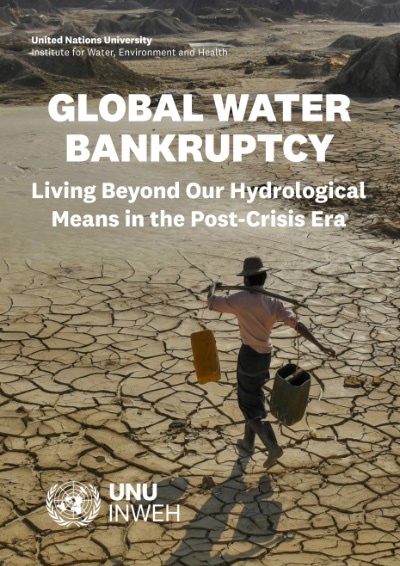
“This report tells an uncomfortable truth: many regions are living beyond their hydrological means, and many critical water systems are already bankrupt,” says lead author Kaveh Madani, Director of the UN University’s Institute for Water, Environment and Health (UNU-INWEH), known as ‘The UN’s Think Tank on Water’…
I find this kind of poorly informed, alarmist communication to be utterly fascinating.
The proposed Pagosa West development might indeed be a ‘horrible’ idea — even though we have almost no idea what is actually being proposed.
The subdivision maps presented to the Pagosa Springs Planning Commission last October, covering a possible 100-acre mixed-use development near the Pagosa Springs Medical Center, showed — basically — nothing at all, except for four apartment units and a gas station at the west end, and a couple of streets.
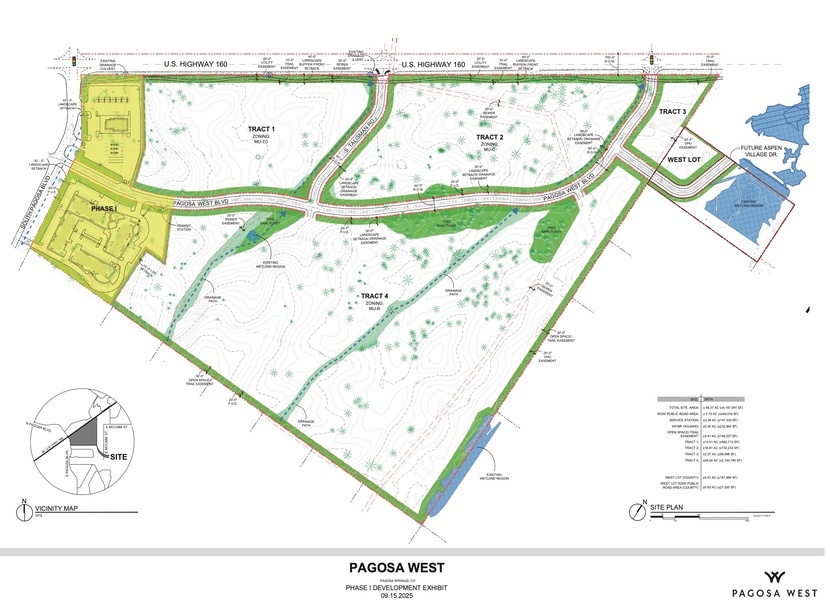
The Planning Commission approved this map without requiring any information about how many homes and businesses would eventually occupy the development, in an obvious violation of the Town Land Use and Development Code. When a group of citizens threatened to appeal the commission’s approval, the developer withdrew his application.
But the ‘horrible’ part of the Pagosa West development — should it ever come to fruition — has nothing to do with water shortages, in my opinion.
About 94% of the water used in Archuleta County is used to grow grass for cows. If there is any threat to the water supplies in Pagosa Springs, it comes from America’s love affair with beef… and from the proliferation of “trophy ranches” over the past 50 years… not from a proposed mixed-use development at the west end of town.
I’m sure the person who posted this misinformed and misleading complaint on social media truly believes what she wrote. The support for her argument? A study published by the United Nations, and a website that states:
In the Middle East and North Africa region, high water stress, climate vulnerability, low agricultural productivity, energy-intensive desalination, and sand and dust storms intersect with complex political economies;
In parts of South Asia, groundwater-dependent agriculture and urbanization have produced chronic declines in water tables and local subsidence; and
In the American Southwest, the Colorado River and its reservoirs have become symbols of over-promised water.
It’s pretty obvious that water supplies are in a crisis situation in many places around the globe, including in some parts of the American Southwest. As the UN website states, “the Colorado River and its reservoirs have become symbols of over-promised water.”
But reservoirs are not necessarily the solution. Sometimes, reservoirs are the problem… as we are witnessing during the current Colorado River controversy.
In the same sense, new subdivision developments can be seen as problems, or as solutions… Take your pick.
For some reason, the Pagosa Springs Planning Commission determined last October that an overwhelmingly blank map of a proposed subdivision west of downtown was part of a solution, rather than part of a problem. The general public did not agree.
But let’s consider the alarmist comments mentioned above.
This is why the Pagosa West development is a horrible idea. There will NOT be enough water, and unless we build more reservoirs first, it will get pretty darn bad. Even then there probably won’t be enough.
Many people in Archuleta County subscribe to these same ideas. That there will NOT be enough water. That we need to build more reservoirs. And that even then, there probably won’t be enough water.
If I were cynical, I would ask, “Are we ready to give up eating beef?” But I’m not going to ask that. At least, not today.
Less cynically, I could ask, “Do the water alarmists have believable evidence that Pagosa Springs faces a community-threatening water shortage within the next 50 years?” I’ve been researching and writing about water in Archuleta County for over 20 years and have yet to come across any such evidence.
We are not North Africa. We are not the Middle East. During the historic 100-year drought here in 2002, the Pagosa Springs Golf Course was allowed to water its fairways. Many places have very serious water issues, but in spite of a 2026 snow pack only half the annual average, I expect our water reservoirs to begin the summer season full, or nearly full.
What I’m going to ask, this morning, is, “Where is the heart of Pagosa Springs?”
Naturally, that question can have more than one interpretation.
“Where does the community gather? Where can we find ‘the heart’… the social center? The hub around which the spokes of the wheel rotate? The vascular organ that keeps the blood flowing?”
This might be a physical place. Some people would locate it within the town limits, within the historic downtown area. During the debates at School Board meetings, over the past several months, I heard overwhelming support from the public to locate a new K-8 school within the downtown area, even though the majority of our residents live at least four miles to the west or even further to the north.
Another interpretation of the question would be:
“Where can we find the heart — the compassion, the benevolence, the kindness — of Pagosa Springs? The love for the people, the love for the place? Does Pagosa Springs have that type of heart?”
This doesn’t refer to a physical place. If anything, it refers to a spiritual place.
One more interpretation.
“Where is Pagosa’s heart — its courage, its bravery, its backbone? The guts to face the future, unafraid?”
Bill Hudson began sharing his opinions in the Pagosa Daily Post in 2004 and can't seem to break the habit. He claims that, in Pagosa Springs, opinions are like pickup trucks: everybody has one.