
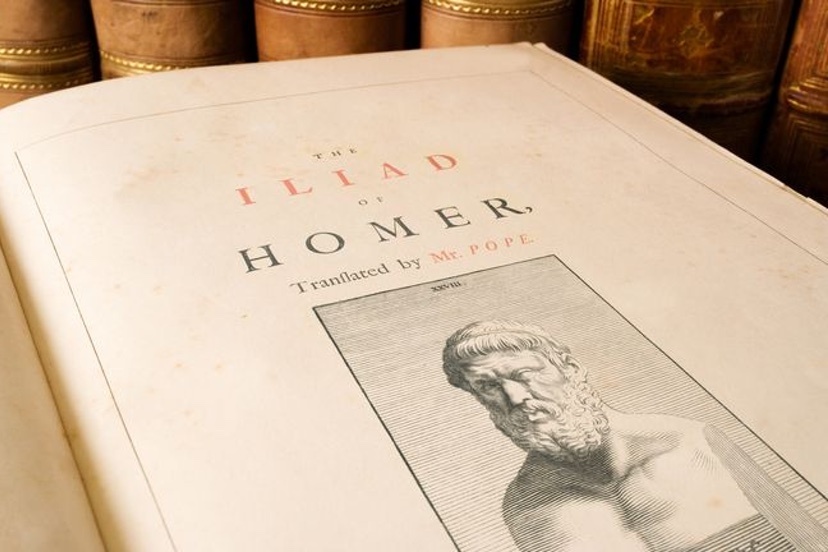
I’m thinking today about Homer.
Not Homer Simpson. The real Homer. The original news reporter.
I heard on the radio this week that media companies like The New York Times, the Chicago Tribune, Radio-Canada, and The Hollywood Reporter are suing AI companies.
Media companies spend a lot of money on journalist like me to generate news (or stuff that closely resembles news) so as to attract the type of eyeballs that advertisers need. Advertisers need eyeballs — consumer eyeballs — because they are trying to sell things to people, who may or may not want or need said things, but who will buy said things anyway because their paycheck is burning a hole in their wallet.
I mentioned in one of my columns, last week, that I shopped during the busiest shopping weekends in the universe — between Black Friday and Cyber Monday — but the only things I bought were some bananas and some potato chips. I did not, however, buy these things because they were advertised in The New York Times or elsewhere. I bought them because I was hungry. No one advertises bananas in The New York Times because that would be a huge waste of time and money. Either a person is hungry for bananas or they aren’t. Advertising bananas would make no difference to them.
So The New York Times needs to advertise things like iPhones and BMWs and gold jewelry. Things that people don’t actually need but can be fooled into thinking they need.
But the media landscape has changed significantly ever since news started appearing online, for free. First came the blogs. Then came social media, and podcasts, and YouTube, and TikTok and…
This was hard on legacy media companies like The New York Times, which has been selling newspaper advertising since 1851. When I can get news for free, online, why would I spend my heard earned money on a printed magazine or newspaper full of ads? I can see all the ads I want on social media. More than I want, actually.
Then along come data centers running Large Language Models (LLM) and spitting out something called Artificial Intelligence (AI). What they’re actually spitting out is not “intelligence” at all. It’s plagiarism.
These AI companies download The New York Times and the Chicago Tribune and the rest into their processing units, and shift the words around so no one can tell that they stole everything from media outlets, and from published novels, and even from humor columns like this one. I wish I had a dime for every word stolen from my READY, FIRE, AIM columns.
Anyway, The New York Times thinks they should get a cut of all the profits AI is earning from stealing content from The New York Times.
Unfortunately, ChatGPT and Grok and Claude and the rest haven’t actually figured out how to make a profit.
Which brings us to Homer.
Back in the day — before newspapers, and AI, and even before advertising — the news was spread by blind poets, traveling from town to town. The blind poets didn’t necessarily want to spread the news, but it was really the only thing they were good at. (Which I can identify with.)
In the 8th century BC in Greece, one of these “walking newspapers” was a guy named Ὅμηρος… pronounced ‘Hómēros’, but apparently, he went by his nickname, Homer.
He was so good at reciting the news that eventually someone got the bright idea of writing down his stories, including the Iliad and the Odyssey. (I doubt Homer himself wrote the stories down. He was blind.)
This was almost 3,000 years ago. You can buy The Iliad/The Odyssey on Amazon for about $11, or up to about $120 for a boxed set.

Did Homer see any of these profits? No.
People have been selling his stories — even though they were ‘old news’ — for 3,000 years, and he never saw a penny of it.
Okay, yes, he was blind so he couldn’t see the pennies anyway. But you know what I mean.
My point being, I’m not blind, and I wouldn’t mind seeing a dime for every word ChatGPT and all the other AI engines have stolen from my articles without my permission.
Probably not going to happen.
But at least, I can report on it.
Underrated writer Louis Cannon grew up in the vast American West, although his ex-wife, given the slightest opportunity, will deny that he ever grew up at all. You can read more stories on his Substack account.