
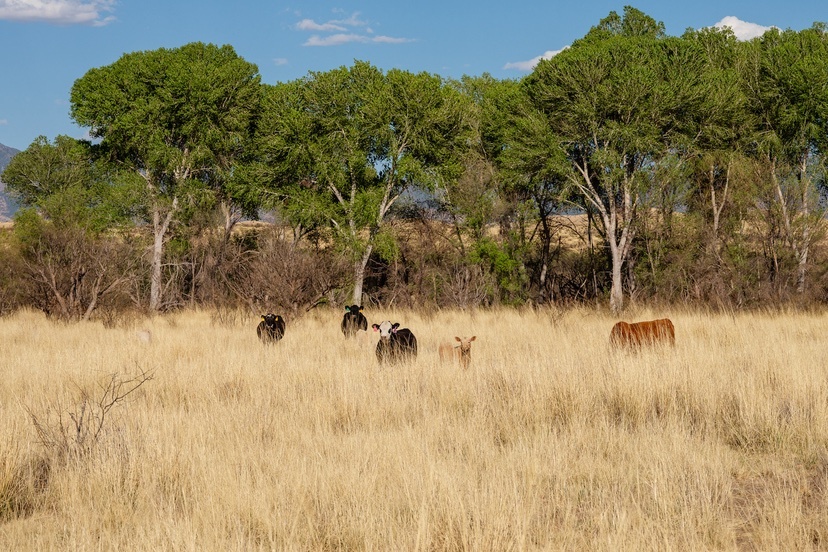
Photo: Cattle forage on a Bureau of Land Management grazing allotment in southern Arizona that is also key habitat for native species. (Photo by Roberto “Bear” Guerra/High Country News)
This article by Mark Olalde, ProPublica; Lucas Waldron, ProPublica; and Jimmy Tobias, High Country News; appeared on Colorado Newsline on December 6, 2025. This story was originally published by ProPublica and co-published with High Country News. We are sharing it in three installments.
During a visit in late April, a grove of hearty cottonwoods stood against the afternoon sun, casting cool shadows over a narrow creek. This stretch of green sustains birds, frogs, snakes and ocelots. It’s also designated under federal law as critical habitat for five threatened or endangered species. Cattle are not allowed in the creekbed, but a thin barbed-wire fence meant to stop the animals lay crumpled in the dirt.
A native leopard frog broke the hot afternoon stillness as it leapt from the creek’s bank. Its launching pad was the hardened mud imprint of a cow hoof, and it landed with a plop in water fouled by cow feces and the partially submerged bones of a cow corpse. A half-dozen cattle crashed through the creek and up the steep embankment, tearing up plants that protected the soil from erosion and sending silt billowing into the water.
“Looks like a sewer,” Chris Bugbee, a wildlife ecologist with the environmental group the Center for Biological Diversity, remarked as he took in the destruction. “This one hurts. There is no excuse.”
A 2024 BLM land health assessment listed the grazing allotment as “ALL STANDARDS MET.” In April, a camouflaged trail camera bearing the agency’s insignia was pointed toward the creek. (ProPublica and High Country News submitted a public records request for images on the camera’s memory card in May, but the BLM has yet to fulfill the request.)
No ranchers paid to graze their livestock in this allotment last year, according to BLM data, so it is unclear who owned the cattle. The Arizona Cattle Growers’ Association, which represents ranchers in the state, did not respond to requests for comment.
Over the past eight years, Bugbee and his team have annually surveyed grazing impacts on the banks of streams and rivers in the Southwest that are designated as critical habitat under the Endangered Species Act. Half of the 2,400 miles of streams they inspected “showed significant damage from livestock grazing,” according to their March report.
The industry maintains that the presence of livestock benefits many ecosystems, pointing to studies that have found, for example, that grazing can increase soil’s ability to hold carbon dioxide that would otherwise contribute to climate change. Other research suggests that, when managed properly, grazing can improve the health of habitat enough to support a more diverse mix of species.
Grazing also reduces vegetation that could fuel wildfires. Frank Shirts Jr., owner of the largest sheep operation on Forest Service land, said that sheep eat invasive weeds and brush, creating firebreaks. “These animals are fantastic,” he said.
Retta Bruegger, a range ecologist at Colorado State University, said that some ecosystems, especially those that receive more precipitation, can withstand more intense grazing without permanently damaging the land. In regions where plants evolved over many years alongside large grazers like cattle, livestock can “provide a very important ecosystem function.”
“We should be asking, ‘Are there individual producers who need to be doing a better job?’ instead of asking, ‘Should there be grazing or no grazing?’” said Bruegger, who supports balancing the industry’s needs with the land’s.
But answering those questions, she said, would require adequate staff to monitor the land.
After a century of intense grazing wore down public lands, a court ruled in 1974 that grazing permits were subject to environmental reviews, and Congress passed a law two years later mandating them every decade.
For years, a backlog of permit reviews grew, as federal land management agencies lacked the staff to inspect all their territory — 240 million acres across BLM and Forest Service jurisdictions. Around 2000, Congress began giving temporary approval for regulators to skip reviews. Western Republicans, with the livestock industry’s support, pushed to enshrine the concept in law. The idea ultimately received bipartisan approval in December 2014, after being slipped into a must-pass defense spending bill.
Some conservationists now call it simply “the loophole.”
Many in the livestock industry lambaste the lack of reviews. When permits are automatically renewed, the law does not allow the terms to change, so ranchers are prevented from updating their grazing practices.
“It just locks people into grazing the same place, the same time, year after year,” said Chris Jasmine, manager of biodiversity and rangelands for Nevada Gold Mines, which owns 11 ranches in northern Nevada.
To help inform permit renewals, teams of BLM experts — rangeland specialists, hydrologists, botanists, soil scientists and wildlife biologists — assess the health of grazing allotments.
When the process is working as intended, these assessments are considered in permit reviews. But the current lack of staff has left large swaths of land without scrutiny.
A barbed-wire fence on a federal grazing allotment in Arizona’s Sky Islands region separates recently grazed land, right of the fence, from land that has had time to recover, left of the fence. (Photo by Roberto “Bear” Guerra/High Country News)
All told, the BLM oversees 155 million acres of public lands available for grazing. But the agency has no record of completing land health assessments for more than 35 million acres, nearly a quarter of its total.
Where the BLM has conducted such assessments, it found grazing had degraded at least 38 million acres, an area about half the size of New Mexico. And close to two-thirds of the land it listed as being in good shape had not been checked in more than a decade, the analysis found.
The situation, though, is even worse than those numbers indicate, as the agency has often skipped permit reviews on land in poor condition. Even if the BLM had previously found the environment to be in bad shape, Congress’ 2014 law still dictated automatic renewal. Of the acreage the agency had previously found to be degraded due to livestock, 82% was reauthorized for grazing without a review, according to ProPublica and High Country News’ analysis.
Several BLM employees said agency higher-ups instruct staff to study land that’s in better condition while avoiding allotments that are in worse shape or more controversial. Environmental groups such as the Western Watersheds Project as well as local stockmen’s associations are quick to litigate changes to permits. Automatic renewals avoid these drawn-out public fights. “We were just using a bureaucratic loophole,” one staffer said. “We were allowing ongoing degradation of habitat.”
“This can’t be the future of public lands,” Bugbee, with the Center for Biological Diversity, said of parcels degraded by cattle, likening the land to a “mowed lawn.”
Colorado Newsline is part of States Newsroom, a nonprofit news network supported by grants and a coalition of donors as a 501c(3) public charity. Colorado Newsline maintains editorial independence. Contact Editor Quentin Young for questions: info@coloradonewsline.com.