
I’m not afraid of change, generally speaking.
Just yesterday, for example, I cleaned up my office, and got rid of stacks of old reports and agendas and miscellaneous print-outs that had been sitting on my countertops for who-knows-how-long.
Getting rid of outdated, useless stuff can brighten your day. Ditto, organizing your files.
I’ve often argued for political change, here in the Daily Post. I’ve questioned ever-growing subsidies for the tourism industry, and we’ve urged an increased focus on our local housing crisis. I’ve pushed for fiscally conservative spending, and criticized government efforts to put the taxpayers ever more deeply into debt for new government buildings.
Not all change is ‘positive’. Things can easily change for the worse. But does it help to fear change, when it’s going to happen anyway? Probably not. My approach has been to speak out, publicly and often, in opposition to harmful policies and decisions. And fearlessly, whenever possible.
The Pagosa Area Water and Sanitation District (PAWSD) board met last night and voted to offer the position of District Manager to their current Operations Manager Andy Connor. The board had two excellent candidates to choose from; the other was Las Vegas water engineer Dillon Cottingham. Board members expressed the wish they could afford to hire both candidates.
The board also heard that the new $44 million Snowball Water Treatment Plant is now delivering high quality drinking water to PAWSD customers in the downtown Pagosa and Highway 84 area.
Peaceful changes.
Also yesterday, in Part Three of this editorial series, I quoted Archuleta County Commissioner Veronica Medina, commenting on her hope that the County can soon revise its Community Plan and its Land Use Regulations, with the possible result that development can happen more efficiently in our community.
She apparently feels that the Community Plan is outdated, and the County needs better regulations.
One might be tempted to agree with her, depending upon one’s definition of “better”.
From the 2017 version of the ‘Archuleta County Community Plan’, here once again is a section of the ‘Vision’ for our community:
Archuleta County should retain its outstanding scenic and natural qualities while providing quality employment, housing, education, and recreation to its residents. Tourism, recreation, and agriculture will remain major segments of the economy…
Certainly, tourism and recreation are major segments of our economy.
But “agriculture”? Are we kidding ourselves?
Here’s the 2023 list of employment types in Archuleta County, according to Region 9 Economic Development District.
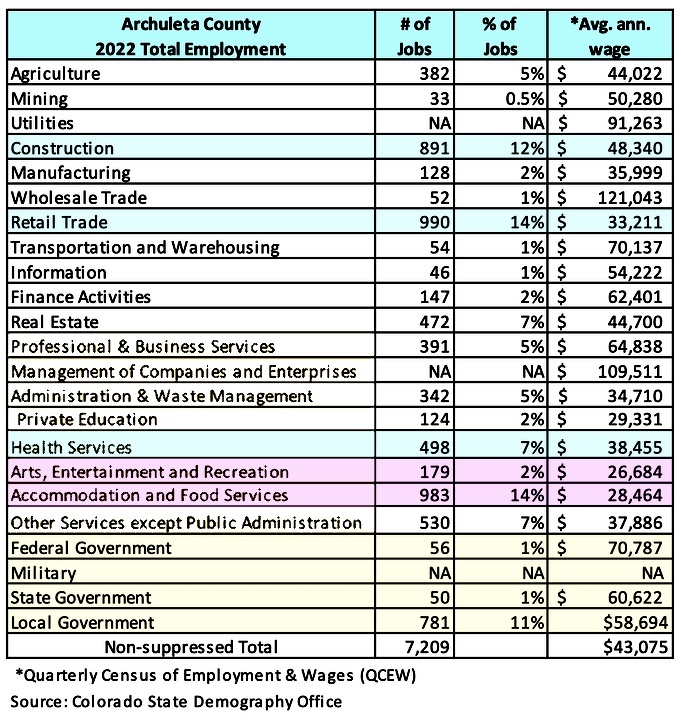
I analyzed this chart in a previous editorial series, back in July, and calculated that government jobs contributed about $65 million in wages to our economy in 2022.
The construction industry contributed about $43 million in employee wages.
Tourism employment contributed about $33 million that year, and the Retail sector contributed a similar amount.
Professional & business services provided about $25 million in wages, Real estate jobs, about $21 million. “Other services”, about $20 million.
Agriculture, according to Region 9, provided about $17 million in wage income in 2022.
When we look at the economic data provided by USDA for 2022, however…
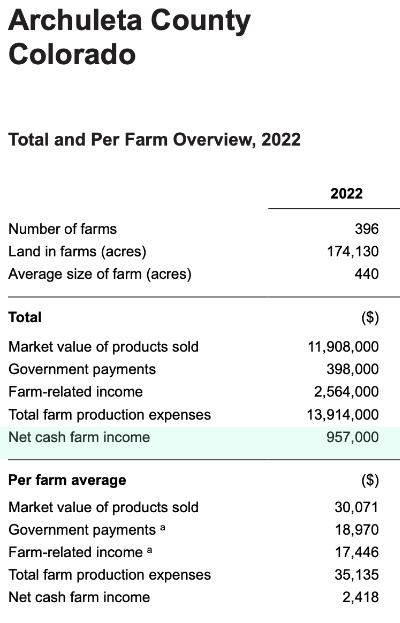
…the “Net cash farm income” in 2022 was less than $1 million. According to USDA, only 12 farms in Archuleta County — out of 398 farms — had a net income of more than $50,000.
These numbers don’t seem, to me, to indicate that “agriculture” is actually a “major segment of the economy”.
Were the people who wrote the Archuleta County Community Plan in 2017 living in a fantasy world?
None of my comments are meant to belittle the hard work and dedication of the people involved in Archuleta County agriculture. I’m merely questioning the notion that the Archuleta County economy is largely supported by a vibrant agriculture industry.
Let’s connect that question with the Conditional Use Permit (CUP) approved by the Board of County Commissioners on Tuesday. After listening to public testimony — both pro and con — and after reviewing the report by the County Planning Department, the BOCC voted unanimously to allow 84 Ranch LLC to place five ‘tiny homes’ on its 40-acre hog farm to accommodate ‘agritourists’ who might want to spend time there, learning about sustainable agriculture.
84 Ranch will have to meet seven conditions of approval, prior to taking on any tourists.
The neighbors who spoke in opposition to the CUP protested that their neighborhood was zoned “Agricultural” and that accommodating tourist visits is not an agricultural activity. Brian Wattier — the applicant — explained that farmers in Archuleta County cannot earn a sustainable living without expanding the uses of their property beyond merely agricultural operations.
The BOCC agreed with Mr. Wattier’s perspective, and approved his “tiny home” tourism encampment.
I find this approval especially fascinating, because just a few weeks ago, the same three commissioners denied a “tiny home village” on an agricultural-zoned property directly across the highway from 84 Ranch. That tiny home village, proposed by Travis and Sarah Troxtell, would have provided much needed long-term housing for Pgosa Springs workers, accommodating up to 40 households in the midst of a serious housing crisis, without any need for government subsidies.
You can read about that planned village here.
The BOCC unanimously rejected the Troxtell’s proposed housing project, mainly on the basis — as I recall the commissioner comments — that the surrounding neighbors were engaged in agriculture and the neighborhood was zoned “Agricultural”.
I’ve driven that stretch of Highway 84 dozens of times, maybe hundreds of times, and I cannot recall ever seeing any evidence of “agriculture” happening in that particular neighborhood. No obvious farming, or livestock. Just acres and acres of vacant land.
Maybe I just have a poor memory? Or maybe what we mean by “agriculture” in Archuleta County is “vacant land owned by wealthy people who dislike any kind of meaningful economic activity in their neighborhood”.
Apparently, the current BOCC is okay with housing in an agricultural zone, so long as it serves only tourists.
Or else… the BOCC is finally realizing they can choose to support a functioning economy, rather than serving the isolationist desires of wealthy ‘trophy ranch’ owners.
That would be a peaceful change for the better.
Bill Hudson began sharing his opinions in the Pagosa Daily Post in 2004 and can't seem to break the habit. He claims that, in Pagosa Springs, opinions are like pickup trucks: everybody has one.