
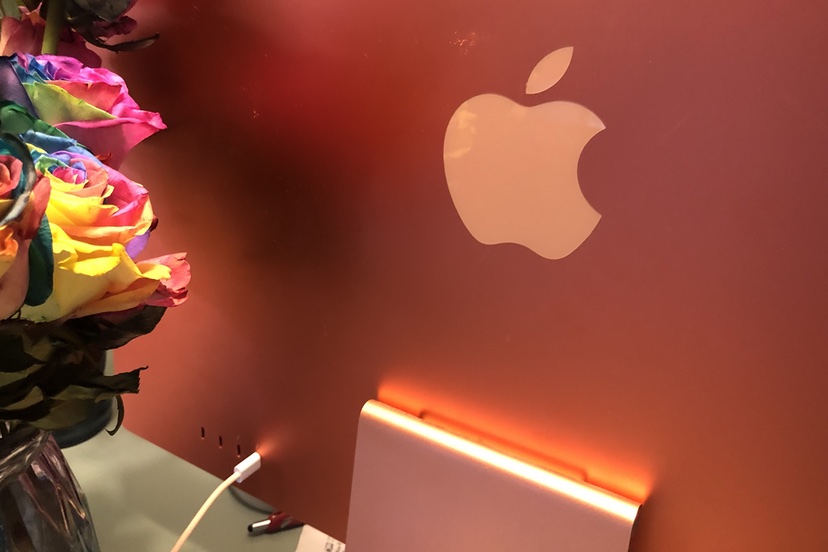
Der Apfel war aber so künstlich gemacht, daß der rote Backen allein vergiftet war. Schneewittchen lusterte den schönen Apfel an, und als es sah, daß die Bäuerin davon aß, so konnte es nicht länger widerstehen, streckte die Hand hinaus und nahm die giftige Hälfte. Kaum aber hatte es einen Bissen davon im Mund, so fiel es tot zur Erde nieder…
However, the apple was so artfully made that only the red cheek was poisoned. Snow White gazed longingly at the beautiful apple, and when she saw the peasant woman eating it, she could no longer resist; she reached out her hand and took the poisoned half. But no sooner had she taken a bite than she fell dead to the ground…
— from ‘Schneewittchen’, published it in 1812 in the first edition of Grimms’ Fairy Tales, numbered as Tale 53.
Don’t worry. She’s not actually dead.
She can still be awakened from her deathly state by a kiss from a true Prince, if one happens to be passing by.
Problems can be solved simply, if you have the right personnel.

However, we still have to deal with poisoned apples. Or at least, some of us do.
In 1936, a Princeton University student named Alan Turing wrote a paper, “On Computable Numbers, with an Application to the Entscheidungsproblem” that described a theoretical machine that could “read” instructions, “calculate” answers, and “print” the results. At that point in time, no such machines existed.
But apparently, such a machine could be imagined, and described, by a person with an unusual personality. Later on, mathematicians and engineers would create machines that could read, calculate, and print, and ultimately be used to spread misinformation globally.
I’m writing this article using such a machine.
You can download Alan Turing’s 38-page paper here. It has been called “easily the most influential math paper in history”. Also, easily one of the most incomprehensible.
As Turing admitted in his 1936 paper, such machines can solve certain types of problems, but not all types of problems. This is still true.
For example, toenail fungus. Computers and similar machines may be able to provide information about toenail fungus, but they cannot cure it.
Nor could they cure Dr. Turing’s problems with the British legal system.

Prior to getting into hot water with the British court system, Alan Turing had, during World War II, broken the code behind the German military communication system call the Enigma Machine. In a very real sense, Alan Turing had solved a problem that helped the Allies defeat the German war machine.
Unfortunately, Dr. Turing was also gay, and in 1952 was convicted of “gross indecency” under Section 11 of the Criminal Law Amendment Act 1885… it being, at the time, a criminal act in Great Britain to engage in sex with a person of the same sex. As punishment, Dr. Turing was required to receive injections of synthetic estrogen, which caused him to become impotent.
Two years later, his housekeeper found him dead in his bed, with a half-eaten apple sitting on the bedside table.
From Wikipedia:
A post mortem was held that evening, which determined that he had died the previous day at age 41 with cyanide poisoning cited as the cause of death. When his body was discovered, an apple lay half-eaten beside his bed, and although the apple was not tested for cyanide, it was speculated that this was the means by which Turing had consumed a fatal dose.
No handsome Prince was passing through the neighborhood to apply the redemptive kiss.
Nevertheless, Dr. Turing left us with an important idea: the Turing Test. Originally called, “the Imitation Game” — as in, a machine imitating a human.
In his 1950 paper, “Computing Machinery and Intelligence”, Dr, Turing wrote:
I propose to consider the question, ‘Can machines think?’
“Thinking” is difficult to define, especially in 2026. So Turing simplified the question, by suggesting a “test” wherein a computer’s responses would be judged by a human interrogator. If the human ‘judge’ were unable to tell whether or not the respondent was human — if the machine could believably imitate a human response — then in Dr. Turing’s opinion, the word “thinking” could reasonably be applied to the machine.
By this definition, the Siri app on my iPhone is engaged in “thinking”. She sounds to me just like a human.
But in reality, of course, Siri is merely repeating stuff she read on the internet. There’s no way a machine — or a human — who repeats stuff they read on the internet is engaged in “thinking”.
So basically, we’re all failing the Turing Test.
Underrated writer Louis Cannon grew up in the vast American West, although his ex-wife, given the slightest opportunity, will deny that he ever grew up at all. You can read more stories on his Substack account.