
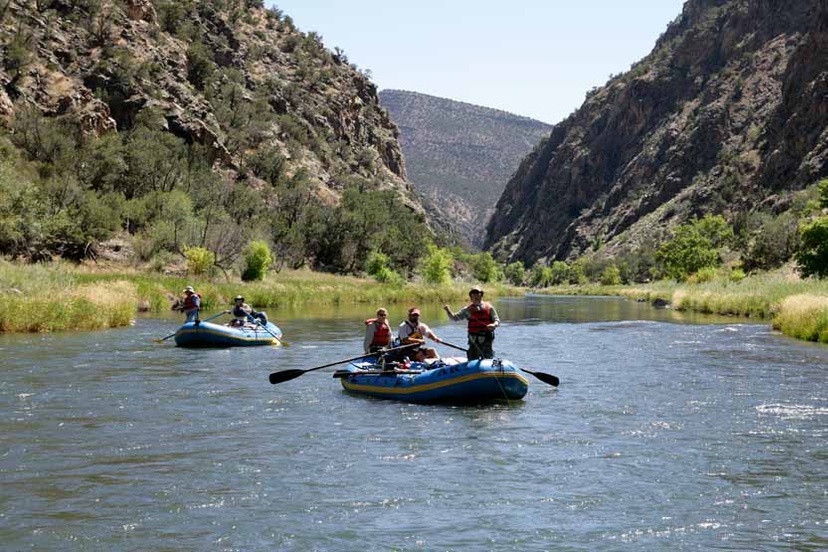
Photo: Rafters in the Gunnison Gorge National Conservation Area. (Photo by Jerry Sintz/BLM)
This op-ed by Gary Wockner appeared on Colorado Newsline on August 19, 2026.
In 2018, I went on a canoe trip down the Whanganui River in New Zealand. I went on the trip because, in 2017, the government of New Zealand had granted “personhood” status to the river, giving it legal rights in court to speak for itself. The government’s action was the result of a 140-year legal battle by Māori indigenous people to protect the river and have the government recognize the river in the worldview consistent with Māori culture, which sees the river as “alive.”
As I paddled the river, I wasn’t thinking about how the Whanganui River’s personhood status could also be seen as “climate action,” but my understanding of the Rights of Nature movement has grown and evolved since then.
When we picture climate solutions in Colorado, we usually imagine solar panels, electric vehicles, or high-density housing. Rarely does legal philosophy make the list. But the Rights of Nature movement — which recognizes ecosystems like rivers, forests and mountains as legal persons with inherent rights — is emerging as a potentially powerful tool in the climate fight. The movement doesn’t just protect biodiversity for its own sake; it restructures the legal and economic systems that drive the extraction, damming and deforestation fueling the climate crisis.
Under most legal systems, and here in Colorado, nature is treated as property — something to be owned, extracted, or developed, with value measured only in what can be taken from it. Rights of nature flips this framework, holding that ecosystems have an inherent right to exist, flourish and regenerate, independent of their usefulness or value to humans.
At the international level, in addition to New Zealand’s actions on the Whanganui River, Ecuador enshrined rights of nature in its 2008 constitution. Bolivia passed a Law of Mother Earth in 2010.
India’s Uttarakhand High Court briefly did the same for the Ganges and Yamuna Rivers. Colombia’s Constitutional Court recognized the Atrato River basin as a rights-holder in 2016, explicitly citing climate change as a driver of its ruling. Rights of nature for rivers has also been granted in Canada, Panama and Bangladesh.
These laws aren’t symbolic gestures. Legal personhood creates standing — the ability of guardians, communities or governments to sue on a river’s or forest’s behalf when it is harmed, independent of whether a human plaintiff can prove personal injury or financial loss. That single shift matters enormously for climate action, in at least five distinct ways.
It creates a new class of climate plaintiffs
Traditional environmental law requires proving that a human was harmed, such as by polluted water, lost income, or damaged health. Climate harms are diffuse, slow-moving, and hard to pin to a single actor, which is partly why extractive projects have historically been so hard to stop in court. Rights of nature sidesteps this by letting the ecosystem itself be the injured party. A river choked by a dam, a forest cleared for a pipeline corridor, or a wetland drained for development can be defended in court on its own terms, opening legal pathways that human-harm standards have long foreclosed.
It protects natural carbon infrastructure
Rivers, wetlands, mangroves, peatlands and old-growth forests are not just scenic — they are active climate regulators. Wetlands and river floodplains sequester carbon, buffer floods and recharge groundwater in ways engineered infrastructure cannot replicate. Because these same ecosystems are often massive carbon sinks and climate buffers, protecting and restoring them can be a significant type of climate action. And, when they have legal standing, it becomes far harder to permit the kind of large-scale extraction, damming or development that releases stored carbon and destroys these systems’ capacity to keep absorbing it.
It disrupts the economic logic of extraction
Fossil fuel, mining and river damming projects are financially viable partly because environmental damage is treated as an externality — a cost borne by ecosystems and local communities, not by the project developers. Rights of nature forces some of that cost back onto project balance sheets, because legal liability for ecological harm becomes real and enforceable rather than diffuse. This is precisely the kind of structural change many climate economists argue is necessary — making environmental destruction expensive rather than free.
It elevates Indigenous and local governance
Rights of nature laws often originate from local and Indigenous worldviews that never treated land and water as separable from law and rights in the first place. Thus, local and indigenous stewardship is increasingly recognized by climate scientists as effective conservation and carbon-sequestration practices. Legal frameworks that empower guardianship — whether it be Indigenous or local communities — of rivers and forests are, functionally, climate policy. In the U.S., state and federal “preemption” is challenged and potentially overturned so that local communities have a stronger say in protecting their local environment.
It builds legal scaffolding for the long-term
Climate change is, at root, a crisis of a legal and economic system that has never had to account for the living systems it depends on. Rights of nature doesn’t replace emissions reductions or renewable energy, but it builds a legal infrastructure — precedent, guardianship structures and enforceable standing — that makes it harder to reverse ecosystem protections once they’re won. That durability can turn a single court victory into a potential precedent with lasting impact.
Here in Colorado, our organization, Save the Colorado, has helped pass resolutions at the local level supporting a policy of rights of nature for local rivers and watersheds in Nederland, Lyons, Grand Lake and Ridgway. The city of Durango passed a similar resolution for the Animas River. We are engaging with other Colorado towns and cities to achieve the same outcome.
While these resolutions are not “laws” that create standing in court, they start the ball rolling around the idea that rivers and natural ecosystems in Colorado should have inherent rights, that they are “alive,” and that local communities can stand up and speak out to protect their local environment in ways that can serve as important climate action.
Colorado Newsline is part of States Newsroom, a nonprofit news network supported by grants and a coalition of donors as a 501c(3) public charity. Colorado Newsline maintains editorial independence. Contact Editor Quentin Young for questions: info@coloradonewsline.com.
Gary Wockner, PhD, is a scientist and conservationist based in Colorado. Follow him on Twitter, @GaryWockner. Learn more at savethecolorado.org