
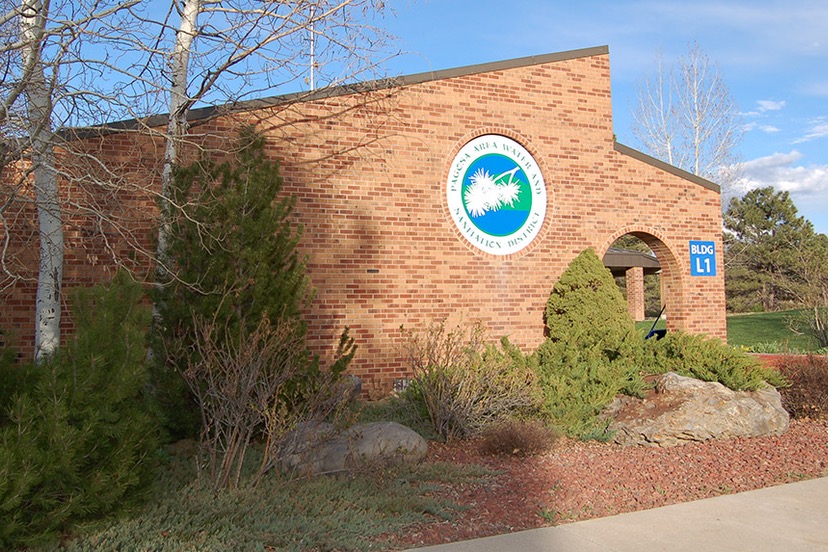
Photo: The Pagosa Area Water and Sanitation District offices on Lyn Avenue.
Let’s start this editorial series with some personal details.
I currently serve as a volunteer Board member for the Pagosa Area Water and Sanitation District (PAWSD), serving as Board secretary, meaning that I get to apply my signature to meeting minutes, after they are approved by the Board.
The five-member Board also includes Gene Tautges, President; Alex Boehmer, Treasurer and Vice President; Glenn Walsh; and Bruce Jones.
One of my fellow Board members suggested that this editorial series could be titled:
PAWSD, the Most Dangerous Government Board in Archuleta County
That’s exactly how I felt in 2008, when I first began investigating, and writing editorials about, PAWSD. The PAWSD Board of Directors had recently obtained a $9.2 million loan to purchase a ranch a couple of miles northwest of downtown Pagosa Springs — the Running Iron Ranch — as the site for a future 32,000-acre-foot reservoir. In 2009, we heard the estimated cost for the reservoir: $357 million.
The drainage running through the Ranch was shown on maps as Dry Gulch.
Prior to 2008, the PAWSD Board had already put in place a new fee charged to every new home and new commercial building: the “Water Resource Fee”. This new fee, we were told, would cover the payments on the Ranch loan and, eventually, the cost of the Dry Gulch Reservoir.
The more I learned about the proposed reservoir, the more convinced I became that the Ranch purchase had involved a frightening mix of government corruption, government misinformation, government overreach, and government stupidity.
I still feel the same way.
We note, here, that “the PAWSD Board” had made these financial decisions — to go into debt and to create a new Water Resource Fee — without needing any approval from the taxpayers and customers. All it took was a vote by a majority of the Board. Three votes.
The Dry Gulch Reservoir was never built, because the Board members who had approved these actions, without any voter approval, were subsequently voted out of office and replaced by local business owners and retirees who determined that the Ranch purchase had been a mix of government corruption, government misinformation, government overreach, and government stupidity.
For a timely comparison:
The Archuleta School District (ASD) Board of Education has been planning to build a new K-8 school complex for over 15 years, but they needed voter approval. ASD receives nearly all its funding from local property taxes, and in Colorado, taxes cannot be increased and new taxes cannot be created without voter approval. An attempt to get the bonds approved in 2011 failed miserably, by a 3-to-1 “NO” voter.
But the dream remains.
On your November ballot, you will find a request from ASD to increase property taxes by up to $156.5 million — up to $6.7 million a year for 25 years — to authorize bonds for a PreK-8 complex on Vista Boulevard, west of City Market. The existing Elementary School and Middle School buildings, in downtown Pagosa, would be abandoned.
The property-tax-funded bonds to fund this dream can be sold only with voter approval.
Compare this with PAWSD.
Over the past few years, the five-member PAWSD Board approved approximately $56 million in new district debt — for the new Snowball Water Treatment Plant on Snowball Road, to replace the old treatment plant, and for upgrades to the Vista Wastewater Treatment Plant on Lyn Avenue, as required by the Colorado Department of Public Health and Environment.
No voter approval was required.
Why? Because PAWSD collects fees. And a majority of the PAWSD Board — three people — can increase customers fees whenever they want, following a ‘public hearing’.
In fact, back in 2008, when PAWSD took out a $9.2 million loan for the Running Iron Ranch, the Board promised they would fund the debt payments with increased customer fees, if the Water Resource Fee (WRF) proved insufficient. A subsequent Board eliminated the WRF, and the customers have been footing the annual $256,000 loan payment ever since.
Two years ago, the PAWSD Board received two offers, from private individuals, to purchase the Running Iron Ranch, which would relieve our customers of about $10 million in future loan payments. (Yes, because of interest charged on the loan, PAWSD customers still owe more than the original price of the Ranch.)
But PAWSD owns the Ranch jointly with the property-tax-funded San Juan Water Conservancy District (SJWCD) and the SJWCD Board refused to authorize the sale.
This conflict might be settled in a courtroom at some point, or it might be settled by some type of agreement between the two Districts.
Last week, on Thursday, September 24, the PAWSD Board held a special meeting to discuss a range of topics.
One of the topics was the 2027 Budget.
The news coming from staff was not good.
When a government district takes out loans without getting voter permission, the lenders place certain requirements on the district’s finances. One of those requirements concerns the district’s “Debt Service Coverage Ratio”. The DSCR.
In the case of the loans currently held by PAWSD, the DSCR is “1.1”
This means that PAWSD must collect from customer operations slightly more than the cost of those operations plus the amount owed in debt payments.
Seems simple enough. But in fact, the situation is quite complicated. Due to a number of factors, PAWSD might have to make some significant changes to its customer fees and/or to its operations’ budget in 2027.
We will look at those possible changes tomorrow in Part Two.
It’s tricky… because I don’t think anyone wants to see their monthly bills increase in the current economy.
Bill Hudson began sharing his opinions in the Pagosa Daily Post in 2004 and can't seem to break the habit. He claims that, in Pagosa Springs, opinions are like pickup trucks: everybody has one.