
The Pagosa Area Water and Sanitation District (PAWSD) board of directors have authorize staff to post a draft 2027 district budget for public review. I am one of the five volunteer PAWSD board members.
I do not consider this draft budget to be final version. That version will need to be approved by mid-December.
More about the PAWSD budget on Monday.
I’ve been writing in thids ediorial series about the impact of growth on a government budget, such as the draft version that will soon be available on the PAWSD website. Past PAWSD budgets have been constructed around the idea that the number of homes and businesses in Archuleta County will increase by about 2% annually, thus contributing to an increasing PAWSD budget.
But growth has slowed considerably over the past couple of years.
A new subdivision adjacent to Great West Avenue, wrapping around the existing Rock Ridge mobile home park, could help to reverse that trend.
Ponderosa Mountain subdivision. Proposed by Jonathan Fink, representing Modern Community Builders LLC.
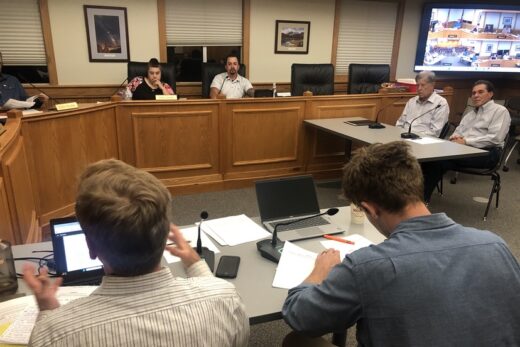
I attended the ‘standing-room-only’ Town Planning Commission meeting on September 8, where the commission (somewhat hesitantly) approved a ‘sketch plan’ for the subdivision, and recommended to the Town Council approval of a Planned Development Agreement. 90% of the public testimony was in opposition to the development.
The question posed by this editorial series is “Do We Even Want Development in Pagosa Springs?” The answer to that question depends on whom we mean by “We”.
If “We” is local government, the answer is generally “Yes”.
If “We” is the business community, the answer is generally “Yes”.
If “We” is the collective community of 14,500 residents, the answer is generally “No”.
When the Planned Development Agreement for the Ponderosa Mountain subdivision was discussed by the Town Council on October, the Town’s planning staff once again made an (aggressive?) defense of the agreement, arguing that the overall community would benefit from a development featuring at least 82 “lodging units” and potentially hundreds of residential units — almost none of which would be affordable to people who live and work in Pagosa Springs unless they were doctors or lawyers or government bureaucrats. Or second-home buyers.
Two of the five Town Council members present at the October 8 public hearing on the PD Agreement expressed their overall disapproval of the agreement and the subdivision. Council member Mat deGraaf stated that the proposed development did not fit with the town’s desired character. Council member Leonard Martinez argued that the Town’s failing sewer system needs to be fixed before any big new subdivisions are approved within the Sanitation District. Mr. Martinez also expressed the view that the current tourism-based economy represents a “single point of failure” for the town’s overall economy, and said he was worried that this development would “exacerbate” that problem.
The other three Council members — Mayor Shari Pierce, Brook Lindner and Vahid Shabro — had a sufficient number of concerns to cause them to vote to delay any approval decision — pro or con — until a future Council meeting. (The Council was missing two members that evening: Gary Williams and Madeline Bergon.)
The outlook for the developer did not look too terribly promising.
A few interesting things were revealed during the October 8 Council hearing that were not revealed during the September 8 Planning Commission hearing.
About halfway through the Council hearing, Council member Brooks Lindner as developer Jonathan Fink what previous subdivisions his company had developed.
Mr. Fink had just finished explaining why he had chosen Pagosa Springs as a place to create a mixed-use neighborhood that, he claimed, would be the type of neighborhood that would attract second-home owners looking for a less expensive option than… well, he didn’t say exactly what it would be less expensive than.
Council member Lindner:
“Is there a similar community that you’ve developed a neighborhood that you’ve developed, that you could point me to, that I could check out?”
A reasonable question.
Mr. Fink’s response:
“Most of the communities I’ve designed haven’t been built.
“I did re-design a community up in Salem, Oregon, actually, which was a 70 or 80 acre property. We came in and re-designed it; I changed it all around. And we sold that to Equity Lifestyle Properties.”
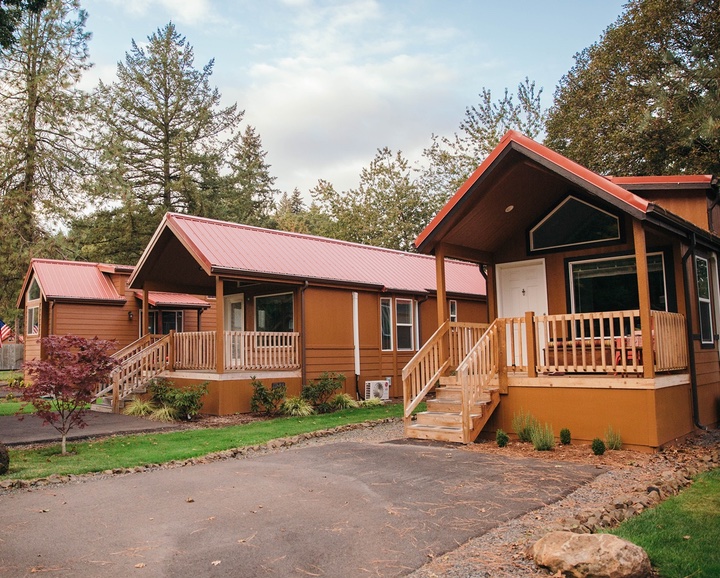
For anyone not familiar with Equity Lifestyle Properties (ELP), it was founded in 1984 by billionaire Sam Zell and reportedly owns more than 200 mobile home parks. Their property near Salem, Oregon is called ‘Hope Valley Resort’..
Mr. Fink sounded, to me, rather proud of having designed a community for Equity Lifestyle Properties.
Mr. Fink:
“I don’t know what they’ve done with [the ELP property] lately, but the family who started that development, who owned the land for years, needed to sell the property. I helped them improve it for three years, so… But most of the other properties, I’ve only worked on the design elements of it. And most people had very little experience with ‘off-site construction’ and what needed to be done.
“I’ve helped a lot of people, I hope, save a lot of money by re-thinking the way they design their communities to be livable.”
Here’s one of the problems that planning departments face. They might be helping a developer get through the approval process for a large subdivision… and get the project plan approved by the governing board… and then the developer sells the approved plan to a company like Equity Lifestyle Properties, and things turn out differently from what the planning department had expected.
Read Part Four… on Monday…
Bill Hudson began sharing his opinions in the Pagosa Daily Post in 2004 and can't seem to break the habit. He claims that, in Pagosa Springs, opinions are like pickup trucks: everybody has one.